DOJ presses Tornado Cash prosecution as Treasury drops mixer reporting plan
Federal prosecutors are pursuing the criminal case against Tornado Cash co-founder Roman Storm, leveraging a Bitcoin Fog appeal to maintain charges even as the Treasury Department rescinds a broad mixer-reporting proposal.

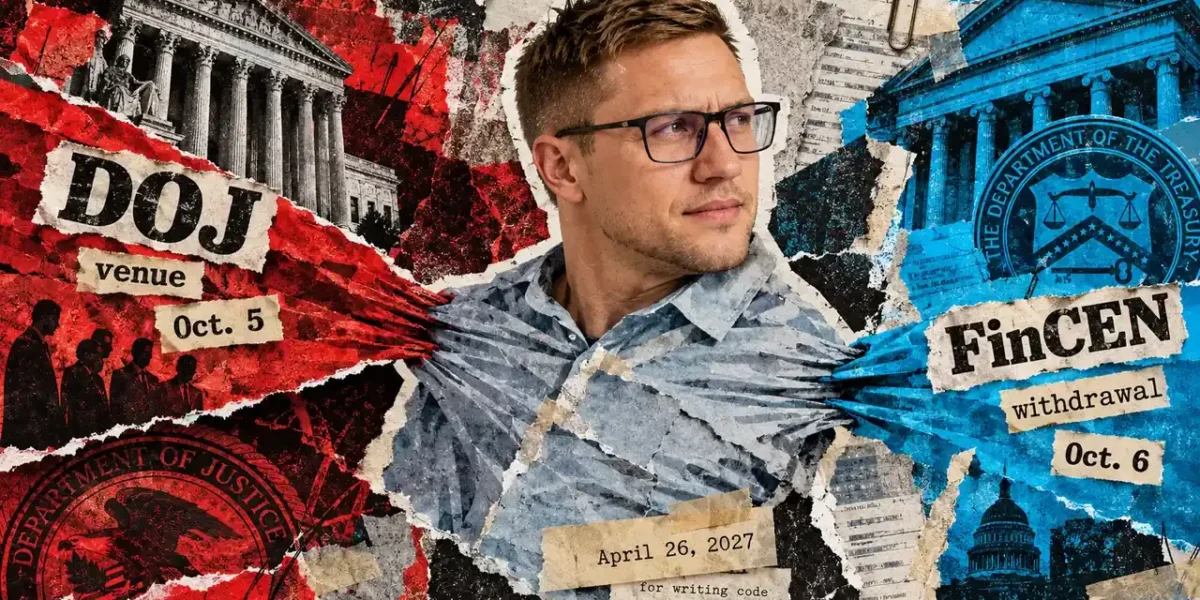
Federal prosecutors are leveraging a recent Bitcoin Fog appeal to maintain two counts against Roman Storm in New York. In an Oct. 5 letter, the government urged Judge Katherine Polk Failla to dismiss his venue challenge concerning money-laundering and money-transmission conspiracy charges. Storm helped co-found Tornado Cash, a cryptocurrency mixer designed to obscure transaction trails.
This court filing coincided with the Treasury Department’s move to rescind a broad mixer-reporting proposal. The ongoing litigation hinges on allegations that Storm consciously engaged in criminal activity, whereas the policy shifts acknowledge lawful privacy rights and restrict specific charging choices. Whether his development of the software crossed the line into criminality remains heavily contested.
Storm, utilizing the handle @rstormsf on social media, characterized potential prison time as a penalty “for writing code” while contrasting his situation with the Treasury’s policy retreat. His remarks highlight the significant implications for privacy-focused developers, though the recent legal filing strictly addresses where the trial may occur.
Storm previously secured an August 2025 conviction on a single count of money-transmission conspiracy, which carries a statutory maximum sentence of five years. A court order dated Aug. 25, 2026, scheduled his retrial for April 26, 2027, accounting for his pending motion for acquittal and a requested continuance.
Prosecutors in the Southern District of New York are looking to the D.C. Circuit’s Sept. 25 ruling in United States v. Sterlingov—which involved Bitcoin Fog, a separate cryptocurrency mixer—as persuasive authority to counter Storm’s venue objection.
Their legal argument focuses on a Manhattan-based user, Shakeeb Ahmed. Prosecutors assert that Ahmed’s deposits expanded the anonymity pool and made illicit funds more difficult to trace, even though the currency stayed in the system briefly. Furthermore, they contend that providing services to a customer within the district justifies establishing venue for the money-transmission charge.
Why the crypto policy shift has not ended the case
The Treasury Department’s Financial Crimes Enforcement Network (FinCEN) is rescinding its 2023 finding alongside proposed enhanced reporting and recordkeeping requirements for international cryptocurrency mixing services. The withdrawal notice, submitted Oct. 5 for publication on Oct. 6, points to concerns regarding a “chilling effect on legitimate activity” and excessive compliance burdens on financial institutions.
FinCEN maintains support for lawful financial privacy while preserving surveillance mechanisms targeting money laundering, terrorist financing, and other illegal operations. However, this administrative policy withdrawal only addresses a reporting proposal; it does not nullify criminal statutes or resolve Storm’s ongoing legal battle.
The Department of Justice’s own policy evolution establishes a similar boundary. A memo issued on April 7, 2025, by Deputy Attorney General Todd Blanche instructed prosecutors to refrain from targeting mixers solely based on user conduct or inadvertent regulatory violations, while also mandating reviews of active cases.
Nonetheless, the memo explicitly excludes Section 1960(b)(1)(C)—which applies to funds known to originate from crimes or intended for illicit purposes—from its regulatory charging limitations.
During remarks in August 2025, DOJ official Matthew Galeotti outlined additional protections against fresh charges under that provision for qualifying software, stipulating that the technology must be fully decentralized, exclusively automate peer-to-peer transactions, and leave third parties without custody or control over user assets. Other charges may still apply where criminal intent is present.
That conditional protection against future charges, however, did nothing to vacate Storm’s current conviction.
The DOJ characterizes Storm’s actions as building, operating, and profiting from a platform despite knowing it transmitted criminal proceeds. Conversely, Storm rejects the criminal prosecution of his software development work.
An April 9, 2026 hearing underscored the broad scope of the government’s legal theory. Prosecutor Ben Arad argued that legitimate deposits helped obscure illicit capital, thereby strengthening the case against the developers, while deliberately differentiating the perspective of innocent depositors from that of Storm and his co-conspirators.
Consequently, the core dispute revolves around whether developers bear responsibility for maintaining and enhancing a utility utilized by bad actors.
Judge Failla questioned whether the broader legal theory adequately proved willful misconduct. Arad subsequently stressed that Storm took active measures to sustain and upgrade the service rather than merely leaving liquidity pools active, prompting the judge to closely scrutinize the government’s rationale.
Why Ulbricht’s pardon is different
Comparisons to Ross Ulbricht introduce separate considerations regarding individual clemency. A presidential pardon granted to Ross Ulbricht on Jan. 21, 2025, applied exclusively to his specified convictions and did not extend to Storm or create a blanket exemption for cryptocurrency developers.
Upcoming milestones will depend on judicial rulings regarding the pending motions and any modifications to the trial schedule. Washington’s growing backing for lawful cryptocurrency privacy has not, by itself, brought closure to the contested criminal proceedings.
Frequently Asked Questions
- What is Tornado Cash? Tornado Cash is a cryptocurrency mixer that obscures transaction trails to provide financial privacy.
- Why is Roman Storm facing prosecution? Federal prosecutors allege that Storm knowingly built, maintained, and profited from a service used to transmit criminal proceeds.
- Did the Treasury Department change its rules on crypto mixers? Yes, FinCEN withdrew a 2023 proposal for enhanced reporting and recordkeeping on international mixing to avoid chilling legitimate activity, though this administrative shift does not repeal criminal laws or resolve ongoing trials.
- Does the DOJ pardon or protect all crypto developers? No. While the DOJ issued guidance limiting charges against truly decentralized, non-custodial open-source software creators, prosecutions remain active when criminal intent or involvement with known illicit funds can be proven.