
Bitcoin miners escape months of distress as daily revenue surges by 78%
Bitcoin miners escape months of financial strain as climbing prices drive a 78 percent surge in daily sector revenue, with hashprice and profitability staging a dramatic rebound across the network.


Bitcoin miners are breaking out of a prolonged period of financial strain as climbing BTC prices drive a 78% surge in daily sector revenue.
Data from CryptoQuant’s weekly report, shared with CryptoSlate, highlights that total daily mining income grew from roughly $27 million during July lows to as high as $48 million. This expansion follows Bitcoin’s roughly 45% price recovery, which pushed values from $58,000 to over $83,000.
This market turnaround is equally evident in the hashprice, a primary gauge of mining profitability that measures the anticipated daily revenue produced by a specific unit of computing power.
Metrics from Hashrate Index reveal that the indicator recently surpassed $40 per petahash per second per day, marking its peak level since January. At the time of writing, it has experienced a minor dip to roughly $39.
This represents a dramatic rebound from the financial hardships experienced earlier in the year. CoinShares previously documented a drop in hashprice to roughly $27.70 in June, driven by depressed Bitcoin values, persistently low transaction fees, and a mining difficulty level that remained disproportionately high compared to incoming revenue.
While the subsequent market bounce has bolstered the economics of running mining machinery, profits still vary widely among individual operators depending on their electricity expenses, hardware performance, and debt servicing obligations.
Bitcoin’s rally reverses months of mining distress
According to CryptoQuant’s Miner Profit/Loss Sustainability indicator, the financial standing of the industry has strengthened markedly since August.
Throughout the May-to-August timeframe, miners predominantly fell into the “extremely underpaid” bracket. Under the analytics firm’s framework, this classification signaled that incoming revenue was inadequate to sustain the network’s processing difficulty.
That dynamic shifted on Aug. 21 as Bitcoin surged to about $76,000. Ever since, the tracking tool has largely stayed within the “fairly paid” tier, indicating that mining income has successfully realigned with the computational power required to protect the network.
This shift is vital because mining enterprises earn rewards in Bitcoin while settling utility bills, equipment purchases, and other overhead costs in fiat money.
Consequently, higher token prices boost the fiat value of mining payouts without automatically forcing an immediate rise in operational expenses.
That said, a loftier hashprice also points to shifting network competition, given that each segment of computing power yields greater revenue when fewer competitors vie for identical block rewards.
This interaction helps clarify why overall industry income and individual profit margins have bounced back even though the overarching network hashrate remains shy of its historic peak.
CryptoQuant noted that the global network hashrate has bounced back to roughly 962 exahashes per second (EH/s), rising from 899 EH/s on July 31 when declining market valuations deeply squeezed corporate margins.
The wider recovery has reduced the network’s active drawdown from an 18% peak in late July down to 13%. This contraction likely stems from improving profitability inspiring operators to bring offline processing capacity back to life.
Even so, the financial recovery remains heavily tied to market price action rather than a surge in transaction activity.
CryptoQuant’s tracking of seven-day average daily transaction fees shows an increase from approximately $195,000 to $275,000. However, those totals remain far below the $400,000 to $800,000 windows logged during periods of 2025.
As a result, block subsidies continue to drive the majority of mining income, leaving operators vulnerable if Bitcoin’s price corrects or if network difficulty scales upward faster than revenues.
Miner selling pressure eases as profitability returns
Enhanced mining economics are also starting to shape how corporate operators handle their digital asset treasuries.
CryptoQuant confirmed that extreme miner outflows have ceased since Aug. 21, a date when roughly 29,000 BTC exited miner-linked addresses while Bitcoin pushed toward $76,000.
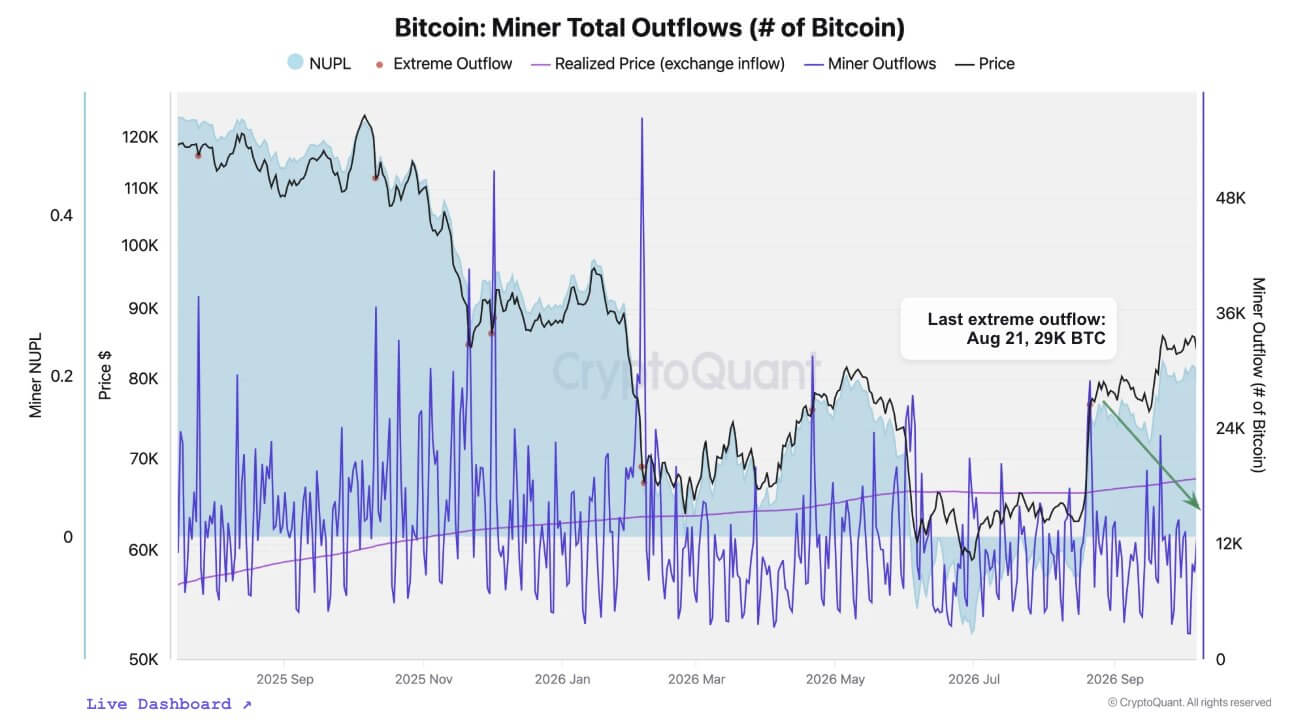
Since that milestone, transfer volumes have stabilized within normal historical parameters, with latest daily figures sitting near 12,000 BTC.
Although wallet transfers do not guarantee immediate exchange liquidations, the downturn could indicate that operators face less urgency to offload sizable asset reserves following months of cash flow hardship.
This behavior shift is also visible among the network’s oldest stakeholders.
According to CryptoQuant, Satoshi-era participants—excluding addresses tied to Patoshi—moved roughly 600 BTC out of storage in September. This metric reflects a nearly 70% reduction compared to the 2,000 BTC shifted during January.
Given that their collective reserves remain considerable at around 590,000 BTC, any adjustments in their spending habits carry meaningful implications for prospective market supply.
Simultaneously, wallet cohorts holding between 100 and 1,000 BTC have halted the asset depletion trend seen over previous months.
The total holdings of this group shrank by roughly 20%, falling from 64,000 BTC in December 2025 to about 51,000 BTC by early September. Since then, balances have held relatively steady.
This stabilization suggests miners are growing less dependent on draining legacy reserves as macro conditions stabilize.
For everyday investors, reduced liquidation pressure removes a notable headwind that previously weighed on market prices during the recent slump. That said, miners have yet to display a consistent pattern of returning to aggressive accumulation.
Bitcoin’s $80,000 support level emerges as a test for mining profits
At the same time, newly emerging limits dictate how far the industry’s financial recovery can go.
As operators fire up hardware and network rivalry intensifies, climbing difficulty metrics could squeeze hashprice once again unless market prices maintain an upward trajectory.
CryptoQuant pointed to Bitcoin’s 365-day moving average near $80,000 as a critical short-term support baseline, followed by its 200-day moving average situated near $71,000.
A prolonged retreat toward those thresholds could jeopardize the revenue gains secured since July, particularly for businesses utilizing aging, less efficient infrastructure.
Ultimately, a lasting industry recovery will depend on whether major mining operations begin actively rebuilding their Bitcoin balances while network hashrate continues to grow, confirming that rising revenues comfortably offset operational expenses and encourage reinvestment despite rising network competition.
Frequently Asked Questions
- What caused the recent surge in Bitcoin miner revenue? Daily industry revenue climbed due to rising BTC prices, which recovered about 45% from lows of $58,000 to levels above $83,000.
- What is hashprice and how has it changed? Hashprice is a metric tracking the expected daily earnings generated by a unit of computing power. It recently climbed above $40 per petahash per second per day, reaching its highest point since January.
- Are miners still selling off large amounts of Bitcoin? No, extreme miner outflows have ceased since August 21, and wallet transfers have returned to more normal daily averages of about 12,000 BTC.
- What price levels are critical for miners moving forward? CryptoQuant highlights Bitcoin’s 365-day moving average near $80,000 as a vital short-term support zone, with the 200-day moving average sitting around $71,000.