
Bitcoin drops to $82,000 on US data, and inflation fear is blamed
Bitcoin dropped to an intraday low of $82,775.94 following mixed US economic data showing cooling job openings alongside rising consumer anxiety over inflation and interest rates.

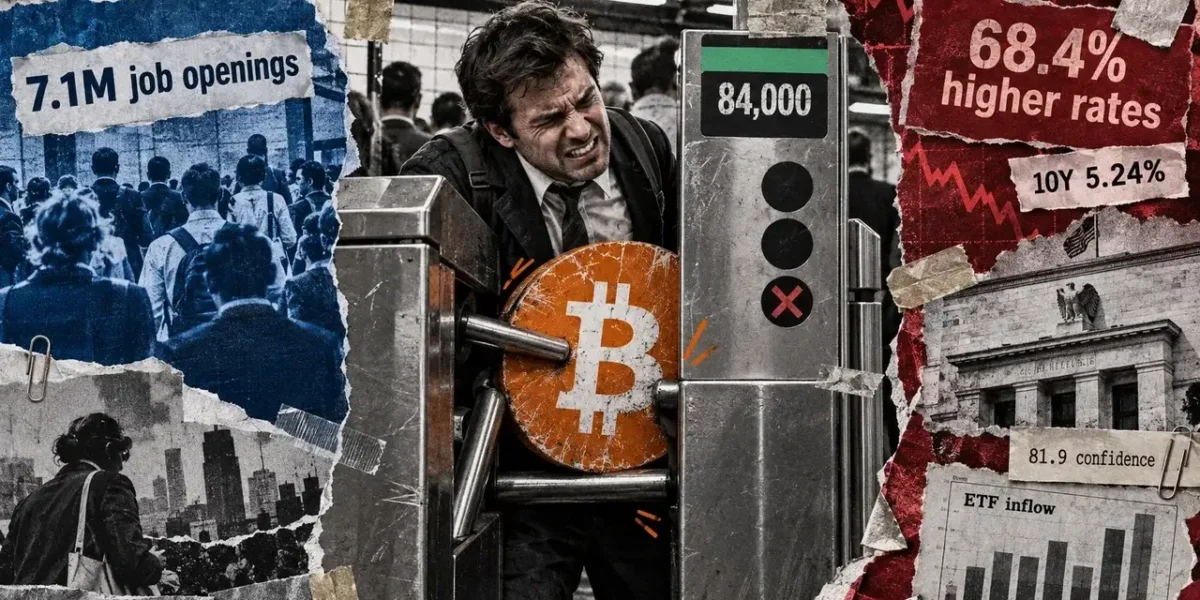
Following September 29 economic releases, Bitcoin investors found themselves weighing mixed signals as US job openings cooled moderately in August alongside rising consumer anxiety over inflation and interest rates.
On Tuesday, Bitcoin hit an intraday low of $82,775.94. Whether the cryptocurrency can reclaim the $84,000 support level relies primarily on the trajectory of yields and fresh demand rather than any singular vacancies report.
While the labor and consumer surveys outline distinct economic pressures, neither officially determines the root cause of Bitcoin’s price fluctuations.
Job openings ease as rate worries rise
Data from the Bureau of Labor Statistics shows that August job openings remained relatively stable at 7.1 million, dipping from an upwardly revised 7.3 million in July (which saw a 64,000 upward adjustment to soften the comparative drop).
Hires held steady at 5.2 million, quits remained unchanged at 3.1 million, and layoffs alongside discharges hovered near 1.6 million. These figures point to slightly softer employment demand; while a slower labor market could alleviate pressure on interest rates, a dramatic economic deterioration might simultaneously damage overall risk appetite.
Conversely, The Conference Board reported that its September consumer confidence index dropped to 81.9 from August’s 88.6. The Expectations Index—which measures consumer outlooks regarding income, business, and labor conditions over the short term—fell for the third straight month to 63.6, with participants also expressing less optimism about current job market conditions.
Consumer sentiment regarding rates and inflation directly contradicted any simplistic “soft jobs mean lower yields” market assumption. Specifically, the percentage of consumers anticipating higher interest rates over the upcoming 12 months climbed by 5.2% to reach 68.4%.
Furthermore, average expected inflation for that same timeframe increased to 6.1%, while the median crept up to 5.1%, both registering a 0.3% rise compared to August.
Because the survey was fielded between September 1 and September 23—a timeframe encompassing the Federal Reserve’s September 16 rate hike to a target range of 3.75%-4.00%—these figures reflect specific context regarding consumer responses.
According to Treasury daily par yield curve figures published for September 28, the 10-year rate stood at 5.24% and the two-year rate hit 4.92%. Because this observation preceded the releases on Tuesday, it does not account for an immediate bond-market reaction.
Given that Treasury securities provide significant yields while Bitcoin yields no coupon, softer hiring trends would benefit Bitcoin more significantly if upcoming inflation figures allow bond yields room to decline.
ETF demand and the next economic tests
Data tracked by Farside Investors revealed that US-traded spot Bitcoin ETFs recorded a net inflow of $31 million on September 28, marking a smaller total than each of the prior five completed sessions.
If completed sessions experience stronger inflows, it would demonstrate that buyers are returning even with yields remaining high. Should inflows remain subdued, a lower-yield environment will likely carry more weight in driving a sustained recovery past the $84,000 threshold.
Neither the preceding day’s aggregate ETF figures nor real-time Bitcoin price quotes measure how investors ultimately reacted to Tuesday’s macroeconomic data.
The Bureau of Economic Analysis is set to release August personal income and outlays figures—including Personal Consumption Expenditures (PCE) inflation metrics—on September 30, with the September employment report scheduled for October 2.
A milder inflation report combined with a slower yet orderly hiring pace would bolster arguments for reduced Treasury yields. Should yields subsequently drop alongside healthier completed ETF inflows, Bitcoin could face reduced competition from yield-generating assets alongside clearer signs of new buyer demand.
Conversely, a hotter-than-expected inflation print or persistently elevated yields would undermine that outlook, even if payroll growth slows down. Meanwhile, a drastic slowdown in job creation would introduce entirely separate market risks.
At present, labor metrics indicate moderation, whereas consumer surveys highlight persistent anxiety surrounding prices and interest rates. Bitcoin’s path back above $84,000 depends on whether upcoming economic reports and market pricing can resolve this tension, alongside whether buyers show up in finished ETF inflows.
Frequently Asked Questions
01Why did Bitcoin drop to $82,000?
Bitcoin dipped to an intraday low of $82,775.94 following US job openings data for August and consumer surveys from September that highlighted heightened worries over inflation and interest rates.
02How do Treasury yields impact Bitcoin’s price?
Treasury securities provide substantial yields while Bitcoin does not pay a coupon. Softer hiring trends help Bitcoin more when subsequent inflation data allows yields room to fall, reducing competition from interest-bearing assets.
03What upcoming economic data are investors watching?
Market participants are monitoring the Bureau of Economic Analysis’s August personal income and outlays report (including PCE inflation data) slated for September 30, as well as the September employment report on October 2.