
क्रंचबेस डेटा: 2026 के वेंचर फंडिंग का 2% से भी कम हिस्सा चुनाव के बाद के रेड स्टेट्स को मिला
2026 के चुनावों के बाद के क्रंचबेस डेटा के अनुसार, कुल अमेरिकी स्टार्टअप वेंचर फंडिंग का 2% से भी कम हिस्सा चुनाव के बाद के रेड स्टेट्स में स्थित कंपनियों को गया, जबकि कैलिफोर्निया जैसे ब्लू स्टेट्स ने अधिकांश हिस्सा हासिल किया।

For several decades, the overwhelming majority of startup capital in the United States has consistently flowed to enterprises located in blue or purple states, where Democrats maintain control over either some or all statewide executive and legislative offices.
However, following Tuesday’s electoral outcomes, the investment gap separating blue, purple, and red states has widened significantly.
As of Election Day this year, less than 2% of total startup investment has been directed toward companies situated in post-election red states—categorized as those featuring both a Republican governor and a pair of Republican U.S. senators.
The portion captured by red states is substantially lower than historical figures, driven primarily by five states transitioning into the purple category. Among them, Texas represents the largest venture capital ecosystem—having flipped to purple due to the election of Democratic Senator James Talarico and Governor Gina Hinojosa—followed subsequently by Ohio.
By Election Day this year, startups operating across the remaining 17 red states1, which account for nearly a quarter of the American population, had collectively secured a mere $8.6 billion in venture financing. Prominent contributors among these included Florida, Tennessee, and Utah. To place that figure in perspective, it amounts to less than what the entire nation typically generates in a single week.
Purple states rising
Meanwhile, the 10 purple U.S. states2—accounting for just over 25% of the U.S. population—attracted approximately $28.6 billion year-to-date through Election Day. While significantly outperforming the red state total, this still equates to less than 6% of all nationwide startup funding.
Aside from the aforementioned recent additions of Texas and Ohio, several other purple jurisdictions consistently pull in substantial venture backing, such as Pennsylvania, North Carolina, and, to a lesser extent, Wisconsin.
It is also worth highlighting that the disparities between red, purple, and blue territories narrow somewhat when examining the frequency of funding rounds. Roughly 12% of startup financing deals valued at $1 million or more went to purple-state businesses this year, while approximately 9% went to red-state enterprises.
On a macro level, financial backers continue to uncover plenty of investment-grade talent outside of blue states when evaluating smaller transactions. Nevertheless, investors are channeling the vast majority of their capital into massive artificial intelligence funding rounds for companies based in California and New York.
Blue states get over 90% of startup funding
This leads to the central observation: blue states capture the lion’s share of startup investments, with the majority concentrated in California.3
According to an analysis conducted by Crunchbase last week, California-based enterprises secured over three-quarters of all U.S. startup funding throughout 2026. This trend is driven largely by mega-financings for San Francisco-based entities OpenAI and Anthropic.
While no other state rivals California in drawing capital, the closest runners-up are also predominantly blue states, specifically New York and Massachusetts. In total, blue states have pulled in a remarkable $481 billion in startup investment this year as of Election Day, marking a new record according to Crunchbase figures.
Politics and what makes for a venture hub
Is this trend driven by politics, or is it merely coincidental?
Generally speaking, the foundational elements that characterize geographic startup hubs—including deep technological talent pools, urban environments, prominent technology corporations, and elite research universities—are not exclusive to blue states. That said, predominantly rural regions, which typically lean conservative, feature these ingredients less frequently.
Even so, nothing precludes a red state from demonstrating startup prowess. Austin, for instance, successfully established its reputation as a major technology hub even while the state of Texas remained firmly under Republican governance. Utah similarly boasts a sophisticated and thriving startup ecosystem.
Yet, in the wake of a Democratic electoral sweep, it comes as little surprise that a greater concentration of startup hubs now resides within blue or purple territories.
अक्सर पूछे जाने वाले प्रश्न
01How are red, purple, and blue states defined in this analysis?
Red states feature a Republican governor and two Republican U.S. senators. Purple states exhibit a mix of Democratic and Republican representation across their gubernatorial and Senate seats. Blue states are defined by a Democratic governor alongside two Democratic or Democratic-aligned U.S. senators, based on the results of the November 2026 elections.
02What percentage of 2026 venture funding went to red states?
As of Election Day 2026, less than 2% of all startup investment went to companies located in post-election red states.
03Why did the red state share of venture funding drop?
The drop is largely attributed to five states shifting from red to purple, most notably Texas—the largest venture hub among them—and Ohio.
संबंधित Crunchbase क्वेरीज़:
- Red State Venture Funding In 2026
- Purple State Venture Funding In 2026
- Blue State Venture Funding In 2026
संबंधित पठन:
- कैलिफोर्निया के स्टार्टअप्स ने 2026 में अब तक पूरे अमेरिका द्वारा किसी एक वर्ष में जुटाई गई कुल राशि से अधिक जुटाया है
- Austin’s Star Is Still Shining Bright: Venture Funding To City’s Startups Hits All-Time High
- Only 2 States Saw Their Share Of US Venture Funding Rise Last Year
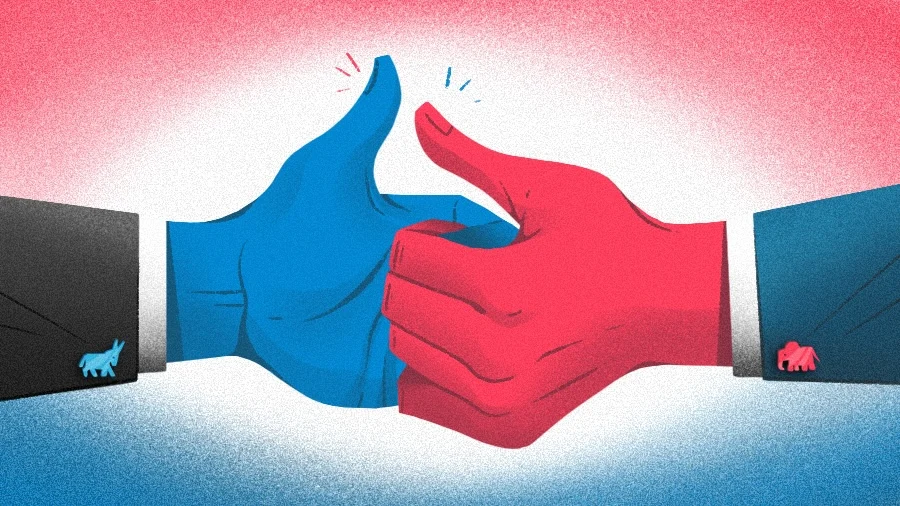
चित्रण: डोम गुज़मैन
-
For this analysis, “red states” are defined as states with a Republican governor and two Republican U.S. senators, based on the results of the November 2026 elections. They include Alabama, Arkansas, Florida, Idaho, Indiana, Kentucky, Louisiana, Missouri, Montana, Nebraska, North Dakota, Oklahoma, South Dakota, Tennessee, Utah, West Virginia and Wyoming. Mississippi and Alaska, where senate races have yet to be called as of this writing, were not included as red, blue or purple states in this analysis.↩
-
For this analysis, “purple states” are defined as states with a mix of Democratic and Republican representation among their governor and two U.S. senators, based on the November 2026 election results. They include Iowa, Kansas, New Hampshire, North Carolina, Ohio, Pennsylvania, South Carolina, Texas, Vermont and Wisconsin.↩
-
For this analysis, “blue states” are defined as states with a Democratic governor and two Democratic or Democratic-aligned U.S. senators, based on the November 2026 election results. They include Arizona, California, Colorado, Connecticut, Delaware, Georgia, Hawaii, Illinois, Maine, Maryland, Massachusetts, Michigan, Minnesota, Nevada, New Jersey, New Mexico, New York, Oregon, Rhode Island, Virginia and Washington.↩