
सीनेट का टैक्स बिल स्थिर सिक्का खर्च को मुक्त करता है जबकि बिटकॉइन IRS फॉर्म पर रहता है
प्रसारित प्रस्ताव पात्र डॉलर-स्टेबलकॉइन खरीदारी को बिना किसी निर्धारित मूल्य सीमा के नो-गेन/नो-लॉस ट्रीटमेंट देगा, जबकि साधारण बिटकॉइन खर्च पर डिस्पोज़िशन रिपोर्टिंग बनी रहेगी। द पोस्ट सीनेट टैक्स बिल फ्रीज़ स्टेबलकॉइन स्पेंडिंग व्हाइल बिटकॉइन स्टेज़ ऑन IRS फॉर्म्स अपीयरड फर्स्ट ऑन क्रिप्टोस्लेट।

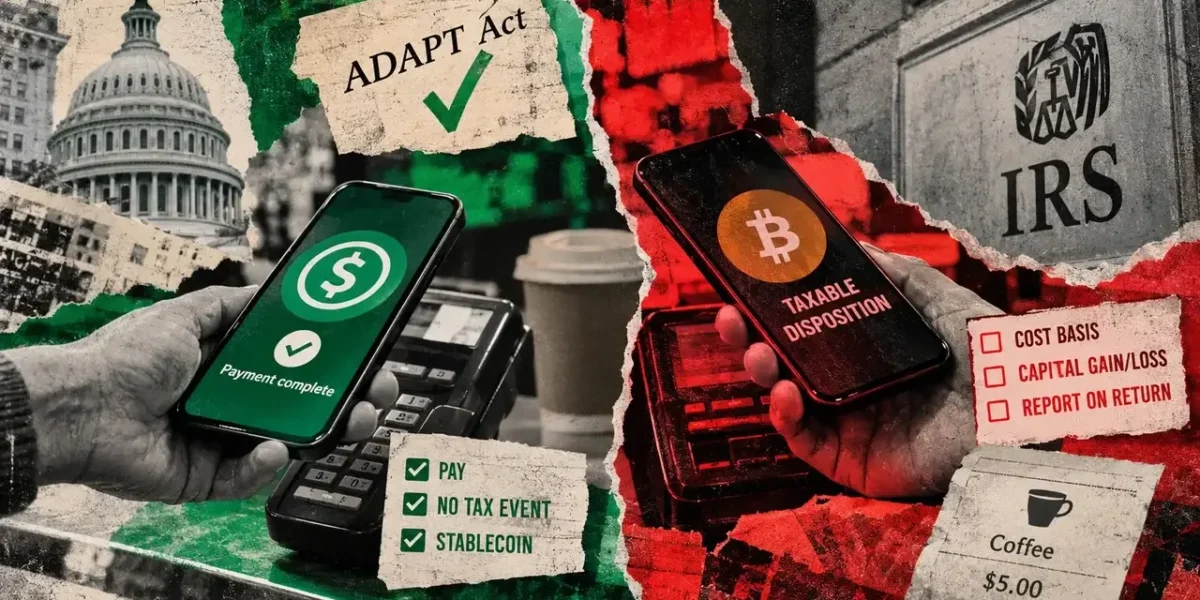
Purchasing a coffee using an eligible dollar stablecoin would bypass gain-or-loss recognition under the ADAPT Act, unveiled Sept. 30 by Sen. Steve Daines. Meanwhile, buying that same coffee with Bitcoin would still necessitate the cost-basis calculations and capital gain or loss reporting typically required when spending digital assets.
Bloomberg Law reported on Sept. 25 that Daines had circulated an early draft and planned to introduce the legislation the following week. Spanning 56 pages, the text released on Sept. 30 is officially titled the Aligning Digital Assets with Principles of Taxation Act and includes Sens. Cynthia Lummis, Bernie Moreno, and Tim Scott of South Carolina as cosponsors.
Under existing IRS guidelines, using digital assets of any amount to purchase goods or services constitutes a disposition. Individuals holding personal or investment assets must compute and report capital gains or losses, which rely heavily on the specific asset’s original cost basis and current market value.
Because a payment can result in a gain, loss, or break-even scenario, the IRS frequently uses a cup of coffee to illustrate the rule. For instance, purchasing a $5 coffee with Bitcoin that carries an allocated basis of $3 generates a $2 capital gain that must be included on a tax return.
What qualifies as a covered stablecoin
New section 1034 of the tax code would treat the transfer of covered payment stablecoins for products or services as a nonrecognition event. While this relief eliminates capital gains or losses on the token itself, standard obligations like sales taxes remain fully applicable.
To qualify, the token must be a recognized U.S. dollar stablecoin issued by an authorized payment stablecoin issuer operating under the GENIUS Act.
Foreign issuers may qualify through registration with the OCC or via a Treasury determination that their domestic regulatory framework is comparable. Such issuers must appear on the Treasury’s most recent report prior to any payment transaction, and the taxpayer must have acquired the token at a price within 3% of $1.00.
The Treasury department would issue this updated report at least once every three months, detailing every qualified stablecoin that actively traded within 3% of $1.00 during the 12 months leading up to the prior month. Consumers and payment processors would verify transactions against this latest official list.
Traders, brokers, and dealers specializing in qualified dollar stablecoins are excluded from the provision, as are taxpayers utilizing a functional currency other than the Treasury dollar. Furthermore, the Treasury holds the authority to expand these trade-or-business exclusions to comparable enterprises.
Taxpayers are required to maintain accurate records that clearly differentiate eligible stablecoin payments from other financial transactions. These covered payments would be exempt from broker information returns under section 6045(i)(1), and brokers would be permitted to rely on customer certifications without independently verifying the 3% acquisition test for tokens sourced elsewhere. These stablecoin provisions are slated to apply to transactions initiated on or after Jan. 1, 2027.
Bitcoin keeps its paperwork, with one fee carve-out
Because section 1034 is strictly tailored to stablecoins, using Bitcoin at checkout continues to be treated as a taxable disposition, though Section 11 introduces a narrower exception specifically for transaction fees.
Under the newly proposed section 1044, digital assets disposed of solely to cover transaction costs would be exempt from gain-or-loss recognition provided the aggregate value of the assets used for those fees is $10 or less. This covers base, gas, and priority fees, with related transactions being aggregated together.
Exclusions from this fee rule apply to traders, brokers, dealers, businesses that batch transactions or assist in validating them on behalf of others, and any assets subjected to mark-to-market accounting. Additionally, individuals who initiated more than 5,000 separate digital asset transactions during the preceding taxable year are barred from the exception.
This fee exemption takes effect for dispositions starting Jan. 1, 2027, aligning with the rollout of the stablecoin relief. Consequently, when purchasing a coffee with Bitcoin, the microscopic fraction of BTC spent on network fees might qualify for the exception, while the primary coins delivered to the merchant remain subject to standard taxable disposition rules.
The legislation also exempts qualified dollar stablecoins from the strict wash-sale and constructive-sale rules that it extends to other types of digital assets.
Earlier bills used dollar thresholds
Earlier legislative proposals attempted to minimize tax friction for qualifying personal crypto transactions by implementing specific monetary thresholds.
Sen. Ted Budd introduced S.4171 on March 24, which would have required both the total transaction value and the otherwise recognized gain or loss to remain at $200 or less. Related transactions would have been aggregated, with exclusions targeting business-property and cash-equivalent exchanges.
Meanwhile, Sen. Lummis’s S.2207, unveiled in July 2025, established a $300 ceiling for both transaction value and recognized loss, while terminating further exemptions once qualifying annual gains crossed the $5,000 mark.
While the House PARITY Act previously advanced a $200 threshold specifically for stablecoin transactions, Lummis’s newly cosponsored bill links tax relief directly to eligible stablecoins regardless of purchase size.
A separate House proposal, H.R.10357, was introduced on Sept. 14, and the House Ways and Means Committee subsequently voted 38-5 to approve it on Sept. 16. Its stablecoin redemption-value accounting system and qualifying $10 fee relief operate via distinct mechanisms, and committee approval marks an important preliminary step prior to a full House vote.
What happens next for stablecoin and Bitcoin
These measures remain strictly legislative proposals, meaning current IRS enforcement rules remain completely unchanged. The bill’s text directs the Treasury to establish operational mechanics, including quarterly reporting lists, recordkeeping mandates, and broker reporting standards. Because the framework borrows its core issuer definitions directly from the GENIUS Act, token eligibility will depend heavily on approvals granted under that separate statute.
For everyday consumers, Daines’s legislative text draws its primary boundary around the specific asset used for payment, regardless of the purchase total. A $5 coffee bought with a qualifying stablecoin would fall outside the scope of gain-or-loss recognition, whereas purchasing that exact same coffee using Bitcoin would remain firmly within the capital-gains tax system.
अक्सर पूछे जाने वाले प्रश्न
01Would buying a coffee with stablecoins trigger taxes under the ADAPT Act?
No. Under the proposed ADAPT Act, purchasing items with a qualifying U.S. dollar stablecoin would avoid gain-or-loss recognition on the token itself, provided certain issuer and price requirements are met.
02How would Bitcoin purchases be treated under the proposed bill?
Spending Bitcoin at checkout would still be treated as a taxable disposition, requiring users to perform cost-basis calculations and report capital gains or losses on their tax returns.
03Are transaction fees for crypto also covered?
Yes. Section 1044 introduces a narrow rule allowing digital assets used exclusively to cover transaction costs (such as gas or base fees) to escape gain-or-loss recognition if their aggregate value is $10 or less.
04When would these proposed tax changes take effect?
If enacted, both the stablecoin relief and the transaction fee exception would apply to covered transactions entered into starting January 1, 2027.