When Will Nvidia Stock Go Down? Here’s What Could Trigger It
While Nvidia maintains strong revenue growth and bullish analyst price targets, several external factors could trigger a decline in share value, including AI slowdowns, custom client chips, and supply constraints.

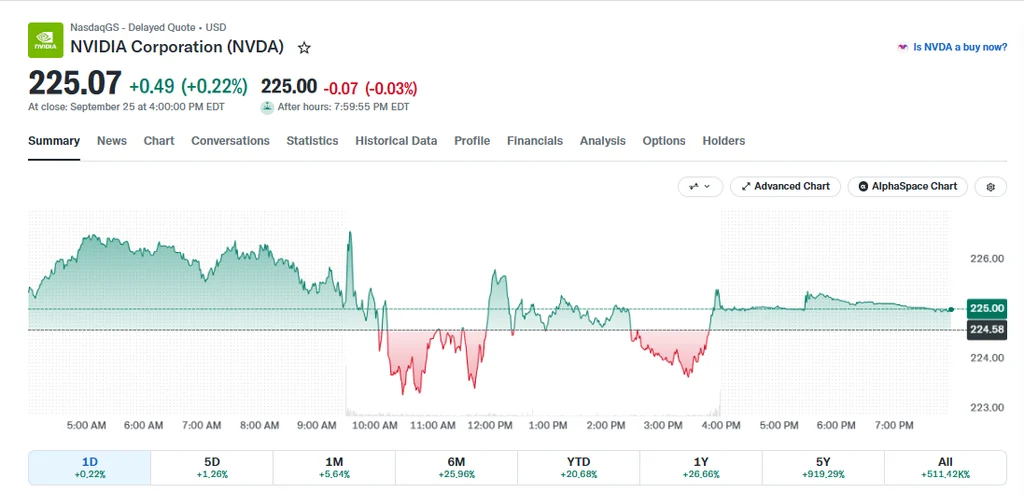
Pinpointing the exact day Nvidia stock will decline is impossible, as share values fluctuate based on real-time economic indicators and market forces. However, traders can monitor specific triggers, such as a deceleration in artificial intelligence growth, major clients manufacturing proprietary chips, shortages in supply, trade and export restrictions, or a widespread market downturn. As of the September 25 close, NVDA trades at $225.07. Wall Street maintains a bullish outlook for Nvidia, with the average price target resting at $328.66. Nevertheless, genuine risks persist, which has kept the 2026 rally relatively moderate thus far.
When Will Nvidia Stock Go Down? Risks, Forecast And Price Targets
Even with continuous business expansion, people often wonder when NVDA might drop. For the second quarter of fiscal 2027, Nvidia posted $96.2 billion in revenue, marking a 106% increase compared to the previous year.
During the Q2 fiscal 2027 earnings announcement, Nvidia CEO Jensen Huang noted:
“AI has reached its inflection point. It’s doing useful work.”
Yet, the share price has not entirely mirrored this momentum. Year-to-date gains for 2026 sit near 18%, largely because concerns surrounding an AI bubble continue to linger across the market. The catalyst for any downward movement depends less on financial earnings and more on external factors surrounding the enterprise.
Supply Limits And Customers Building Their Own Chips
Determining when supply issues might pull Nvidia stock down is difficult, but inventory constraints represent a subtle risk for NVDA shares. Leadership projected approximately 70% growth for fiscal 2028, tying that projection directly to manufacturing capacity, with CFO Colette Kress highlighting memory scarcity as the primary limitation.
On the August 26 earnings call, Jensen Huang remarked:
“Our demand is much greater than 70%.”
Over the long term, a greater threat stems from major clients like Amazon, Google, and Meta engineering their own alternative processors. The stock would likely face downward pressure on this front once those large purchasers significantly reduce their reliance on Nvidia graphics processing units.
Taiwan, Export Rules And Market Shocks
Because TSMC manufactures Nvidia’s most sophisticated processors—with a high concentration of that output based in Taiwan—any operational disruption in the region could severely impact the share value. Furthermore, international sales remain constrained by trade policies and export controls. NVDA also experiences notable volatility, registering an annualized rate of roughly 41.9%. During a wider market sell-off, NVDA stock would likely decline rapidly, driven by external hazards entirely outside the organization’s control.
What Analysts Expect From The NVDA Stock Price Target
Current projections for Nvidia lean strongly toward optimism. A survey of 61 analysts conducted by S&P Global yields a consensus Strong Buy rating for NVDA. The average price target of $328.66 represents roughly a 46% premium over current levels. Conversely, the most conservative price target of $180 illustrates the extent of a potential pullback should artificial intelligence spending begin to slow. Only Wall Street’s most pessimistic forecasts anticipate a slide to that threshold.
Commenting on AI investments, Jensen Huang stated:
“The AI infrastructure buildout is at full steam.”
Also Read: Nvidia vs. SpaceX: Which AI Stock Has More Potential?
Ultimately, determining when Nvidia stock will decline does not point to weak financial reports, according to current forecasts. The 2026 trajectory for Nvidia relies much more heavily on supply constraints, proprietary chips developed by clients, regional disruptions in Taiwan, or broad macroeconomic sell-offs.
अक्सर पूछे जाने वाले प्रश्न
01What is the current consensus price target for Nvidia stock?
The average analyst price target stands at $328.66, based on a survey of 61 analysts by S&P Global.
02What are the main risks that could cause NVDA to drop?
Key risks include slowing AI adoption, major buyers creating their own hardware, supply bottlenecks like memory scarcity, export restrictions, regional disruptions in Taiwan, and general market downturns.
03What is Nvidia’s projected revenue growth for fiscal 2028?
Management has projected growth of roughly 70% for fiscal 2028, though executives noted that actual demand exceeds that forecast due to supply limitations.