
Hoskinson says Vitalik’s AI warning could delay the internet’s quantum defenses
Cardano creator Charles Hoskinson claims that Vitalik Buterin's warnings regarding AI-driven mathematical breakthroughs could delay the internet's implementation of quantum-resistant lattice-based cryptography.

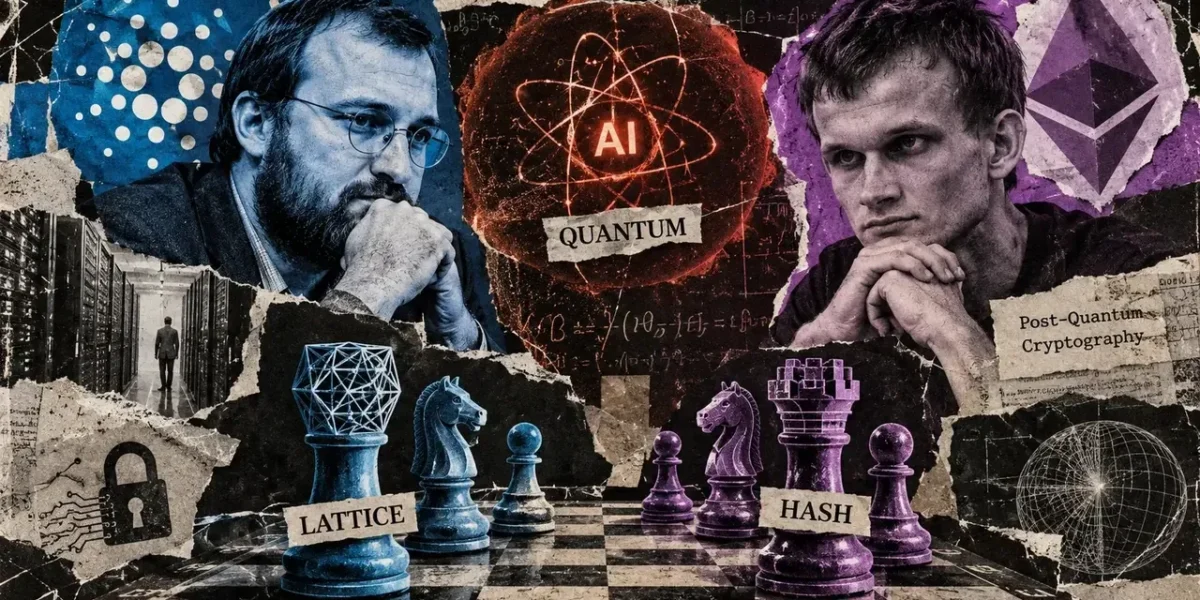
Cardano creator Charles Hoskinson has claimed that Vitalik Buterin is undermining quantum-resistant cryptography by issuing speculative cautions regarding artificial intelligence-driven mathematical breakthroughs.
During an Oct. 9 statement, Hoskinson pushed back against the Ethereum co-founder’s doubts regarding lattice-based cryptography, maintaining that many years of security analysis have already taken the known vulnerabilities of the technology into account.
He cautioned that prompting developers to steer clear of established methods might delay the implementation of safeguards that are currently being rolled out across internet architecture, thereby leaving networks vulnerable to upcoming quantum threats.
This pushback comes after Buterin cautioned that AI-aided mathematical breakthroughs might undermine cryptographic frameworks built to withstand quantum computing.
Buterin noted that Ethereum’s extended “lean” strategy has shifted its focus toward hash-based proofs and signatures, steering clear of lattice-centric configurations.
Hoskinson dismissed this logic, claiming that Buterin is too committed to Ethereum’s current research trajectory to alter his perspective.
“The case against lattices is the GNFS story, a.k.a. a hunch about ‘structure,’ and a multiplier pulled out of thin air,” Hoskinson stated.
The disagreement centers on post-quantum substitutes for the elliptic-curve signatures currently utilized by platforms like Bitcoin and Ethereum.
Hoskinson challenges the mathematical case against lattices
Buterin’s apprehension stems in part from the evolution of integer factorization, where mathematical milestones such as the general number field sieve significantly enhanced methods for targeting RSA encryption.
He proposed that artificial intelligence might accelerate decades of equivalent mathematical progress into a much tighter timeframe, potentially uncovering unforeseen shortcuts to defeat lattice frameworks.
Hoskinson argued that the number field sieve arose from methods tied to arithmetic relationships and smooth numbers, whereas no equivalent mechanism has been proven to threaten the lattice problems supporting contemporary post-quantum benchmarks.
The Cardano creator highlighted over four decades of study—including progress in lattice reduction and sieving methods—that have gradually refined attacks without achieving a broad breakthrough strong enough to crack properly structured frameworks.
In 2024, the US National Institute of Standards and Technology standardized ML-KEM for key encapsulation alongside ML-DSA for digital signatures. Hoskinson noted that their security configurations factor in those documented attacks.
Hoskinson likewise pushed back against Buterin’s hypothetical proposal that multiplying key sizes by a factor of ten could safeguard public-key encryption against math advancements driven by artificial intelligence.
To “multiply key sizes by ten” is merely “numerology,” Hoskinson penned, asserting that security settings need to be modified based on quantifiable advancements in attack algorithms.
Shifts in attack performance might warrant moderately expanded parameters, whereas a deep mathematical breakthrough would likely demand abandoning an algorithm entirely.
Ethereum’s hash-based strategy faces its own questions
Hoskinson likewise questioned the premise that hash-driven cryptography delivers superior security against unforeseen mathematical breakthroughs.
He referenced past vulnerabilities found in MD5 and SHA-1 to illustrate that hash functions can harbor exploitable designs, though those past failures do not indicate flaws within contemporary standards like SHA-256.
His critique further targeted Poseidon and Poseidon2, which are hash algorithms built for optimized performance within zero-knowledge proofs and tied to Ethereum’s long-range cryptographic studies.
The Ethereum Foundation has previously backed studies examining Poseidon’s defense against algebraic attacks, which include analyses utilizing Gröbner bases and alternative cryptanalytic strategies.
Hoskinson contended that these frameworks likewise introduce possible targets for AI-supported mathematical breakthroughs, raising questions as to why lattice architectures face heightened scrutiny.
While hash-based signatures can deliver quantum-safe transaction validation, lattice methods additionally accommodate key encapsulation for encryption and additional advanced cryptographic frameworks.
Stepping away from lattice research could consequently restrict the choices accessible to developers constructing privacy networks, encrypted messaging, and alternative tools demanding those functions.
Frequently Asked Questions
01What is lattice-based cryptography?
Lattice-based cryptography is a class of cryptographic algorithms built on hard mathematical problems involving multidimensional lattices, widely considered strong candidates for post-quantum security.
02Why are quantum computers a threat to current cryptography?
Quantum computers could theoretically run algorithms, such as Shor’s algorithm, capable of efficiently breaking widely used public-key cryptography like RSA and elliptic-curve signatures.
03What standards has NIST released for post-quantum security?
The US National Institute of Standards and Technology standardized ML-KEM for key encapsulation and ML-DSA for digital signatures in 2024 to protect against future quantum threats.