MU Stock Gets Musk’s Praise as 26 Deals Buffer Memory Cycle Risks
Micron Technology stock received praise from Elon Musk for fair memory pricing, even as shares faced a semiconductor sell-off despite strong long-term customer contracts and surging AI demand.

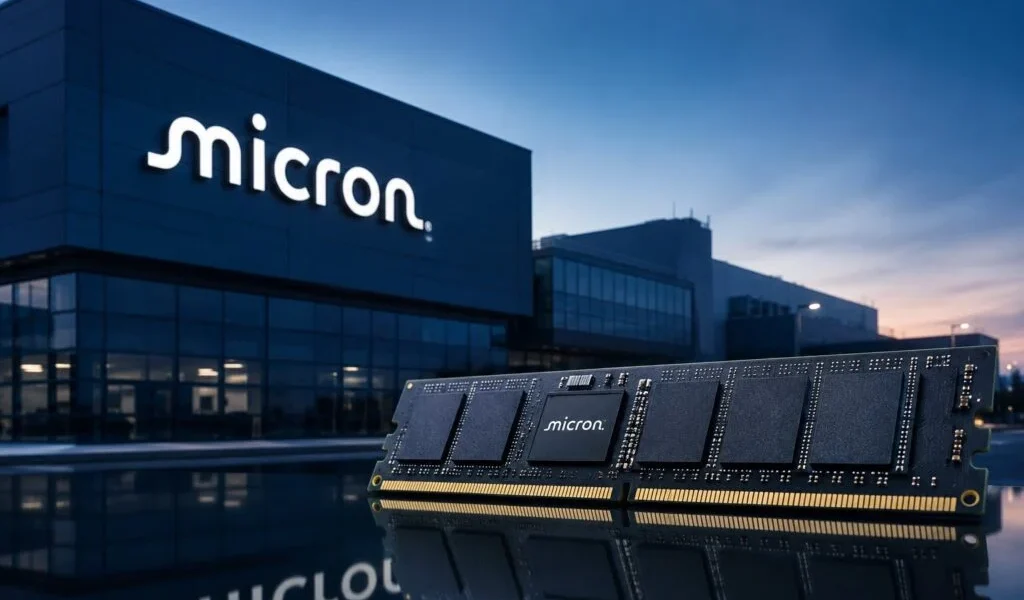
Micron Technology (MU) stock received a public endorsement from Elon Musk on October 13, 2026, when the Tesla and SpaceX chief executive noted that Micron has maintained fair pricing for future memory compared to rival vendors. This commentary comes as Micron memory prices hover near historic highs, bolstered by 26 long-term customer contracts extending through at least 2030 that currently represent over 35% of its revenue. This financial cushion influences the broader MU stock outlook by potentially dampening the impact of the next downturn in the cyclical memory market.
Also Read: Micron Stock: Revenue Soars 379% to $54.23B as AI Memory Demand Surges
MU Stock, Elon Musk’s Praise, and Micron’s Memory Price Risks
The public backing from Elon Musk provided an initial boost to MU stock, driving shares up 0.7% in overnight trading on Tuesday. However, the gains failed to stick. Micron closed at $914.13 on October 14, marking a 4.08% decline, and subsequently dropped to $875.15 in after-hours trading. At the time of writing, the equity has fallen nearly 16% across five sessions amid a broader semiconductor sell-off, though it retains a year-to-date gain of approximately 220%.
What Elon Musk Said About Micron
Elon Musk delivered his remarks on X in response to Nicholas Mugalli, an institutional TMT research analyst who posted a bullish research note on the memory sector from JPMorgan. Musk posted the following statement:
“Micron has been reasonable regarding future memory prices, while others have been extortionate, which is something today’s customers won’t forget. Micron is making is the smart move for long-term customer loyalty.”
These remarks hold weight for MU stock because Musk operates as a massive memory consumer. His xAI venture—now integrated with SpaceXAI—operates the Colossus AI data center facility near Memphis, where the installed Nvidia GPUs rely on Micron memory components. Furthermore, Musk identified Micron as an active supplier in April during discussions regarding his Terafab initiative.
How Micron’s Customer Contracts Change The Memory Cycle
Micron’s newly established customer agreements provide an unprecedented level of insulation from historical swings in the Micron memory cycle. Three-quarters of the projected revenue from these agreements features price bands establishing explicit minimums and maximums, while the remaining portion is subject to prevailing market rates. Additionally, buyers have advanced $32 billion, largely through cash deposits. Micron CEO Sanjay Mehrotra noted:
“To date, we have signed 26 SCAs, which we currently estimate to be over 35% of our revenue through 2030.”
According to analyst Mugalli, Micron also maintains a contracted backlog totaling $150 billion, with more than 75% of fiscal 2027 production already allocated. This robust backlog helps explain why buyers are aggressively seeking out the supply associated with the MU stock singled out by Musk.
What The MU Stock Forecast Depends On
The inherent volatility of the Micron memory cycle persists. Bernstein projects dynamic random-access memory (DRAM) prices to advance another 43% in 2027 before declining by 53% in 2028, while JPMorgan anticipates supply constraints to persist through 2028. Mehrotra stated:
“We expect memory and storage supply-demand conditions to be much tighter in calendar 2027 and 2028 than they were in 2026.”
Surging Micron memory prices drove the company’s financial performance this year, with DRAM average selling prices rising roughly 180% in fiscal 2026 alongside a mid-20s percentage increase in shipment volumes. Total revenue surged 256% to approximately $133 billion, yet the stock trades at roughly 13 times earnings, reflecting market expectations that profitability will moderate once pricing cools. Meanwhile, Chinese competitor CXMT introduces additional competition through denser DRAM architectures.
Regarding the broader MU stock forecast, the structured agreements and Elon Musk’s public support provide tangible backing, but approximately 74% of Micron’s sales continue to respond directly to fluctuations in supply and demand. Consequently, MU stock will encounter its true evaluation when Micron memory pricing eventually trends downward.
Frequently Asked Questions
01Why did Elon Musk praise Micron?
Elon Musk praised Micron on X for maintaining fair pricing on future memory products, contrasting them with competitors he labeled as extortionate.
02How much of Micron’s revenue is protected by long-term contracts?
Micron has secured 26 long-term customer contracts (SCAs) that currently account for over 35% of its projected revenue through 2030.
03What is the outlook for DRAM prices?
Analysts like Bernstein expect DRAM prices to climb an additional 43% in 2027 before experiencing a 53% decline in 2028.