US factory costs spike, threatening Bitcoin’s rally above $85,000
US factory costs spiked in September, fueling potential interest rate hikes that could challenge Bitcoin's recent rally above $85,000 as investors await critical employment figures.

American manufacturers indicated broader input-price gains during September, creating a potential financing challenge for Bitcoin if market participants react by anticipating increased interest rates ahead of Friday’s employment figures.
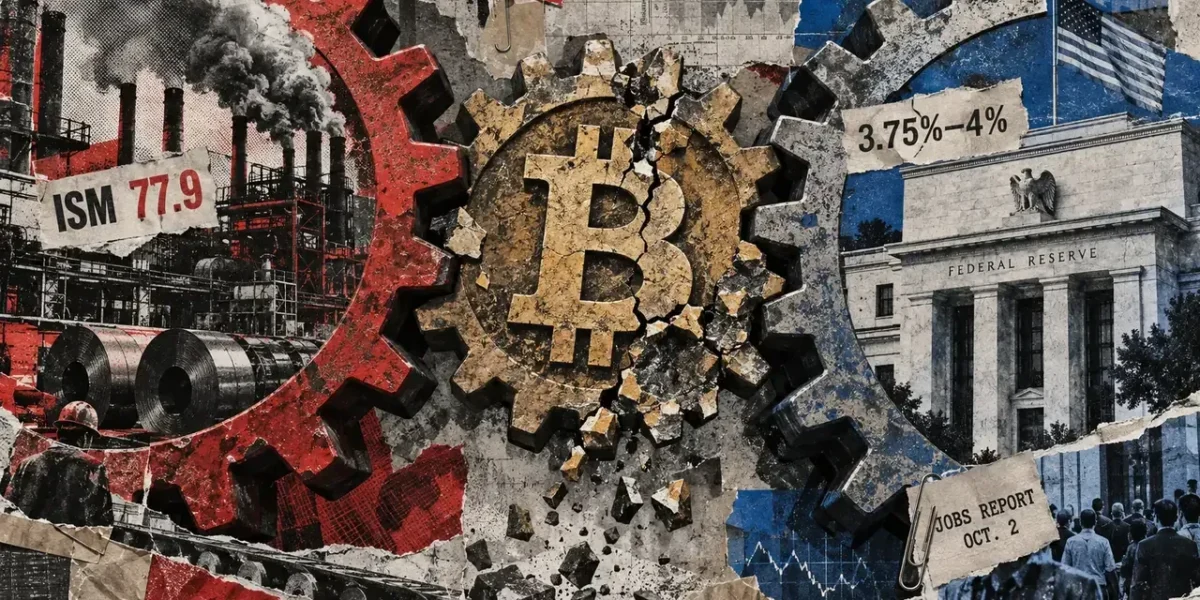
The Institute for Supply Management published its report on October 1, showing the manufacturing prices index climbed to 77.9—an increase of 6.8 points compared to August’s reading of 71.1. Meanwhile, the manufacturing PMI reached 54.5, new orders stood at 55.3, and employment was recorded at 52.7.
This mix is significant for Bitcoin because persistent economic activity and expanding cost pressures may challenge arguments in favor of reducing interest rates.
The prices index tracks the breadth of monthly increases rather than representing a 77.9% inflation rate. Specifically, 58.6% of survey participants observed higher input costs, up from 46.2% in August. This diffusion index is calculated by combining the percentage of higher responses with half of the unchanged responses.
The potential pressure runs through rates
The current monetary policy environment features a completed rate hike by the Federal Open Market Committee, which lifted its benchmark target range by a quarter percentage point to between 3.75% and 4% on September 16.
During a speech on September 29, New York Fed President John Williams noted that an additional rate increase could become appropriate later in the year if economic conditions track his expectations. He presented this as a conditional outlook, adding that there is currently no sign of these identified price shocks translating into broader or more persistent inflation.
The September factory survey introduces fresh data on input costs to this ongoing policy discussion. According to the Federal Reserve’s transmission framework, policy adjustments directly influence short-term borrowing expenses and Treasury bill yields, while future policy expectations shape longer-term rates and broader financial conditions.
For Bitcoin, this potential pressure manifests in two ways: costlier borrowing can discourage leveraged risk-taking, and higher yields on interest-bearing dollar instruments can increase the return investors demand for holding digital assets.
The Bureau of Labor Statistics is set to release the September Employment Situation report on October 2, and the ISM manufacturing employment metric should not be used as a proxy for that official government data.
The ultimate impact on Bitcoin relies on how investors process the collective data releases. Should the upcoming jobs report solidify expectations for higher rates, borrowing costs and competing dollar yields may present a stronger hurdle. Conversely, a drop in front-end Treasury yields or projected policy rates would diminish that transmission mechanism.
A research study published in February 2023 by New York Fed staff observed no systematic reaction from Bitcoin to monetary and macroeconomic announcements within its historical intraday datasets. Consequently, the real test is whether rate expectations actually shift and how Bitcoin reacts, rather than assuming that rising factory costs automatically trigger a market selloff.
Frequently Asked Questions
01How do US factory costs affect Bitcoin?
Rising factory input costs can fuel expectations of higher interest rates. This can lead to costlier borrowing and more attractive returns on traditional dollar-denominated assets, potentially reducing the appeal of holding risk assets like Bitcoin.
02Does the ISM prices index of 77.9 mean 77.9% inflation?
No. The prices index is a diffusion index that measures how widely monthly price increases are reported across survey respondents, not an overall inflation percentage rate.
03Are macroeconomic reports guaranteed to move Bitcoin’s price?
Not necessarily. Historical research from the New York Fed indicates that Bitcoin has not always displayed a systematic response to macroeconomic news, meaning market reactions depend heavily on shifting rate expectations at any given time.