
Tether claims $550 million in Iran freezes, but $35 million slipped past Senate
Tether reported freezing nearly $550 million in Iran-associated USDT, but a Senate subcommittee report claims delays in blacklisting wallets allowed tens of millions to slip past before being blocked.

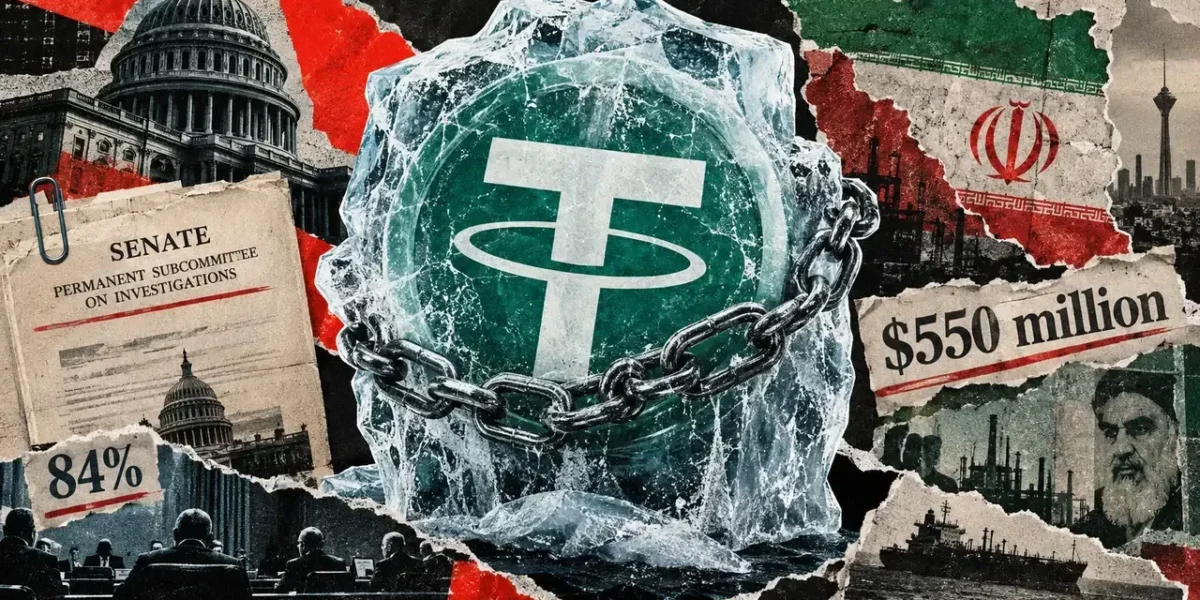
Tether reported assisting in the freeze of nearly $550 million in Iran-associated USDT throughout 2026. Simultaneously, Democratic investigators on a Senate subcommittee claim that delays in blacklisting specific identified wallets permitted tens of millions of dollars to remain in motion.
A preliminary report published on Sept. 28 by Democratic minority staff members of the Senate Permanent Subcommittee on Investigations evaluated 846 cryptocurrency wallets that either Israeli or US authorities targeted for seizure or sanctioned due to ties with Iran and regional groups. The findings indicated that 84% of these wallets conducted transactions exclusively or nearly exclusively using USDT.
Connecticut Democratic Senator Richard Blumenthal, who serves as the ranking member of the subcommittee, forwarded the discoveries to the Department of Justice and the Treasury Department, requesting an inquiry into Tether’s sanctions compliance and anti-money laundering practices.
These referrals do not establish any violation of federal law by Tether, nor do they confirm that either department has initiated a fresh case.
On the same day, Tether released its own statement detailing that actions involving USDT led to the freezing of approximately $550 million across wallets flagged by US officials as linked to Iranian sanctions networks and Iran’s central bank.
The money that moved before the freeze
The 84% figure cited in the Senate report focuses on a specific, curated group.
The sample was compiled by investigators using wallets flagged by Israel’s National Bureau for Counter Terror Financing and the Treasury Department’s Office of Foreign Assets Control (OFAC) as connected to regional groups or Iran. This dataset spanned over five years of designations leading up to August 2026.
For the purposes of the analysis, the Senate report classified a wallet as transacting “predominantly” in a digital currency whenever that specific asset accounted for over 80% of the total dollar value of its combined transactions.
This metric does not indicate the proportion of all USDT transactions that are illicit, nor does it quantify the share of Iran’s broader sanctions-evasion activities carried out using crypto.
While USDT is built to mirror the US dollar and can be transferred across blockchain networks without relying on traditional bank transfers, Tether maintains issuer-level capabilities to blacklist addresses and block any USDT held within them from moving.
Consequently, the exact timing of a freeze constitutes the primary concern for Democratic investigators.
The report from the minority staff reviewed 39 addresses identified in June 2023 by Israel’s NBCTF as connected to Tawfiq Muhammad Sa’id al-Law, whom the US Treasury subsequently sanctioned for supplying financial services to Hezbollah.
According to the document, five of these addresses received blacklists, whereas the remaining 34 went unfrozen until March 2024. Senate researchers calculated that upward of $34.6 million in USDT was transferred out of those wallets after the publication of the Israeli seizure notice and before the final addresses were blocked.
These findings from the Democratic minority do not represent a legal determination by a court that Tether breached US law. Furthermore, they pertain to an earlier timeframe than the enforcement actions highlighted by Tether for 2026.
Tether points to action before public designation
Tether stated that on April 23, it aided US authorities in locking down over $344 million in USDT across two distinct addresses following intelligence provided by OFAC and other US law enforcement bodies.
The following day, OFAC updated the pre-existing sanctions entry for the Central Bank of Iran to include those exact two blockchain addresses as digital-currency identifiers. This listing connects the central bank directly to Hizballah and the IRGC-Qods Force.
Additionally, Tether reported that over $130 million in USDT spread across four wallets was frozen in July as the Treasury broadened its listed blockchain addresses for the Central Bank of Iran.
These two disclosed interventions account for at least $474 million of the roughly $550 million that Tether claims was frozen throughout 2026. The organization did not supply a wallet-by-wallet breakdown to reconcile these specific examples with the overall headline figure.
Chief Executive Officer Paolo Ardoino stated that Tether takes action whenever authorities furnish credible information, noting that public blockchains provide investigators with transaction visibility that traditional cash cannot match.
In contrast, the Senate report noted that although Tether acknowledged receipt of an information and document request from the subcommittee on June 4, it had not replied as of the publication date.
Tether’s Sept. 28 public statement refrained from directly addressing the Senate report’s analysis of 846 wallets or the $34.6 million in transactions that investigators claim occurred prior to the freezing of the addresses.
In a separate US forfeiture proceeding, authorities are pursuing roughly $61 million in cryptocurrency allegedly connected to illicit Iranian oil transactions. Federal prosecutors asserted that this broader network shifted over $1.5 billion in proceeds, alleging that portions of these funds were intended to support Iran’s military and government, including the Islamic Revolutionary Guard Corps.
The Department of Justice noted that the forfeiture effort targeted digital assets tied to money laundering and sanctions evasion linked to the sale of Iranian petroleum.
These two collections of evidence highlight the dual nature of issuer-controlled stablecoins: authorities possess the ability to lock down substantial balances once addresses are identified, yet lags prior to blacklisting can leave assets free to transit.
Senator Blumenthal has formally requested that federal agencies investigate whether the delays highlighted by the Senate minority staff reflect isolated enforcement gaps or more systemic compliance failures.
Frequently Asked Questions
01What is the core disagreement between Tether and the Senate subcommittee?
The disagreement centers on the speed of enforcement. Tether highlights its efforts in freezing approximately $550 million in Iran-linked USDT during 2026, while Senate investigators point to historical delays in blacklisting specific wallets that allowed tens of millions of dollars to move.
02Did the Senate report prove that Tether violated federal law?
No. The findings from the Senate minority staff do not constitute a legal determination that Tether violated US laws, nor do they mean that the Justice Department or Treasury has opened a formal case.
03How much cryptocurrency is involved in the separate US forfeiture case?
A separate US forfeiture case targets approximately $61 million in cryptocurrency allegedly tied to black-market Iranian oil sales, out of a broader network that moved more than $1.5 billion in proceeds.