
Fed guarantees 2-day stablecoin payouts, but $76B remains blocked
A Federal Reserve stablecoin proposal establishes a two-business-day cap on issuer redemptions, yet $76 billion remains blocked on centralized exchanges where users must navigate distinct platform policies and eligibility hurdles.

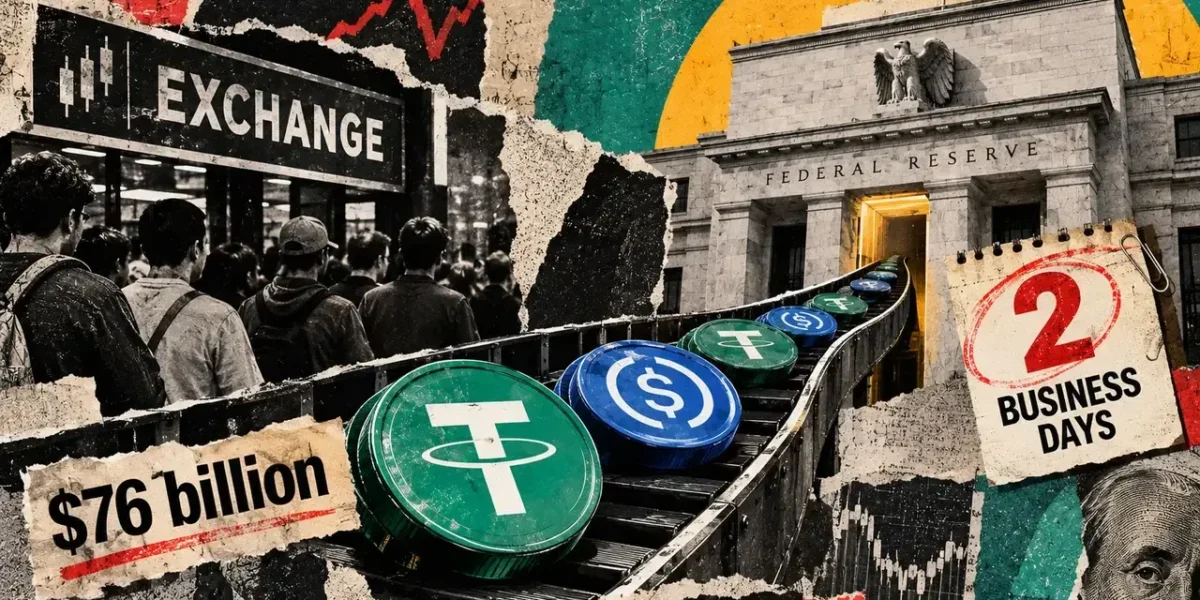
A recent stablecoin proposal from the Federal Reserve would establish a general two-business-day cap on redemptions by issuers under its supervision.
For individuals holding stablecoins on an exchange, the initial challenge is getting that platform to release or convert the funds. According to a July 28 snapshot, researchers identified $76 billion worth of stablecoins sitting on centralized exchanges, where users must navigate exchange policies before ever reaching an issuer.
Analysts at the Andersen Institute for Finance and Economics tracked that total across 12 reserve-backed dollar stablecoins. They note that this exchange figure represents a lower bound because certain exchange wallets remain unidentifiable.
Where the proposed clock starts
The Fed’s proposal, announced by the Board on Sept. 24 and published in the Federal Register on Sept. 29, would mandate that payment stablecoin issuers supervised by the Board clearly disclose their redemption procedures.
Under proposed section 247.12, the standard processing window to complete a redemption after a request could not exceed two business days. Furthermore, the issuer must outline how users can redeem tokens and must accept requests for at least one token type, subject to onboarding and screening protocols.
The Board retains the authority to prolong this timeframe if necessary for financial stability, public interest, or safety reasons. Additionally, the proposal outlines specific safe harbors for delays caused by mandatory customer verification or outside circumstances beyond an issuer’s control. These requirements are currently open to public comment.
Should an exchange submit a valid redemption request to an issuer, that issuer’s duties become relevant to the exchange platform. However, a customer’s directive to a trading venue to sell, convert, or withdraw funds is a distinct transaction governed strictly by the platform’s terms of service.
Existing user agreements highlight why this distinction is critical. Circle specifies that direct USDC redemption outside the European Economic Area is only available to eligible holders who maintain a Circle Mint account in good standing.
Customers lacking such an account cannot redeem directly through Circle until they meet eligibility requirements and register, as the company positions Mint as a tool for institutional distributors.
Similarly, Coinbase outlines in its U.S. user agreement that while a customer owns the balance in their USDC wallet, Coinbase is not obligated to buy back USDC for cash. The company may choose to do so, but its agreement directs users to Circle for direct redemptions under Circle’s separate guidelines.
Coinbase also maintains the right to suspend trading or transfers, meaning that Circle Mint eligibility and the exact timeline for an exchange withdrawal depend heavily on individual user circumstances and the platform being used.
The Andersen research snapshot also presents a scope limitation for anyone attempting to map the Fed’s proposal onto the entire $76 billion figure. The data includes $61.5 billion in USDT and $10.1 billion in USDC residing on exchanges, alongside other tokens, whereas the Fed’s regulatory text focuses strictly on Board-supervised issuers.
Tether’s current guidelines demand verified customer status for direct redemptions alongside a $100,000 minimum threshold. Because the exchange total lumps together different issuer rules and regulatory groups, a thorough issuer-by-issuer examination is necessary before comparing it against the scope of the proposed regulation.
What one stablecoin run can show
During the March 2023 USDC market stress event, Andersen researchers also tracked wallet balances across trading venues. Taking March 9 as the baseline prior to the shock, they discovered that exchanges held 15.2% of the overall USDC supply but drove 40% of the subsequent drop in supply.
While these figures contrast token balances in recognized exchange wallets against total circulating supply, individual customer redemption pathways remain outside the scope of wallet-balance measurements. The portion of assets held on exchanges shifted dramatically during this specific historical market event.
Between March 10 and 13, the total USDC supply dropped by $2.7 billion while tracked exchange balances actually grew by $600 million. Following March 13, the circulating supply plunged by another $8.1 billion, and exchange balances fell by $4.9 billion. This sequence shows that an initial influx of tokens onto exchanges occurred simultaneously with an overall shrinking supply, while the massive drop in exchange balances happened later.
Interpreting this entire episode as a swift and uniform exodus from exchanges would overlook that initial reversal.
Ultimately, the 2023 USDC incident provides limited insight into how USDT or other stablecoins might react under future market shocks. Furthermore, wallet location statistics do not reveal the exact sequence of individual exchange requests.
The proposed framework would establish clear redemption standards for issuers falling under the Board’s jurisdiction, complete with eligibility checks and exemptions. While Andersen’s July data snapshot highlights the magnitude of funds stored on exchanges, determining today’s venue balances and customer withdrawal speeds requires fresh, independent evidence.
Frequently Asked Questions
01What does the Federal Reserve’s stablecoin proposal change?
The proposal places a general two-business-day redemption limit on payment stablecoin issuers supervised by the Federal Reserve Board and requires them to clearly disclose their redemption procedures.
02Are all stablecoins covered under the Fed’s proposed rules?
No. The Federal Reserve’s text addresses specifically Board-supervised issuers, whereas total exchange holdings involve a mix of different tokens, issuers, and distinct regulatory categories.
03Can everyday users redeem stablecoins directly with issuers like Circle or Tether?
Direct redemption often depends on meeting specific criteria, such as holding an institutional account in good standing (like Circle Mint) or meeting account verification thresholds and minimum transaction sizes (like Tether’s requirements).