
Three hidden flaws in Uniswap’s StablePair hook drain LP returns
Uniswap's StablePair fee hook aims to retain value from rebalancing stablecoin pools, but its reliance on a static reference rate exposes liquidity providers to inventory risk and potential losses during market shifts.

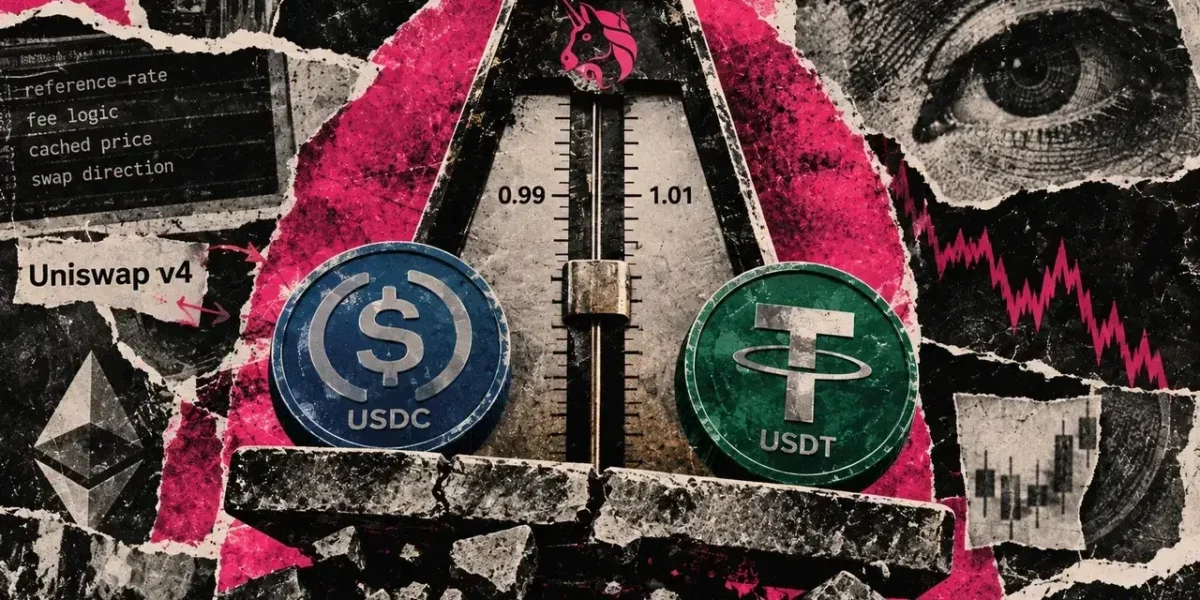
Uniswap’s StablePair fee hook aims to retain a higher share of value from rebalancing stablecoin pools on behalf of liquidity providers.
However, the rule determining which trade counts as a correction relies entirely on a configured reference rate.
StablePair operates as a Uniswap v4 hook—a contract designed to modify pool behavior. Its fee logic contrasts a cached pool price against a reference stored directly in the hook’s configuration. This setup prices trades around a set benchmark, leaving providers vulnerable if the economic value of a token drifts away.
Uniswap Labs unveiled two Ethereum pools, USDC/USDT and USDC/USDG, on Sept. 10. A subsequent explanation on Sept. 16 pointed out that providers allocating capital today are selecting both a fee mechanism and the specific token inventory it demands they hold.
What the dynamic fee captures
Deployment documentation outlines one-for-one reference rates for both pools. The fee execution path uses this stored reference alongside the pool’s price, without referencing any external market-price feed.
Inside a tight band around the reference, the fee shifts based on swap direction to establish a consistent bid and ask prior to price impact. When the pool sits squarely at the reference, both directions incur the designated optimal fee. As the price shifts toward an edge, the fee drops in one direction and climbs in the other.
For a basic example, suppose an optimal fee is set at one basis point (0.01%). At the reference point, a swap involving 10,000 input units incurs a fee of one input unit for liquidity providers.
Outside of this band, the fee structure divides trades according to direction. Any swap deemed to be moving farther away from the reference incurs a zero LP fee, whereas a swap that pulls the pool back toward the reference encounters a decaying fee.
A trade pushing the pool outward can yield a favorable price for LPs relative to that benchmark. Conversely, the counter-trade enables an arbitrageur to capture the spread by returning the pool price to baseline. A standard static fee rate charges both directions equally.
Instead, StablePair provides progressively more advantageous terms for corrective trades as time passes in blocks.
Should a trader accept the fee, LPs collect it while the trade rebalances the pool. Uniswap Labs states that this architecture captures the “vast majority” of rebalancing profit.
The initial swap in each block caches the pool price utilized for subsequent fee computations. While this eliminates any same-block fee advantage from splitting corrective swaps, later trades can encounter stale inputs. If the live price crosses the reference midpoint during a block, the cached classification might assign fees to the opposite directions until the next block begins.
Inventory risk and the evidence on returns
This boundary emerges when the external market ceases to treat the two assets as equivalent.
Consider a conditional issuer shock that diminishes the external value of one coin while the configured reference continues to assume a one-for-one exchange. Selling that depreciating coin in exchange for the stronger coin can push the pool further from the reference even as its price moves closer to external market realities.
Consequently, a trade categorized by the fee rule as moving away from the reference may actually represent genuine price discovery rather than a short-term imbalance.
The fee logic cannot independently verify issuer solvency or restore redemption value. This scenario remains strictly hypothetical and should not be interpreted as an indication of any current depeg, exploit, or loss within either StablePair pool.
If an LP retains 10,000 hypothetical coins and their external worth drops from $1 to $0.90 each, that inventory values out at $9,000—representing a $1,000 loss before fees. Earning income from rebalancing trades does not automatically offset this shift in token valuation.
Trades can also alter what the provider actually owns. Offloading a weaker coin into accessible liquidity depletes the stronger coin, leaving active LP positions concentrated in the depreciating asset. A trade classified as moving away from the reference incurs zero LP fee, leaving no fee revenue to compensate for that heightened exposure.
The exchanged amount still hinges on available liquidity, the provider’s selected range, and price impact. Furthermore, StablePair’s zero-fee classification relies on the cached price, meaning it should not be assumed that every sale of a weakening coin is free under all circumstances.
On Sept. 30, the Uniswap interface Stats panels recorded the USDC/USDT StablePair pool with approximately $6.1 million in total value locked and $117.9 million in 24-hour volume around 15:59 UTC. The USDC/USDG pool registered roughly $2.6 million and $8.7 million, respectively, around 15:57 UTC.
A comparable reference pool was available: the Ethereum USDC/USDT v3 pool charging a 0.01% fee showed approximately $34.2 million in TVL, $15 million in 24-hour volume, and $1,100 in 24-hour fees around 16:02 UTC.
Because these observations were unsynchronized, featured different fee structures and liquidity conditions, and the StablePair panels offered no absolute fee totals or realized position-level returns, direct performance comparisons are limited.
Economically speaking, verifying such return claims would demand matching periods, active liquidity ranges, fee income metrics, and inventory valuations. Volume metrics alone cannot prove whether an LP performed better than they would have in an alternative pool or simply by holding the underlying assets.
Governance controls the benchmark, with limits on the hook
Under Uniswap’s documented framework, governance maintains control over live fee configurations, implementation upgrades, and role administration.
Modifying the reference alters the benchmark applied for classifying and charging swaps. The deployment guide instructs integrators to fetch live configurations straight from the hook because governance retains the power to adjust parameters.
Certain boundaries restrict what upgrades can execute. The hook’s permanent address permissions expressly forbid remove-liquidity callbacks and custom accounting deltas.
According to Uniswap’s security documentation, upgrades cannot leverage those functions to restrict LP withdrawals or manipulate swap amounts to siphon extra fees. That said, the ability to withdraw funds does not guarantee the market value of the tokens received.
Uniswap notes that OpenZeppelin reviewed a non-upgradeable predecessor of the core fee mechanism between Feb. 9 and 13, 2026, successfully resolving the splitting issue via block caching. Subsequent upgradeability features and role structures fell outside the scope of that review.
Ultimately, StablePair alters the pricing structure for supplying liquidity aimed at rebalancing. For LPs, the remaining economic choice is to determine whether the underlying assets justify the reference baseline around which liquidity is provided, and whether the earned fees adequately compensate for the inventory held at the end of the day.
Frequently Asked Questions
01What is the Uniswap StablePair hook?
StablePair is a Uniswap v4 hook designed to retain more value from rebalancing stablecoin pools for liquidity providers by utilizing a configured reference rate to adjust fees dynamically.
02How does StablePair calculate fees?
The hook compares a cached pool price against a stored reference rate. Within a narrow band, fees shift based on swap direction. Outside this band, trades moving away from the reference incur zero LP fees, while corrective trades face a decaying fee.
03Can StablePair protect LPs from token depegging or price drops?
No. The fee logic cannot verify issuer solvency or offset losses caused by a drop in a token’s external market value.
04Who manages the reference rates for StablePair pools?
Uniswap governance controls live fee configurations, implementation upgrades, and role administration, including adjustments to the reference benchmark.