Ripple quietly made Brazil the center of its XRPL tokenization push
Ripple has quietly established Brazil as a central hub for its XRPL tokenization push, accounting for billions in real-world assets, strategic partnerships with local financial institutions, and innovative payment corridors.

Ripple’s footprint in Brazil encompasses both securities records and cross-border payments within a nation that Chainalysis ranked first for grassroots cryptocurrency adoption.
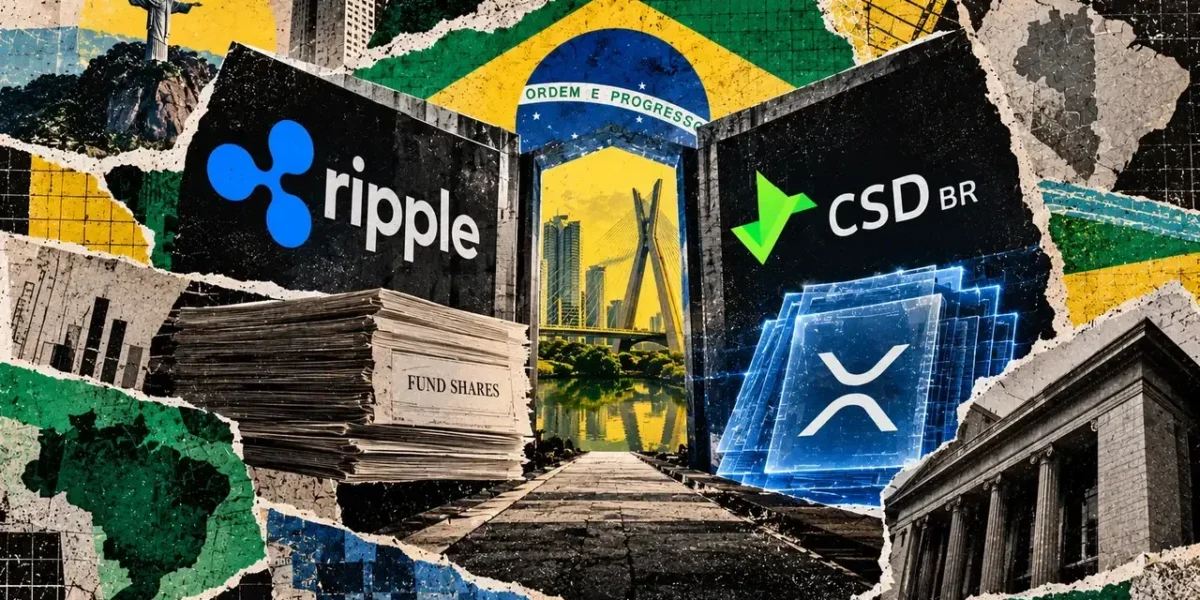
On Sept. 29, Ripple and regulated financial market infrastructure operator CSD BR revealed an initial phase to mirror ownership data for BTG Pactual investment fund shares on the XRP Ledger (XRPL). While these records will be reflected on-chain, CSD BR’s infrastructure stays the official system of record for deposit, registration, and settlement.
This news follows a Sept. 28 interview where RippleX executive Markus Infanger informed Estadão’s E-Investidor that Brazil accounted for approximately $2.7 billion of the $6.7 billion in tokenized real-world financial assets he tracked on the XRPL.
That proportion means roughly 40% of the tracked asset value resides in a single country, though this metric measures asset representations rather than transactional payment volumes.
Altogether, these milestones demonstrate how years of market expansion have integrated Ripple into multiple layers of Brazil’s financial framework. This presence spans firms managing investment assets, institutions moving funds, and platforms distributing stablecoins, each tracked by distinct performance metrics.
Ripple was building there before the ranking
Ripple established its Brazilian branch in 2019 and launched XRP-powered payment corridors alongside Travelex Bank in August 2022, preceding the current adoption ranking by several years.
When its partnership with Mercado Bitcoin launched in October 2024, it initially focused on internal treasury transfers between Portugal and Brazil. That rollout positioned corporate and retail international remittances as future services rather than immediate offerings.
By March 2026, Ripple broadened its Brazilian enterprise suite across treasury management, prime brokerage, custody, and payments. It highlighted Banco Genial, Nomad, and Braza Bank among its payment clients, while Ripio, Foxbit, and Mercado Bitcoin joined as platforms supporting or listing its dollar stablecoin, RLUSD.
In tandem with this growth, Ripple disclosed intentions to pursue a virtual asset service provider license in Brazil.
Individual firms frequently bridge multiple facets of this ecosystem strategy. For instance, Mercado Bitcoin announced in July 2025 that it would tokenize over $200 million worth of permissioned real-world assets on the XRPL, integrating an asset issuance dimension alongside its existing stablecoin and payment links.
The 2026 adoption index from Chainalysis places Brazil at the top overall, securing second place for cross-border transactions, third for domestic peer-to-peer activity and service flows, and fourth for overall crypto balances.
The revised evaluation model rewards balanced strength across all four categories. Securing the top rank does not imply Brazil possesses the biggest crypto market globally by absolute dollar volume, and methodological shifts restrict direct comparisons to prior years’ standings.
Between July 1, 2025, and June 30, 2026, Chainalysis calculated that Brazilian crypto activity reached $252.5 billion. Its Latin America report additionally noted a 1.6% contraction in Brazil’s crypto economy during that timeframe, indicating that leadership in adoption ran parallel to an overall market slowdown.
For Ripple, the most relevant insight lies in how local enterprises utilize digital assets. The analysis highlights Brazilian firms leveraging stablecoins for international money transfers and liquidity optimization—use cases that align directly with Ripple’s enterprise roadmap.
Beginning Oct. 1, regulatory rules in Brazil will prohibit virtual assets from clearing aggregated eFX transactions between foreign entities and local providers, though individual cross-border virtual asset transfers remain permitted.
From represented assets to financial infrastructure
Infanger’s disclosed XRPL asset metrics illustrate the tangible scale of the Brazilian operation. The $2.7 billion figure outlines the total worth of tokenized real-world assets anchored to the XRPL.
In October 2025, Ripple reported that VERT’s credit platform processed documentation, payments, and lifecycle activities on the XRPL and its EVM sidechain. At the time, its pension-receivables fund managed upward of R$200 million in net assets.
The partnership with CSD BR scales this integration deeper into core securities infrastructure. The inaugural phase utilizes XRPL tokens and Ripple custody to mirror ownership data for BTG Pactual fund shares, with participation limited to vetted Brazilian banking and corporate entities subject to strict anti-money-laundering and identity verifications.
Subsequent phases anticipate introducing native trading and issuance once the mirroring process undergoes validation. Presently, the initiative embeds Ripple within established financial workflows without replacing the authoritative securities ledger with a public blockchain.
Consequently, Brazil serves as a live proving ground for Ripple’s broader enterprise vision. While company statements highlight touchpoints across investment registers, custody, stablecoins, and payments, granular data regarding total active institutional users, RLUSD circulation, or aggregate payment volumes specific to Brazil remains undisclosed.
The long-term success of these integration efforts will depend on sustained transaction volumes and deeper utilization of the CSD BR network beyond initially reported asset valuations.
Frequently Asked Questions
01What is Ripple’s main focus in Brazil?
Ripple’s Brazilian operations span cross-border payments, digital asset custody, stablecoin distribution, and mirroring ownership records for tokenized investment funds on the XRP Ledger.
02How much tokenized asset value does Ripple have in Brazil?
According to RippleX executive Markus Infanger, approximately $2.7 billion of the $6.7 billion in tokenized real-world financial assets on the XRPL was located in Brazil.
03Is the XRPL replacing Brazil’s official securities register?
No. In the initial phase with CSD BR, ownership records for BTG Pactual investment fund shares are mirrored on the XRPL, but CSD BR’s systems remain the official record for deposit, registration, and settlement.