US court blocks victims from 127,000 seized Bitcoin, and petition rules are blamed
A US federal court blocked nine fraud victims from claiming 127,271 seized Bitcoin, ruling they lacked Article III standing due to insufficient links between their lost funds and the targeted wallets.

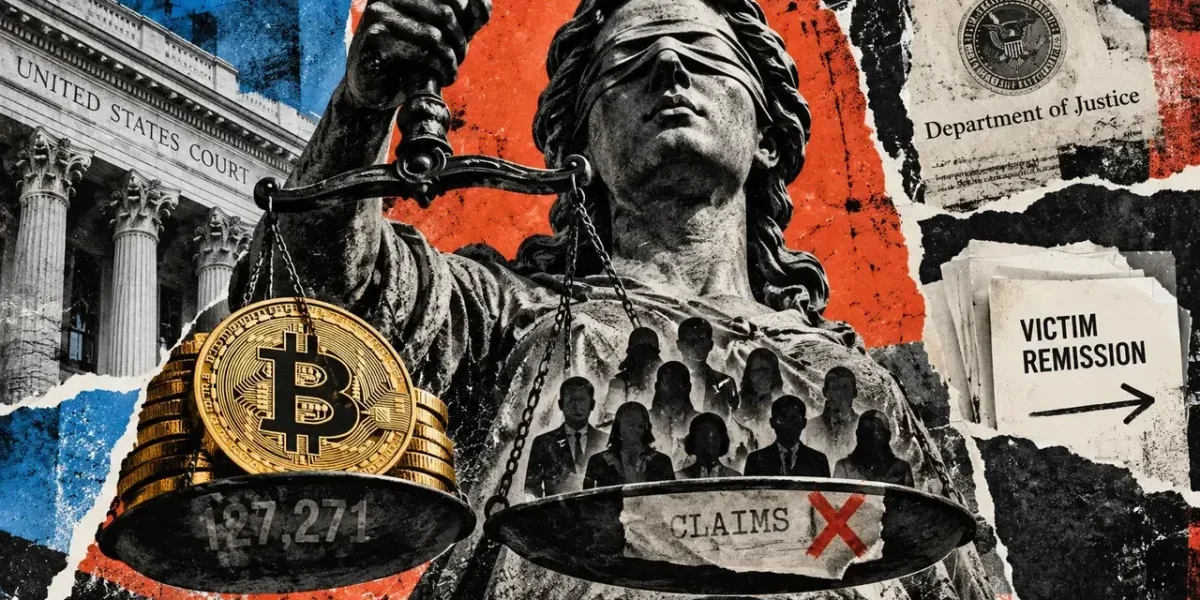
In a Sept. 25 order, Judge Rachel P. Kovner turned down the claims of nine purported fraud victims who attempted to challenge the forfeiture of roughly 127,271 Bitcoin.
Because their submissions failed to establish a plausible link between their missing money and the targeted seized wallets, these individuals must look to an alternative recovery path should the government prevail in the forfeiture proceedings.
The judge for the Eastern District of New York dismissed the timely claims submitted by Connie Wilson and Ath Leepinyo, while also refusing permission for seven additional claimants to file late. All nine failed to meet Article III standing, which is the legal requirement necessary to contest the case.
Proceedings commenced when the Department of Justice filed a civil forfeiture complaint on Oct. 14, 2025. At that time, the DOJ stated that the Bitcoin was held in US custody and asserted connections to fraud and money laundering schemes tied to Chen Zhi and Prince Holding Group, a Cambodian conglomerate.
The court viewed the allegations made by these claimants as establishing them, at best, as general unsecured creditors—individuals pursuing compensation who lack a qualifying property interest in the specific assets slated for forfeiture.
Suffering a loss linked to an alleged fraud did not equate to proving ownership of the coins housed in those specific wallets.
The ruling acknowledged that a constructive trust might grant a claimant standing and an equitable ownership interest, as this remedy can identify a property interest originating from an individual’s assets. Nonetheless, none of the claimants in this matter plausibly demonstrated the required connection between their personal funds and the confiscated Bitcoin.
As an illustration, Lawrence D. Van Dyn Hoven based his claim on an investigator’s assumption that his stolen digital currency formed part of the seizure. Judge Kovner noted that his legal filings presented no underlying facts to justify that belief.
What remission could provide
Should the government successfully forfeit the Bitcoin, Judge Kovner indicated that victim remission remains an option. This mechanism permits qualified victims to petition the DOJ for compensation out of the forfeited assets, even if they do not possess a current ownership claim to them.
Pursuant to 28 CFR 9.8, individuals filing petitions are required to substantiate a distinct financial loss stemming directly from the offense that prompted the forfeiture—or a connected offense—while also meeting additional criteria for eligibility. Such criteria mandate that petitioners did not knowingly participate in or benefit from the criminal act, nor did they engage in willful blindness.
Additionally, petitioners must prove they have received no compensation for their losses and possess no reasonably available alternative assets to recover their funds.
If the pool of forfeited property falls short of covering all accepted petitions, recognized victims may be granted proportional portions. Because remission limits payouts to a victim’s share of the related net forfeiture proceeds, the immense size of the Bitcoin seizure does not guarantee total reimbursement.
The Sept. 25 decision finalizes the standing status for these nine claimants. Their ultimate prospects for recovery hinge entirely on a successful government forfeiture outcome followed by a separate, discretionary ruling on a properly documented loss petition.
Frequently Asked Questions
01Why were the fraud victims blocked from claiming the seized Bitcoin?
The court ruled that the nine claimants lacked Article III standing because they failed to plausibly connect their lost funds to the specific wallets holding the seized Bitcoin.
02What is a constructive trust in this legal context?
A constructive trust is a legal remedy that can establish an equitable ownership interest in property derived from a person’s assets, but the claimants did not provide sufficient facts to prove this connection.
03What alternative recovery route do the victims have?
If the government wins the forfeiture case, eligible victims can pursue victim remission by petitioning the DOJ and documenting their direct financial losses under specific federal regulations.
04Does the large size of the Bitcoin seizure guarantee full repayment?
No. Remission is capped at a victim’s share of the net forfeiture proceeds, and if the property cannot cover all petitions in full, victims only receive proportionate shares.