Base’s Cobalt upgrade adds another rule to affect token balances
Base's upcoming Cobalt mainnet upgrade introduces the seizeWithMemo function, empowering B20 token issuers to configure balance seizures independently of standard transfer restrictions and administrative policies.

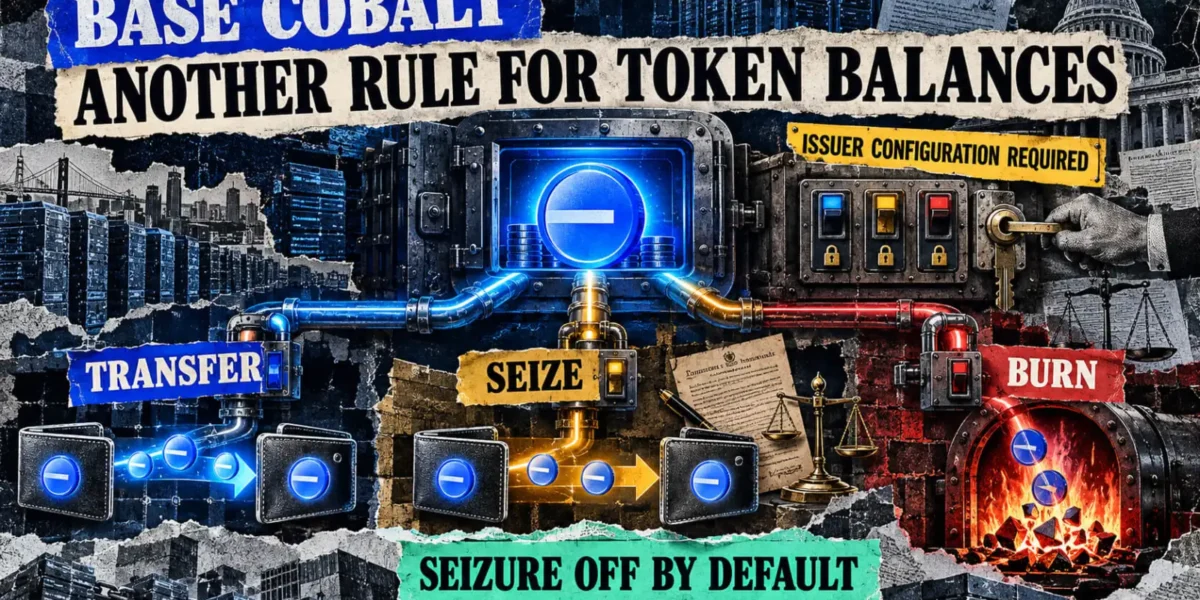
The Cobalt upgrade for Base, slated for the mainnet on September 30 at 18:00 UTC, will empower B20 token issuers to configure balance seizures independently of standard transfer restrictions. For any token activating this capability, holders might retain the ability to transfer assets while remaining subject to administrative reassignment.
B20 functions as Base’s native, ERC-20-compliant token standard available in both Asset and Stablecoin formats. While the standard previously granted administrators authority over roles and policies related to balance movements, it will now additionally govern administrative oversight powers concerning those same balances.
While role assignments specify authorized individuals for a designated power, policy settings dictate which accounts may be impacted by an operation. Furthermore, modifying a token’s rules involves permission checks that remain entirely distinct from executing a balance operation.
Separate seizure permissions
A new administrative operation known as seizeWithMemo facilitates the transfer of a designated amount from a holder to an alternative address. This function maintains the overall token supply while bypassing standard transfer policies and holder allowances.
Before an issuer can extract tokens using this function, they must configure which accounts forfeit their exemption. By default, the SEIZE_EXEMPT_POLICY setting exempts all accounts if left unconfigured. However, setting up eligibility alone is not enough; successful execution additionally demands the SEIZE_ROLE, an active and unpaused seizure function, an authorized recipient, and an adequate balance.
A distinct recipient policy dictates the destination of seized tokens, and leaving this specific policy unconfigured permits any otherwise legitimate destination. Ultimately, a holder’s capacity to execute a standard transfer has no bearing on either seizure-policy determination.
Existing B20 transfer policies evaluate both the sender and the receiver, alongside the executor when transactions occur on behalf of another account. Administrators retain the ability to modify these policies. Although approving a spender does not bypass the evaluations applied to ultimate transfers, these standard transfer permissions remain entirely separate from the new Cobalt seizure rules.
Additionally, B20 already features the burnBlocked function, which allows authorized callers to destroy tokens residing in accounts restricted by the transfer sender policy. Although Cobalt deprecates this specific function, it remains callable and preserves its current behavior.
Consequently, issuers are provided with multiple avenues for removing a holder’s balance. Reassignment relocates tokens to another address to keep them in circulation, whereas destroying the seized supply necessitates a subsequent burn action. Both seizure and burning operations operate with distinct administrative roles and separate pause controls.
According to Base’s status page, the mainnet upgrade is officially scheduled, featuring a maintenance window spanning from 18:00 to 20:00 UTC. The upgrade overview specifies that the Sepolia deployment went live on September 23, with the mainnet rollout planned for September 30.
The v1.4.2 release introduces Cobalt mainnet support, advising node operators to complete their upgrades by September 30 at 18:00 UTC.
Frequently Asked Questions
01When is the Base Cobalt upgrade scheduled to take place?
The Cobalt upgrade is scheduled for the mainnet on September 30, from 18:00 to 20:00 UTC, following its Sepolia testnet launch on September 23.
02What is the seizeWithMemo function?
The seizeWithMemo operation is a new administrative feature that moves a specified amount of tokens from a holder to another address, maintaining total supply while bypassing standard transfer policies and holder allowances.
03How does Cobalt handle the older burnBlocked function?
Cobalt marks the burnBlocked function as deprecated, though it remains fully callable and maintains its original behavior for destroying tokens held by blocked accounts.