S&P brings ratings-style scrutiny to $10 billion crypto vault market as $6 million Base incident exposes risks
S&P Global introduces the Vault Risk Assessment framework to evaluate $10 billion in crypto lending vaults following a $6 million security incident on the Base network.

S&P Global is introducing ratings-style risk evaluations for crypto lending vaults as this rapidly expanding market faces ongoing security challenges.
On Oct. 4, the ratings agency debuted its Vault Risk Assessment framework, establishing a uniform method to measure the probability of investors experiencing asset impairment within lending vaults. S&P notes that deposits in these offerings climbed to approximately $10 billion in September, marking a significant rise from $1.5 billion two years prior.
This rollout coincided with an alert from blockchain security firm CertiK regarding suspicious activity tied to an unidentified vault on the Coinbase-supported Base network.
The security firm reported that a newly launched proxy secured roughly 1,783 aBaswstETH—valued at approximately $6 million—from the vault before exchanging the tokens through Aave for roughly 1,783 wstETH.
The breach did not target Aave directly. Rather, it underscored a growing concern accompanying the rise of vaults: users can face hidden dangers stemming from the smart contracts, access permissions, and operators sitting between their initial deposits and the core lending protocols.
This exact nuance forms the foundation of S&P’s fresh framework. Vaults aggregate user funds and deploy them according to specific strategies, with choices executed either automatically via smart contracts or managed by human operators referred to as curators. In return, participants acquire tokens signifying ownership claims over the pooled capital and generated yields.
Vault growth brings new layers of risk
The evaluation system created by S&P analyzes six distinct categories: portfolio credit quality, liquidity mismatch, curator risk, blockchain risk, protocol risk, and vault security and governance.
This assessment aims to look beyond the immediate visibility offered by on-chain records, investigating instead how a vault might perform under shifting market conditions.
Such analysis gains urgency as vaults increasingly function as on-chain equivalents to traditional managed funds. According to S&P, these architectures can emulate the operations of money-market, private-credit, private-equity, and hedge funds while enabling pooled funds to run natively on blockchains.
Alongside this added versatility come expanded points of potential failure. While a user might ultimately have exposure to a major lending protocol, capital losses can still arise due to poor allocation choices by a curator, limited withdrawal liquidity, modifications to smart-contract permissions, or security flaws within the vault framework itself.
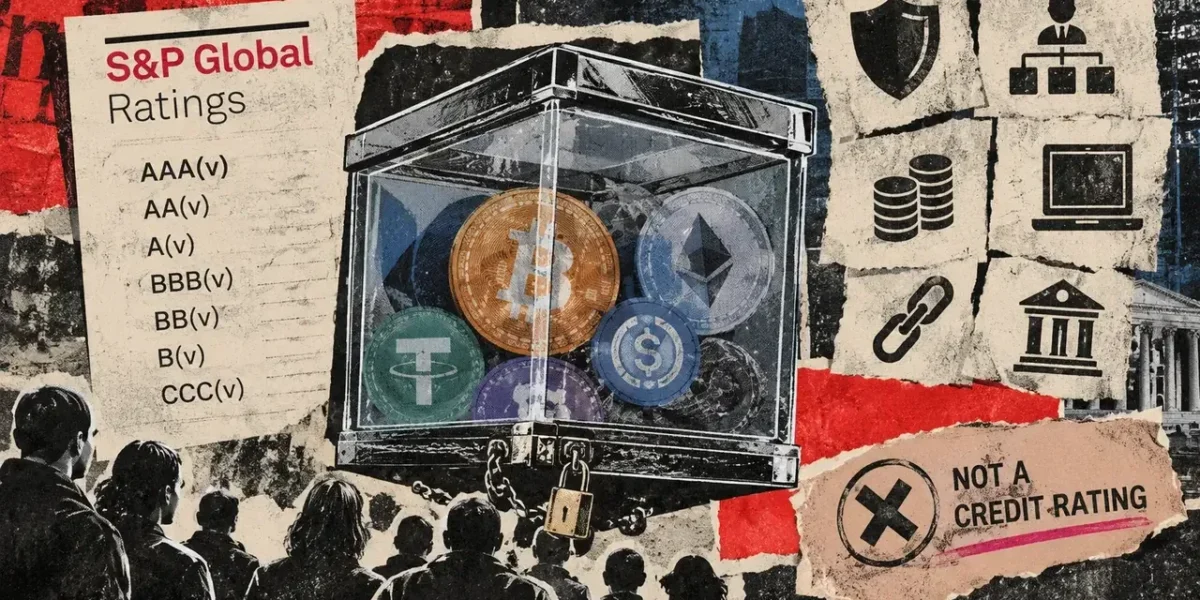
Evaluations issued by S&P feature a “(v)” suffix, where AAA(v) denotes the lowest category of relative risk. These evaluations do not constitute credit ratings, do not measure prospective yields, and do not ensure that participants will successfully reclaim their funds. Instead, the firm defines them as forward-looking opinions regarding the comparative likelihood of asset impairment.
Furthermore, these assessments can shift over time as eligible holdings, underlying risk levels, smart-contract parameters, or liquidity environments change. This grants S&P the flexibility to re-evaluate vaults whose designs become increasingly hazardous, even if their past on-chain history remains spotless.
The upcoming phase will begin when S&P starts releasing evaluations for specific vaults, with further details expected in future announcements.
Such evaluations could supply institutional capital allocators with a shared benchmark to evaluate strategies across a sector that has grown nearly seven times larger over a two-year span.
Additionally, these metrics could increase pressure on vault administrators if participants demand higher returns from lower-scored alternatives or channel their capital toward offerings with superior evaluations.
Frequently Asked Questions
01What is the S&P Vault Risk Assessment framework?
It is a standardized evaluation system launched by S&P Global to measure the relative risk of asset impairment for investors using crypto lending vaults, focusing on areas like liquidity mismatch, curator risk, and protocol security.
02Are S&P vault assessments considered traditional credit ratings?
No. S&P specifies that these evaluations are not credit ratings, do not forecast expected returns, and do not guarantee the recovery of invested capital. They are forward-looking opinions regarding relative impairment risks.
03How big is the crypto vault market?
According to S&P, deposits in these products reached approximately $10 billion in September, growing substantially from $1.5 billion two years prior.