
Bankers sue to overturn OCC trust-bank rule used by crypto firms
Community bankers have filed a federal lawsuit against the OCC to overturn its national trust bank rule, arguing the regulator overstepped its legal boundaries by granting charters to numerous cryptocurrency and fintech firms.

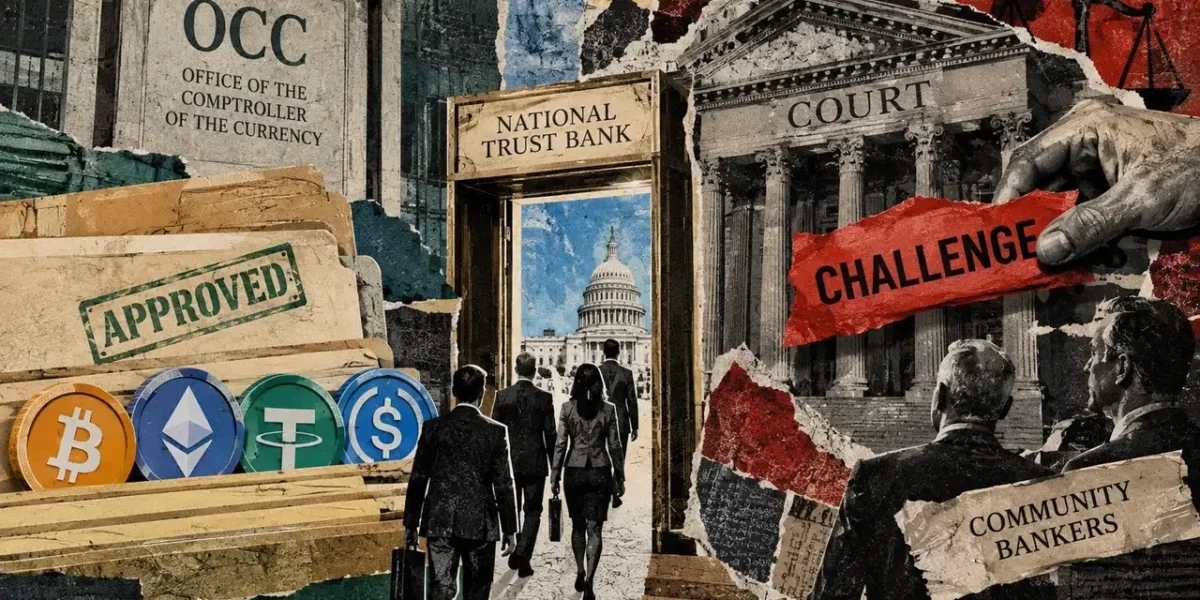
On Oct. 2, the Independent Community Bankers of America filed a federal lawsuit in Washington against the OCC, coming two weeks after the agency granted approvals to Agora National Trust Bank, Catena Trust Bank, and Bastion Platforms.
As reported by American Banker, the legal complaint requests that the court strike down the OCC’s national trust bank rule along with Interpretive Letter 1176. The lawsuit claims the regulator overstepped its legal boundaries by expanding limited-purpose trust charters to accommodate fintech and cryptocurrency companies.
According to the ICBA, the OCC has granted approval or conditional approval to 21 trust banks, with 13 of those entities connected to the crypto sector.
Banks lost the applicant-by-applicant fight against crypto firms
Banking organizations contested these applications on an individual basis, yet the OCC proceeded with approvals. In December 2025, five crypto-affiliated national trust applications secured decisions, including BitGo, Fidelity Digital Assets, First National Digital Currency Bank, Paxos, and entities linked to Ripple.
Additional approvals were granted to Bridge, National Digital Trust, and Foris DAX (the parent company of Crypto.com) in February, followed by Coinbase in April, and Laser Digital in May. Agora, Catena, and Bastion received decisions on Sept. 18, with several of these authorizations remaining conditional or preliminary.
The OCC enacted its final national trust bank rule in February, which took effect on April 1. This regulation swapped the phrase “fiduciary activities” with broader statutory language reading “the operations of a trust company and activities related thereto.”
The OCC maintains that this phrasing preserves its existing chartering authority and notes that national trust banks have historically engaged in certain nonfiduciary functions, such as custody. The agency points to 12 U.S.C. 24(Seventh) as the legal basis for nonfiduciary custody and associated activities.
Conversely, the ICBA complaint interprets the same rule as an improper stretching of a limited-purpose trust charter to encompass non-depository, non-fiduciary crypto operations under regulatory requirements that are lighter than those imposed on insured banks.
While an objection targeting Coinbase or Ripple seeks to block a single applicant, a lawsuit challenging the rule itself asks a judge to determine the outer limits of authority underpinning every charter relying upon it.
The OCC said a court would decide
Within its February rule text, the OCC referenced the Supreme Court’s Loper Bright ruling, noting that when an eligible party disputes whether the National Bank Act permits a national trust bank charter, the judiciary must apply independent judgment to the statutory question.
That specific judicial review is what the ICBA is now pursuing. The OCC spent 2026 issuing crypto trust charters while acknowledging on the record that the legal foundation would ultimately be settled by a court.
Regulatory exposure differs according to each business model: traditional fiduciary custody sits furthest from the controversy, whereas nonfiduciary custody, stablecoin issuance and reserves, payment processing, settlement, asset conversion, and execution lie closest to the center of the dispute.
Coinbase’s authorized plan encompasses digital asset custody managed in a fiduciary capacity alongside transactional services connected to those custodied assets. The OCC defended this structure as permissible under trust-company operations or related activities authorized by fiduciary rules and Section 24(Seventh).
Agora’s business strategy involves issuing dollar-backed stablecoins, managing reserves, offering nonfiduciary custody, and providing payment and settlement services. Catena merges custody, investment management, and trust operations with conversion, clearing, and execution functions, while Bastion delivers white-label stablecoin issuance, custodial wallet solutions, asset conversion, and issuer services.
The operational framework for Foris DAX combines asset custody with trade settlement and staking capabilities, and Bridge’s initial authorization covers custody, stablecoin issuance and orchestration, alongside reserve management.
The ICBA is requesting a vacatur alongside declaratory and injunctive relief. The ultimate impact on current charters relies entirely on the specifics of a judge’s ruling, including how the decision addresses final approvals, conditional authorizations, and activities backed by independent statutory authority.
The OCC reported in August that it had processed 40 de novo charter requests over roughly an 18-month span, with Comptroller Jonathan Gould stating that 23 of those submissions involved digital assets.
The regulatory body’s digital-asset licensing directory features several pending applicants, among them zerohash, Dakota National Trust Bank, Payward (Kraken), Lorum National Trust Bank, EDX Trust, and PAYO Digital Bank.
A primary uncertainty for each of these applicants is whether the OCC will continue evaluating their submissions under current parameters while the judiciary reviews the underlying rule.
Where the court crypto test leads
Should the court rule in favor of the OCC, the national trust bank framework will solidify as a federal pathway for cryptocurrency custody and stablecoin infrastructure.
Projections from JPMorgan estimate market volumes reaching $500 billion by 2028, whereas Coinbase targets a $1.2 trillion model by the close of 2028, and Standard Chartered anticipates figures hitting $2 trillion by that timeframe. Meanwhile, Citi’s projections for 2030 range from a base case of $1.9 trillion up to an optimistic scenario of $4 trillion.
For context, FDIC-insured institutions held approximately $20.7 trillion in deposits during the second quarter, meaning projections between $500 billion and $2 trillion represent roughly 2.4% to 9.7% of that total deposit base. For Bitcoin specifically, a regulatory victory would expand bank-supervised custody and settlement-focused services for institutional clients.
Conversely, if a court decides to vacate or restrict the rule or the associated letter, the fallout will hit business models reliant on stablecoin issuance, reserve holdings, nonfiduciary custody, conversion, payments, and transaction settlement the hardest.
Such enterprises might be forced to restructure their operations through corporate affiliates, state-chartered trust entities, or partner-bank agreements, while pending charter requests could encounter heightened scrutiny. While standard Bitcoin custody might remain accessible, the federal charter structure would lose flexibility regarding adjacent offerings like conversion, execution, settlement, staking capabilities, and collateral transfers.
The San Francisco Federal Reserve projects that Treasury demand from stablecoin issuers could roughly double to about $400 billion by 2030, giving these legal proceedings implications that stretch far beyond the crypto sector.
The extent to which nonfiduciary market infrastructure can legally operate inside a national trust bank is now a matter for federal judges to decide—precisely where the OCC stated the issue would ultimately resolve.
Frequently Asked Questions
01What did the ICBA lawsuit target?
The lawsuit filed by the Independent Community Bankers of America targets the OCC’s national trust bank rule and Interpretive Letter 1176, arguing that the agency exceeded its legal authority by expanding limited-purpose trust charters to fintech and crypto firms.
02How many crypto trust banks has the OCC approved?
The ICBA states that the OCC has approved or conditionally approved 21 trust banks, with 13 of those tied directly to the cryptocurrency industry.
03What is the potential market size for digital asset custody?
Projections vary by institution, with JPMorgan estimating $500 billion by 2028, Coinbase modeling $1.2 trillion by late 2028, Standard Chartered anticipating $2 trillion, and Citi forecasting between $1.9 trillion and $4 trillion by 2030.