
Bitcoin crashes through $81,000 buy wall as $1 billion crypto liquidation bloodbath unfolds
A cryptocurrency market selloff drove Bitcoin down near $80,000, triggering over $1 billion in liquidations primarily affecting long positions and impacting altcoins like Ethereum, Solana, and XRP.


A cryptocurrency market selloff drove Bitcoin down to an intraday low near the $80,000 threshold, instigating over $1 billion in liquidations that predominantly affected traders positioned for higher prices.
At the time of writing, the leading cryptocurrency traded around $80,744, marking a 3% decrease over 24 hours and a roughly 4% drop across the past week as it retreated from a recent push to reclaim $87,000.
According to figures from CoinGlass, the downward move generated $1.16 billion in liquidations throughout the crypto derivatives market over the prior 24 hours. Bullish long positions accounted for $1 billion of that aggregate sum, contrasted with $108 million in short positions.
These numbers highlight how swiftly market positioning deteriorates when falling valuations compel exchanges to forcibly close leveraged trades that fail to maintain required collateral. Such liquidations often exacerbate downward price action as exchanges offload assets or terminate long positions within an already weakening environment.
Selling pressure grew more severe over recent hours, with CoinGlass tracking nearly $700 million in liquidations across a four-hour window, which included $650 million in long positions. Altogether, 166,769 individual traders faced liquidation across the 24-hour timeframe.
Ethereum leads the over $1 billion liquidation rout
Even though Bitcoin’s descent captured primary market attention, Ethereum sustained the most substantial liquidation losses among large-cap cryptocurrencies.
Data from CoinGlass indicated that roughly $324 million in Ethereum positions were wiped out over 24 hours, outpacing Bitcoin’s $240 million in liquidations.
Ethereum dropped beneath $2,500, registering a 4% decline over the same timeframe and deepening its weekly loss to approximately 9.3%.
The single largest individual liquidation took place on Hyperliquid, where traders were forced to close an ETH-USD position valued at approximately $20 million.
As the market discarded leveraged bullish exposure, losses rippled across other prominent digital assets.
Solana dropped 7.2% over a 24-hour span to settle near $108.61, while XRP fell 5.7% to $1.35. BNB recorded a 4.9% decline, and Zcash experienced one of the steepest drops among major tokens, sliding 14%.
The heavier losses seen across multiple altcoins imply that the broader market is enduring deeper strain than Bitcoin’s standalone percentage drop implies.
This market shift follows earlier warnings that leverage levels throughout the altcoin sector had grown increasingly overextended.
Within its weekly market briefing published on Oct. 7, Glassnode noted that an expanding portion of large-cap altcoins maintained unusually high open interest relative to their overall market capitalization.
The analytics provider stated that this proportion had climbed to its peak level observed prior to the October 2025 crypto market crash.
Such positioning leaves market participants susceptible to additional forced liquidations should prices continue downward before leveraged exposures are successfully reduced.
Bitcoin’s newest investors rush coins to exchanges
This market tension is likewise apparent within Bitcoin’s on-chain metrics, which show newly acquired holdings increasingly migrating toward exchange platforms.
Data from CryptoQuant reveals that short-term Bitcoin holders routed upward of 50,000 BTC to exchanges during the daily 24-hour peak.
Out of that volume, more than 29,500 BTC was moved at a loss, translating to roughly 59% of the cohort’s overall exchange inflows.
CryptoQuant noted that the losses linked to these transfers marked the highest figures registered among short-term participants in nearly four months.
This activity highlights a degradation in market confidence among investors who acquired Bitcoin fairly recently and tend to react more sensitively to price fluctuations.
Substantial exchange deposits often point toward an intent to sell, particularly when participants transfer holdings while sustaining losses.
Nonetheless, such movements do not automatically guarantee immediate sales, though the uptick in loss-driven deposits introduces an extra potential layer of market supply just as leveraged positions undergo unwinding. This development also diverges from the profit-taking behavior that accompanied Bitcoin’s previous surge past $85,000.
Glassnode previously highlighted that short-term holders represented roughly 86% of exchange inflows on Oct. 4 as Bitcoin settled above that threshold, marking a one-year high for that category.
The transition from profit-taking to loss-associated transfers indicates that the market correction is increasingly impacting individuals who entered positions during the recent upward run.
Bitcoin’s $81,000 buy wall faces a crucial test
The pressing question is whether Bitcoin can muster sufficient buyer demand around $81,000 to absorb the mounting selling pressure.
In its Oct. 7 market evaluation, Glassnode pointed out a heavy concentration of resting buy orders positioned between $81,000 and $81,250 on the Binance spot order book.
These standing orders had built up starting Oct. 3 and formed the largest visible block of bids underneath Bitcoin’s prevailing market price.
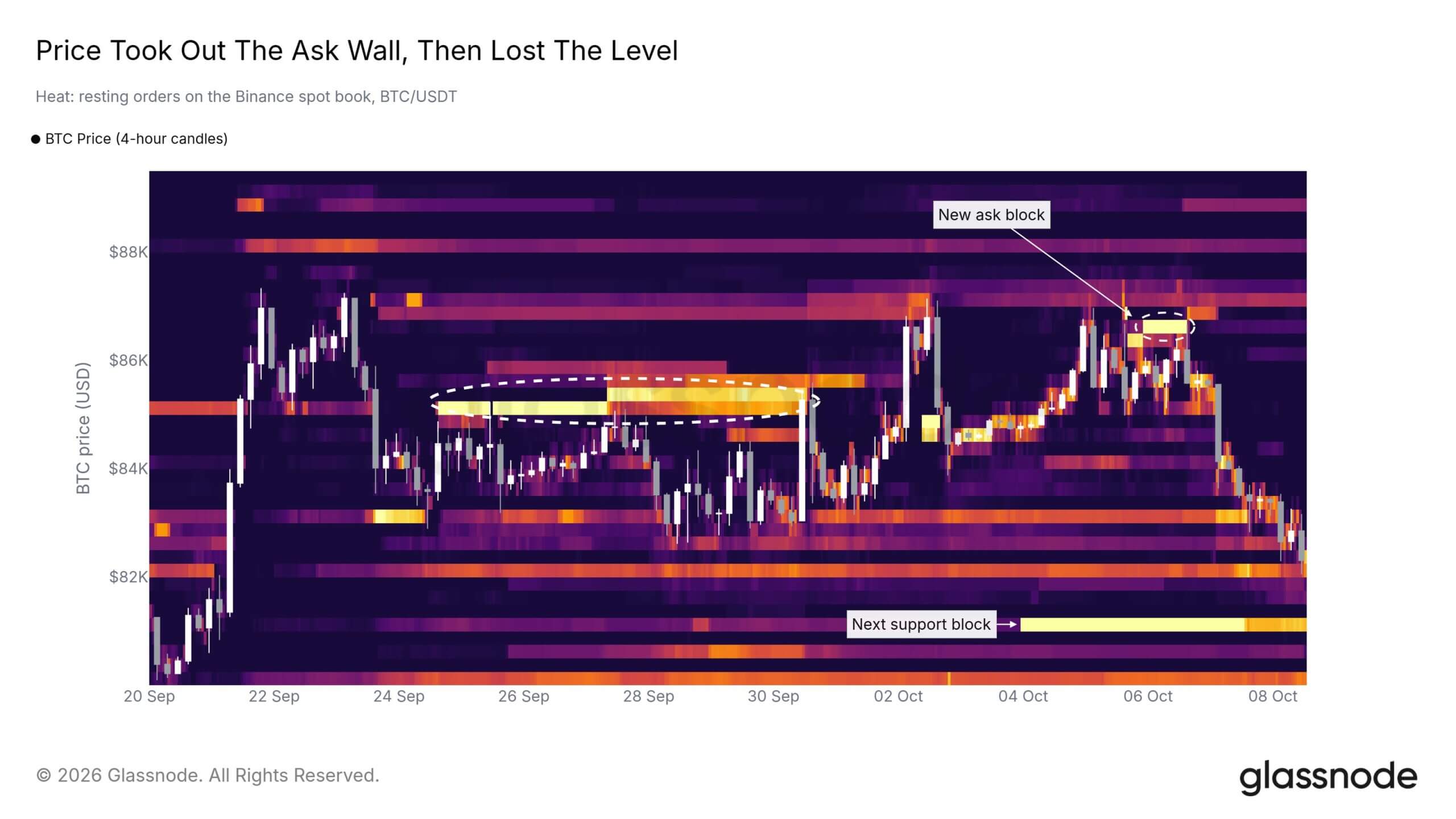
The firm designated this region as a critical support level after Bitcoin failed to break through sell orders sitting between $86,500 and $86,750, subsequently relinquishing the buying support established near $85,000.
However, bid concentrations do not guarantee price stabilization, as orders can be canceled, and persistent selling can easily overwhelm available demand.
Glassnode’s derivatives review flagged a dense cluster of potential liquidation thresholds ranging from $81,700 to $83,300, alongside an additional major cluster positioned near $75,000.
The latest downward movement has already pushed Bitcoin through a significant portion of this near-term band, leaving traders closely monitoring whether the buying interest around $81,000 can hold firm against further downward momentum.
A decisive break beneath the $81,000 bid area could drive Bitcoin lower once more, potentially shifting focus toward the deeper liquidation concentrations outlined by Glassnode.
Frequently Asked Questions
01What caused the massive crypto liquidation event?
The selloff was triggered by falling cryptocurrency prices that forced exchanges to automatically close leveraged trades—primarily bullish long positions—when they could no longer meet collateral requirements.
02Which cryptocurrency suffered the largest liquidation losses?
While Bitcoin’s drop drew widespread attention, Ethereum experienced the largest liquidation losses among major digital assets, totaling approximately $324 million over 24 hours.
03What are short-term Bitcoin holders doing with their coins?
Short-term investors transferred over 50,000 BTC to exchanges at the daily peak, with more than 59% of those exchange inflows moved at a loss—the highest loss-associated transfer volume in nearly four months.
04What is the significance of Bitcoin’s $81,000 price level?
Glassnode identified a large cluster of resting buy orders between $81,000 and $81,250 on Binance, creating a critical buy wall and support zone that must absorb ongoing selling pressure.