PumpFun is making millions from a market where 81% of memecoins crashed 90%
Solana memecoin launchpad Pump.fun continues generating millions in revenue even as a study reveals that 81% of established memecoins have crashed 90% from their all-time highs.

Solana-based memecoin token launchpad Pump.fun continues to pull in millions of dollars in revenue from trading activity, even as the vast majority of established tokens battle severe, long-lasting market slumps.
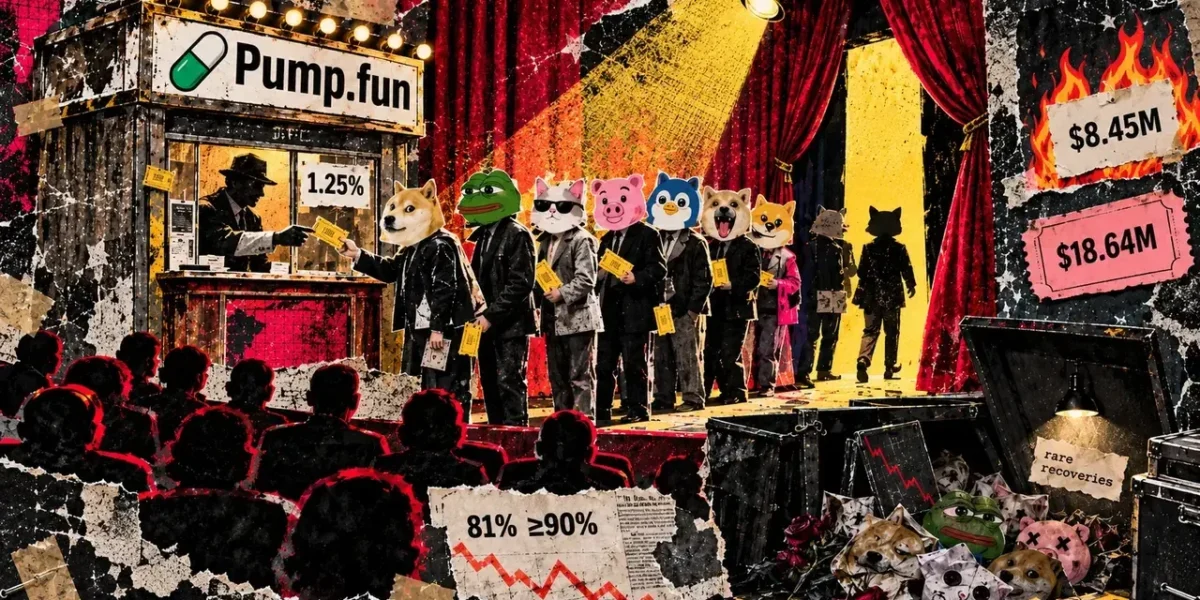
According to DefiLlama figures, the platform generated roughly $18.6 million in protocol revenue during the seven-day period leading up to Oct. 7. Meanwhile, a study conducted by Talos revealed that 81% of a selected sample of memecoins have plummeted by at least 90% from their all-time highs, with recoveries from such deep crashes remaining uncommon.
This dynamic highlights a core division within the memecoin ecosystem: trading volume across Pump.fun can consistently line the platform’s pockets, fuel PUMP token buybacks, or compensate specific users without rescuing an investor stuck holding a token that has lost all market demand.
For its survival analysis, Talos evaluated 150 memecoins, while 151 tokens were used for return comparisons. Each chosen asset was required to have active pricing data on at least one centralized exchange. Because this criterion naturally filters for relatively successful projects, the findings likely underestimate the total failure rate across the broader market of launchpad coins that never achieve centralized exchange listings.
Even within this stronger group of tokens, the financial damage was profound.
On average, the median token hit its peak value roughly 17 days after trading began on an exchange. Talos defined a collapse as a 95% plunge from that eventual peak, calculating a median timeframe of approximately 370 days between the high point and reaching that severe drawdown threshold.
Only a tiny percentage of collapsed tokens ever managed to climb back to their previous highs, and just five out of the 151 coins in the return sample stayed above their initial first-day price. Furthermore, Talos’ examination of major Solana memecoins showed that active addresses holding at least $1 worth of a token dropped to no more than 7% of their peak levels.
These trends indicate that market attention frequently drifts away rather than returning to salvage older holdings. Talos discovered that roughly two-thirds of the Solana-era memecoins analyzed never experienced a meaningful secondary rally following their initial surge.
Consequently, everyday traders face a financial reality entirely different from the business model sustaining Pump.fun itself.
Memecoin churn keeps Pump earning
Pump’s revenue generation relies on transactions happening somewhere within its ecosystem, meaning it does not depend on older tokens making a comeback.
When a trader dumps one fading cryptocurrency to jump into another, it triggers a brand-new fee-generating transaction. Fresh token launches, asset rotation, and speculative trading waves can successfully sustain platform income even while earlier buyers sit on heavy losses.
Data from DefiLlama indicates that traders paid roughly $52.5 million in total fees during the seven days ending Oct. 7, with approximately $18.64 million going directly to the protocol. Over a 30-day window, total fees hit roughly $184.5 million, while protocol revenue climbed to about $60.7 million.
Where that money ultimately ends up depends entirely on downstream distribution paths.
Pump’s fee model divides trading income among the protocol itself, token creators, and liquidity-focused participants. Its native PUMP token also benefits from a dedicated buyback-and-burn mechanism, exposing that specific asset to activity across the wider platform ecosystem.
DefiLlama tracked roughly $8.45 million worth of PUMP token burns over a seven-day span and $27.29 million over 30 days. Pump previously committed to dedicating a portion of designated revenue toward buying and burning PUMP tokens over a one-year period beginning in April.
However, this mechanism provides zero direct help to someone holding a completely separate memecoin.
For those everyday investors, financial recovery still relies heavily on fresh demand returning to the specific asset they own, finding enough market liquidity to sell it, and securing payouts large even to offset the token’s internal losses.
Even so, Pump.fun maintains that it is steadily increasing the portion of platform economics that flows back to users.
Alon Cohen, co-founder of the memecoin launchpad, reported that more than 140,000 users collectively brought in roughly $4.46 million over a recent 24-hour window. This total included $730,000 in Holder Rewards, $330,000 in Callout Rewards, and $3.4 million in creator fees.
“In time, Pumpfun will vastly outperform the social media industry in user payouts & rewards,” Cohen stated.
These distributions back up Pump’s stance that it is actively distributing trading revenues rather than hoarding them entirely at the protocol level. However, the three distinct reward categories target entirely different participants.
Creator fees are designed for the individuals behind the tokens. Callout Rewards compensate approved promoters and contributors. Meanwhile, Holder Rewards apply strictly to participating coins and do not automatically land in the wallet of every single person holding a Pump-launched asset.
That distinction becomes critical when token losses are weighed against incoming rewards.
A holder might collect platform distributions and still lose money overall if the underlying coin’s value drops at a faster rate. In the same way, a creator can rake in substantial trading fees even as buyers who piled in near the market peak suffer devastating drawdowns.
PUMP token holders navigate a separate financial formula. While buybacks drive demand and burns shrink circulating supply, the token faces its own market volatility and does not grant any contractual ownership claim over Pump.fun’s overall revenues. Additionally, scheduled token unlocks can introduce new supply into the market even as ongoing burns remove tokens from circulation.
Ultimately, the economics fracture as speculation flows through the platform. Pump can rake in earnings from aggregate trading volume, PUMP can capture a slice of that action through buybacks, and chosen creators or holders can pocket fee distributions. None of these factors guarantee financial recovery for an investor waiting for buyers to return to an aging memecoin.
That widening gap will only grow more significant as Pump expands its reward initiatives.
If distributions scale up enough to meaningfully compensate holders for plunging token values, they could fundamentally change the financial calculus of staying invested after the initial speculative hype dies down. If trading activity keeps shifting toward brand-new launches faster than rewards can accumulate in older ones, Pump may successfully convert endless market churn into steady revenue while many of the very traders fueling that volume remain trapped in positions they cannot exit at break-even.
Frequently Asked Questions
- What is Pump.fun? Pump.fun is a prominent Solana-based token launchpad that facilitates the creation and trading of memecoins.
- Why are memecoin prices failing? Studies, such as one conducted by Talos, show that a vast majority of memecoins suffer steep drawdowns—often dropping 90% or more from their all-time highs—as initial market attention fades and liquidity dries up.
- How does Pump.fun make money? The platform earns protocol revenue by taking a cut of the fees generated from the continuous creation, rotation, and trading of tokens within its ecosystem.
- Do rewards guarantee a profit for token holders? No. Receiving platform rewards or distributions does not guarantee a net profit if the underlying memecoin’s market value continues to decline at a faster pace.