
Chainlink CCIP 2.0 exposes bridge risk, and issuer gates trigger stalls
Chainlink CCIP 2.0 introduces optional Cross-Chain Verifiers, allowing token issuers to mandate extra validation before cross-chain transfers complete, exposing potential stalls if operators become unresponsive.

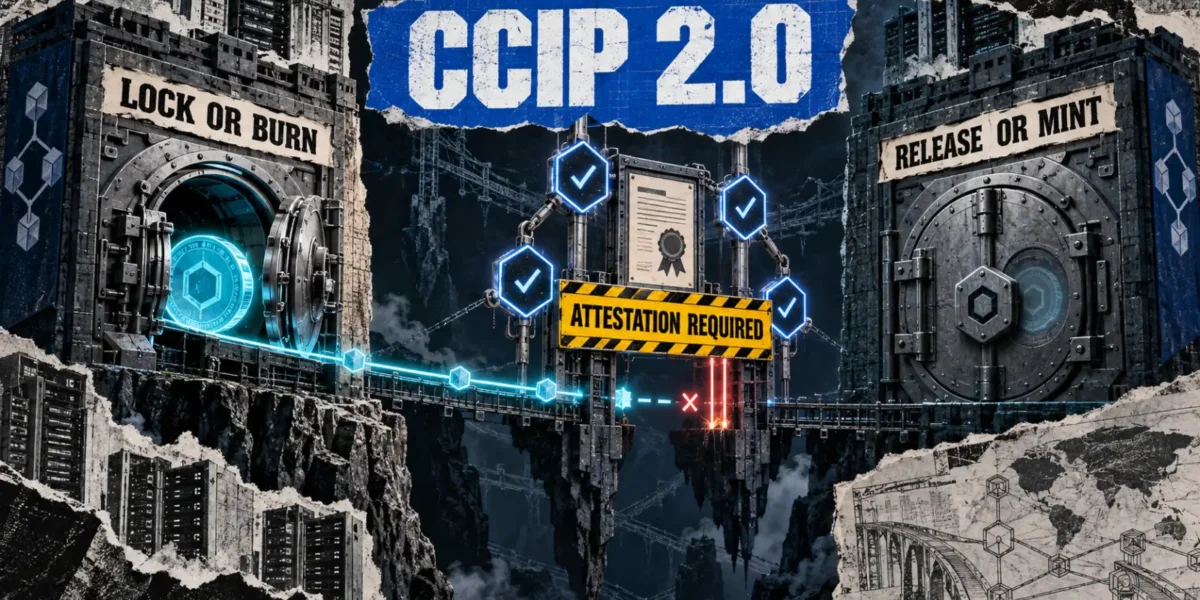
Chainlink’s CCIP 2.0 introduces the ability for a token issuer to mandate an additional verifier before tokens complete their transfer between blockchains. Because a sending pool may already have burned or locked the tokens by the time this validation becomes critical, the receiving chain cannot mint or release them without the verifier’s attestation.
Introduced on September 28, this functionality brings optional Cross-Chain Verifiers (CCVs) into the architecture alongside the default Committee Verifier provided by CCIP. Issuers or third parties are able to run these verifiers and make their authorization a strict requirement for delivery.
Consequently, the uptime and rules enforced by the operator directly influence a holder’s ability to exit. Chainlink’s introductory materials do not reference any specific production asset or route utilizing an issuer-run mandatory CCV, meaning this mechanism does not indicate that any actual holder transfers have been obstructed.
The point where a transfer can wait
The CCIP OnRamp gathers the necessary verifier criteria for a token transfer, and the corresponding token pool subsequently locks or burns the assets. The OnRamp then logs the message for offchain verification services.
These services monitor the source event, execute their verification and finality criteria, and release attestations linked to the specific message ID.
On the target chain, the CCIP OffRamp validates the mandatory attestations prior to the pool minting or releasing the tokens. These checks rely on the specific route and token-pool configurations, alongside any requirements dictated by a receiver contract if one is present.
Sender preferences may augment the verifier requirements on the source side. Transfers consisting solely of tokens lack a receiver callback that would otherwise impose additional verifier criteria. This operational flow ensures that locking or burning happens ahead of verification, while release on the destination chain occurs afterward.
Although a transaction on the source chain might succeed while delivery on the destination remains incomplete, Chainlink points out that every required CCV must yield valid outcomes for execution to move forward. Its trust framework highlights that a non-responsive verifier can cause every message dependent on its attestation to stall.
Should an issuer operate such a verifier and enforce it for their token pool, their service becomes a potential bottleneck capable of delaying completion. A third-party operator introduces an equivalent point of reliance under that specific entity’s management.
While the architectural design permits this level of control, it does not imply that any issuer has intentionally halted a holder’s transfer.
According to Chainlink, the standard Committee Verifier consists of 16 distinct node operators, operating alongside these supplementary CCVs.
Applications or issuers opting to use an additional check must evaluate who manages the associated contracts and offchain services, the specific rules those services enforce, and their ongoing availability.
Chainlink places the burden of implementation, upkeep, and uptime on external CCV operators. For asset holders, the critical inquiries involve determining which attestations are compulsory for a given token and route, as well as identifying the entities capable of generating each one.
What a holder can do when delivery stops
Destination-chain execution becomes permissionless once all necessary proofs are gathered and any optional verifier quorum conditions are satisfied.
While Chainlink’s standard executor typically submits transactions, anyone is permitted to submit them, including via the manual execution workflow. Modifying the executor or covering destination-chain gas fees does not bypass a missing mandatory CCV attestation; the OffRamp still verifies the proofs before minting or releasing tokens.
Recovery pathways depend entirely on where the message halted. If the required attestation is absent, the destination message stays UNTOUCHED, indicating that no execution has been logged. Conversely, if a submitted destination attempt fails within the guarded parameters of the OffRamp, it is designated as a FAILURE.
Chainlink notes that failed attempts can be run again after resolving the underlying issue. The standard executor automatically retries failures inside a designated timeframe currently capped at eight hours, which defines the limits of the automated system.
Holders only have access to a functional manual recovery route after the required proofs are secured and any destination-side errors are cleared. The manual execution documentation outlines procedures for reviewing execution states and verifier statuses, which includes scenarios where indexers fail to gather results from external verifiers.
The officially documented manual execution process from Chainlink does not outline any standard, automated mechanisms for canceling, refunding, or returning source-chain tokens if a mandatory verifier never issues an attestation. Any remedies specific to an issuer rely entirely on the arrangements established for that particular asset.
On EVM-compatible networks, a configured Chainlink Automated Compliance Engine (ACE) hook has the capability to reject outbound transfers prior to any locking or burning by the source pool. This preflight failure causes the source transaction to revert.
Alternatively, a separately configured postflight hook on the destination can decline minting or releasing operations after the source-side transfer has already commenced, keeping the assets undelivered until policy parameters are satisfied and execution is reattempted. The ACE integration documentation categorizes these as separate, optional configurations.
A live release, with deployment questions
Although Chainlink maintains a mainnet directory detailing supported tokens and networks, these listings do not indicate whether a specific production pathway utilizes an issuer-operated verifier or activates a destination ACE gate. Furthermore, partner announcements or historical asset migrations do not confirm these underlying settings.
Without clear visibility into the verifier configuration, route, and token pool, these new capabilities cannot be definitively linked to the issuer of any specific asset.
The rollout also introduces faster-than-finality (FTF) transfers as an option. While standard source-chain finality remains the default setting, the faster alternative can leave a transfer vulnerable to duplicate execution on the destination following a sufficiently deep blockchain reorganization, as detailed in the Chainlink FTF guidelines.
While other required CCVs may enforce their own reorganization policies, opting for increased speed does not remove the requirement for mandatory attestations.
Ultimately, CCIP 2.0 provides issuers with more robust mechanisms for defining cross-chain delivery terms. For token holders, the most pressing considerations involve understanding which validation rules affect their assets, identifying who oversees those controls, and determining what recovery options exist if a transfer stalls after initiation.
Frequently Asked Questions
01What happens if a required Cross-Chain Verifier (CCV) becomes unresponsive?
If a required verifier fails to provide an attestation, any messages depending on that approval will stall on the destination chain because the OffRamp cannot release or mint the tokens.
02Can users manually execute a stalled transfer?
Holders can use manual execution routes, but only after all necessary proofs are accessible and any destination-side errors are resolved. Manual execution cannot bypass missing mandatory CCV attestations.
03Are source-chain tokens automatically refunded if a verifier fails to attest?
Chainlink’s standard manual execution route does not feature an automatic cancellation, refund, or return mechanism for source-chain tokens if a required verifier never issues its proof.