
China’s crypto ban Is failing to stop a $176 billion P2P economy
Despite official bans from Beijing, China's underground crypto landscape has generated at least $176 billion, heavily driven by peer-to-peer stablecoin transactions and high wallet turnover.

Despite long-standing prohibitions from Beijing against digital assets, China’s underground cryptocurrency landscape is pivoting heavily toward peer-to-peer stablecoin transactions.
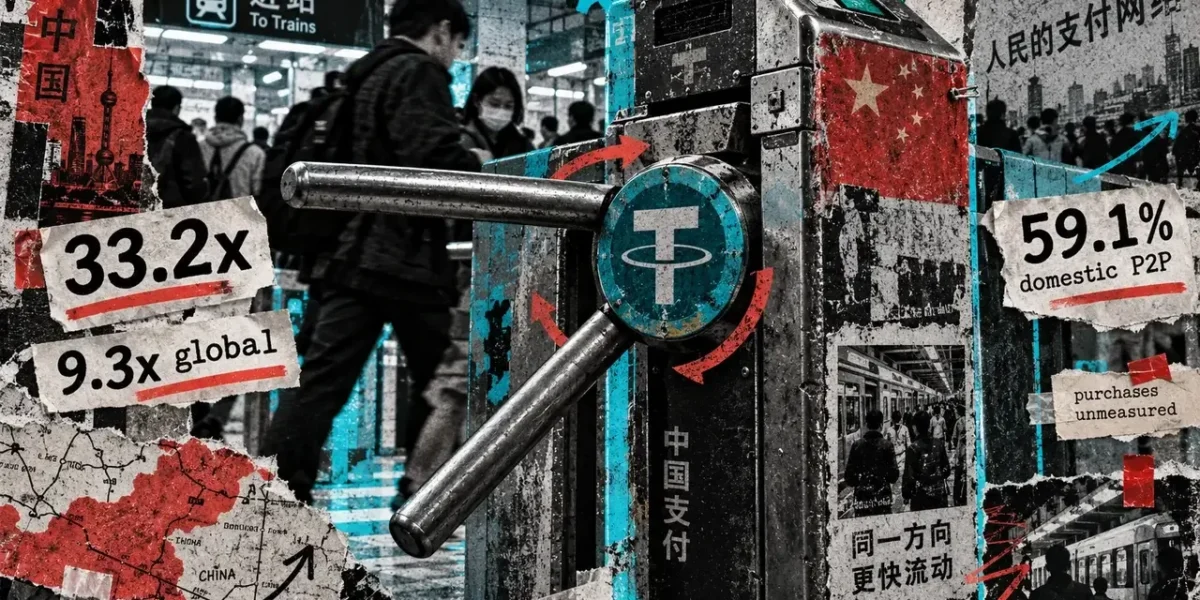
Data from Chainalysis indicates that China generated a minimum of $176 billion in crypto volume over the 12-month period ending in June 2026. Notably, 59.1% of this figure took place via domestic peer-to-peer transfers rather than through centralized platforms and exchanges.
This proportion was 3.5 times higher than the preceding timeframe, presenting a stark departure from the majority of major international crypto hubs, where centralized exchanges continue to serve as the primary gateways for participants.
Stablecoins dominate local activity in China
This transformation has been particularly pronounced within the stablecoin sector. Chainalysis reported that local stablecoin payment volumes began picking up momentum near March 2025, subsequently maintaining growth for 13 consecutive months. This points to a steady transition toward direct, wallet-to-wallet settlements domestically.
Monthly inflows of new activity grew from approximately $240 million in March 2025 to nearly $5 billion about a year later. Furthermore, this expansion spanned transaction sizes typically associated with everyday individuals and small enterprises, rather than being driven entirely by massive institutional movements.
Stablecoin transactions valued under $100 surged by 996% around the onset of this trend, whereas transfers ranging from $100 to $1,000 grew by 1,057%. Volumes between $1,000 and $10,000 experienced an increase of 1,321%, according to Chainalysis.
The blockchain intelligence enterprise noted that this timeline introduces the possibility that the deeper alignment of China’s social-credit network with financial and internet systems is motivating certain participants to execute transactions outside of conventional payment rails.
China broadened elements of its social-credit framework into the financial and digital spheres in March 2025. Chainalysis observed that individuals facing limitations on standard financial services might gravitate toward crypto, while others could leverage stablecoins to conduct business away from heavily monitored e-commerce networks and banking institutions.
The firm characterized this correlation as a working hypothesis rather than definitive proof of cause and effect. While ledger data accurately illustrates the timing and trajectory of asset movements, it cannot uncover the underlying motivations behind an individual’s choice of payment mechanism.
Stablecoins begin to resemble circulating money
The velocity at which stablecoins travel through wallets associated with China additionally implies that users may be utilizing them as functional transactional liquidity.
Chainalysis computed the annual velocity of self-custodied stablecoin balances in China at 33.2 turnovers. This rate exceeds three times the global standard of 9.3 and towers above every other regional market examined in the study.
By comparison, Japan registered a turnover rate of 9.9, Hong Kong logged 6.1, South Korea hit 5.1, and Taiwan recorded 3.5.
Wallets linked to China held a monthly average of roughly $3.1 billion in stablecoins during the studied period while transferring a cumulative $104.1 billion across 18.1 million separate transactions. These metrics demonstrate that the exact same reserve of tokens was continually recycled back into circulation instead of sitting dormant.
Such elevated turnover aligns with stablecoins operating effectively as settlement instruments or working capital, Chainalysis explained—a trend that could formalize as these tokens evolve into a domestic payment infrastructure.
This reliance on peer-to-peer frameworks sets China apart from neighboring jurisdictions, where digital asset ecosystems lean heavily on centralized and regulated services. Conversely, China’s strict bans have successfully funneled activity into direct wallet exchanges.
This dynamic introduces a complex obstacle for authorities in Beijing as stablecoins become simpler to transfer independently of domestic financial intermediaries. While curbs on exchanges restrict formal market entry, dollar-pegged tokens held in self-custody can freely circulate via private transfers and decentralized structures.
For crypto enterprises and stablecoin issuers, China remains a massive reservoir of prospective demand that stays challenging to address directly due to stringent national regulations. Consequently, expansion is likely to persist through self-custody, over-the-counter networks, and offshore platforms rather than traditional consumer-facing crypto firms.
The overarching question moving forward is whether this rapid pace will maintain its momentum as Chinese policymakers tighten oversight regarding digital financial transactions and payments.
Should lower-value stablecoin transfers continue their upward trajectory alongside robust wallet turnover, regulators could confront an expanding mass of dollar-backed assets moving fluidly outside the exchange architectures that past crypto prohibitions aimed to suppress.
Frequently Asked Questions
01Why are stablecoins growing in China despite the crypto ban?
Chainalysis data suggests that stricter integration of China’s social-credit system with financial and internet frameworks may be pushing some individuals and small businesses to seek alternative payment channels outside of monitored banking and e-commerce platforms.
02How does China’s crypto economy differ from other major markets?
While most major crypto markets rely primarily on centralized exchanges for entry and exit points, approximately 59.1% of China’s crypto activity occurs through domestic peer-to-peer transfers.
03What is stablecoin turnover, and why is it high in China?
Stablecoin turnover measures how frequently tokens are recycled back into circulation rather than sitting dormant. China-registered wallets recorded an annual turnover of 33.2 times—more than triple the global benchmark—indicating that users are treating stablecoins as operational working capital and transactional liquidity.