
ETH fee burns cover just 2% of new coins printed in 2026
Ethereum transaction fees have neutralized only 2.07% of newly minted coins in 2026, adding nearly 778,413 ETH to the total supply as discussions continue around gas limits and Glamsterdam upgrades.

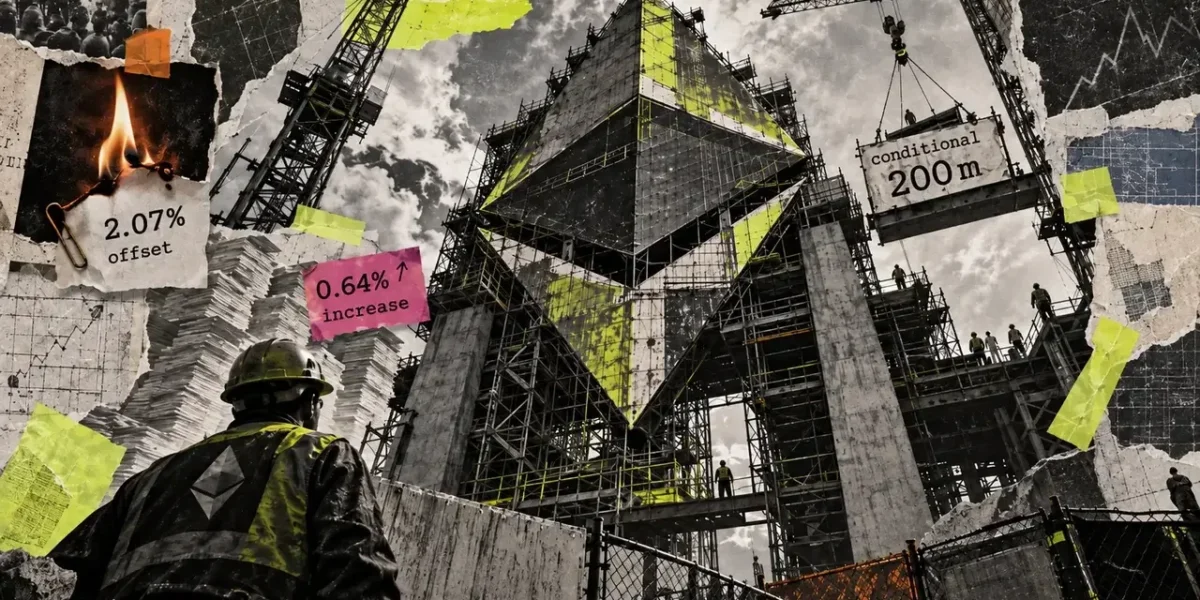
Based on an Oct. 9 supply ledger, Ethereum transaction fees have burned enough ETH to neutralize just 2.07% of the fresh coins minted in 2026.
Following fee burns, validator penalties, and other forms of removal, the network has added roughly 778,413 ETH, expanding its total supply by about 0.64% compared to the start of the window.
Expanding the gas limit allows necessary fee expenditures to distribute across greater activity, which reduces the required fee per gas unit and presents an obstacle for holders anticipating that scaling will drive up ETH scarcity. Developers are targeting a conditional maximum gas goal of 200 million following the Glamsterdam upgrade.
Drawing from a finalized accounting sample, an evaluation indicates that the execution base fee required to balance gross issuance sits at approximately 13.85 gwei given the current 60 million gas limit, or 4.16 gwei under a hypothetical 200 million limit.
Both scenarios demand a daily burn of roughly 2,992 ETH based on the model’s parameters.
What the 2026 ledger shows
Retained data from ethsupply.fyi spans from Jan. 1 at 00:00:11 UTC through Oct. 9 at 15:44:23 UTC. It documents 796,623.377 ETH in gross issuance against 16,524.553 ETH eradicated via execution and blob transaction fees.
An extra 1,685.919 ETH was eliminated via consensus penalties, alongside 0.059 ETH from miscellaneous execution destruction. Deducting these amounts leaves 778,412.846 ETH in net new additions.
These breakdowns explain why the fee-burn offset sits at 2.074%, while the total destruction offset is 2.286%. The higher figure accounts for penalties that do not stem from users paying for Ethereum network usage. Treating that larger metric as transaction-fee demand would exaggerate the amount of issuance users have successfully neutralized.
The service’s framework distinguishes newly minted validator rewards from execution base fees, blob fees, penalties, and rare removals via SELFDESTRUCT. Transfers, staking deposits, and withdrawals maintain overall supply while shifting existing ETH across user accounts or accounting layers.
The corresponding supply snapshot indicates roughly 122.116 million ETH. Removing the net additions points to an opening supply of about 121.338 million ETH at the start of the window, resulting in the roughly 0.64% increase.
While the 2004% offset addresses the aggregate 2026 period, current daily burn rates require a separate daily evaluation.
Ethereum’s EIP-1559 mechanism destroys the execution base fee tied to actually consumed gas. Priority fees route directly to block producers. Blob base fees also eliminate ETH, whereas MEV earnings and application revenues do not automatically transform into protocol burns.
The base fee, measured in gwei, dictates the amount of ETH burned per consumed unit. Applying an elasticity multiplier of two, a 60 million maximum gas limit corresponds to a 30 million target. A theoretical 200 million maximum would suggest a 100 million target if those parameters remain unchanged.
A finalized mainnet beacon block at slot 15,394,656 encompasses execution block 26,155,767, time-stamped Oct. 9 at 15:31:35 UTC under a 60 million maximum. The matching execution-block entry reports a base fee of roughly 0.335 gwei.
Supply impacts rely on consumed gas multiplied by its base fee, combined with blob burns and other destructions. Unused capacity expansion cannot burn ETH, nor does a higher transaction count inherently trigger a larger burn if those transactions consume less gas or incur lower base fees.
CryptoSlate’s Oct. 1 coverage previously established that Ethereum’s 200 million gas target is conditional, contingent on validators, and does not represent an automatic new limit. A Sept. 23 fee analysis also underscored the missing matched-period issuance denominator.
The same burn budget at two limits
For current context, the finalized-epoch accounting snapshot from ethsupply.fyi for epoch 481082, captured Oct. 9 at 15:31:23 UTC, logs 13.296472924 ETH in gross issuance over 32 slots. At 12 seconds per slot, this equals a 384-second window.
The calculation maintains a steady issuance pace, assumes every slot generates a block and consumes gas at the target rate, and initially sets blob burns, penalties, and other destruction metrics to zero. The resulting benchmarks outline the execution base-fee burn required to neutralize gross issuance under those specific conditions.
| Illustrative assumption or result | Current 60 million maximum | Conditional 200 million maximum |
|---|---|---|
| Gas target per block | 30 million | 100 million |
| Base fee needed at target consumption | 13.85 gwei | 4.16 gwei |
| Daily equivalent gross-offset burn | About 2,992 ETH | About 2,992 ETH |
| Base fee needed at half target consumption | 27.70 gwei | 8.31 gwei |
The daily projection scales the individual sample across 225 epochs, applying the resulting burn budget to a hypothetical day. Calculating actual daily issuance and burn demands a full day of observations, as an expanded gas target decreases the mandatory base fee by distributing the same ETH budget across a larger volume of consumed gas.
A more comprehensive zero-net-growth calculation factors in the sample’s 0.016575391 ETH in penalties and 0.000442673483 ETH in blob burns. Keeping those figures steady brings the execution thresholds down marginally to roughly 13.83 gwei and 4.15 gwei. The adjusted total transaction-fee burn budget following penalties comes out to approximately 2,988 ETH per modeled day.
If gas consumption remains static when the maximum limit climbs, the balancing fee does not drop. The half-target row demonstrates how arithmetic responds to consumed gas, though EIP-1559 automatically lowers base fees over consecutive blocks if consumption stays below target.
Real-time data indicates roughly 43.754 million ETH is held in active effective stake across 853,325 active validators. Because Ethereum’s supply dynamics tie issuance directly to staking participation, any future benchmark calculations will require a fresh issuance sample alongside metrics for gas and blob usage.
Glamsterdam is a capacity scenario
The Ethereum Foundation outlined 200 million gas as a feasible post-Glamsterdam goal in its May 11 protocol update. The upgrade’s proposer-builder separation and block-level access lists are intended to enhance overall throughput alongside modifications to gas accounting.
The Foundation’s testnet update on Sept. 28 placed Sepolia activation on Oct. 6 at 13:53:36 UTC, though Hoodi and mainnet rollouts remain unscheduled. The official roadmap leaves the mainnet timeline unconfirmed.
Adjustments to gas costs for execution and state growth mean a single gas unit may purchase differing amounts of computational work following the upgrade. Consequently, modeled limits cannot be directly translated into proportional increases in identical transactions, active users, or burned ETH.
For coin holders, the primary indicator to watch is whether burned fees and associated destructions approach or surpass issuance over a matching timeframe. Expanded gas availability provides room for activity, but creating a shrinking supply environment requires that activity to generate sufficient aggregate fee burns.
Growth in Layer-2 (L2) networks and shifts in staking balances remain distinct from fresh ETH acquisitions and settlement activity. This same principle applies here, as existing token holders can participate in staking and decentralized applications can expand without those metrics alone guaranteeing the necessary burn rate.
October ledger metrics show overall supply rising as developers push toward higher capacity limits. A sustained transition toward a contracting supply would require combined increases in consumed gas, execution base fees, blob burns, and stake-dependent issuance metrics.
Frequently Asked Questions
01Why are Ethereum fee burns currently covering only a small fraction of new coins?
Transaction-fee burns only offset 2.07% of newly issued ETH in 2026 because the volume of gas consumed and the associated execution base fees have not generated enough protocol destruction to match the rate of new coin issuance.
02What effect would a 200 million gas limit have on Ethereum’s base fee?
A hypothetical 200 million maximum gas limit would spread required fee spending across greater capacity, reducing the necessary execution base fee needed to offset gross issuance to about 4.16 gwei, compared to 13.85 gwei under the current 60 million limit.
03Does a larger gas limit automatically make ETH scarcer?
No. An expanded gas limit provides more space for network activity, but shrinking the overall token supply requires that activity to consistently generate enough aggregate burned fees to outpace ongoing issuance.