GPU की गिरती कीमतें AI होस्ट्स के लिए खतरा बनीं, और नए हेजेज मैदान में उतरे
Plunging GPU prices threaten AI hosts relying on rental income to service debts, prompting the introduction of AI compute derivatives and financial hedges to stabilize volatile revenues and manage hardware investments.

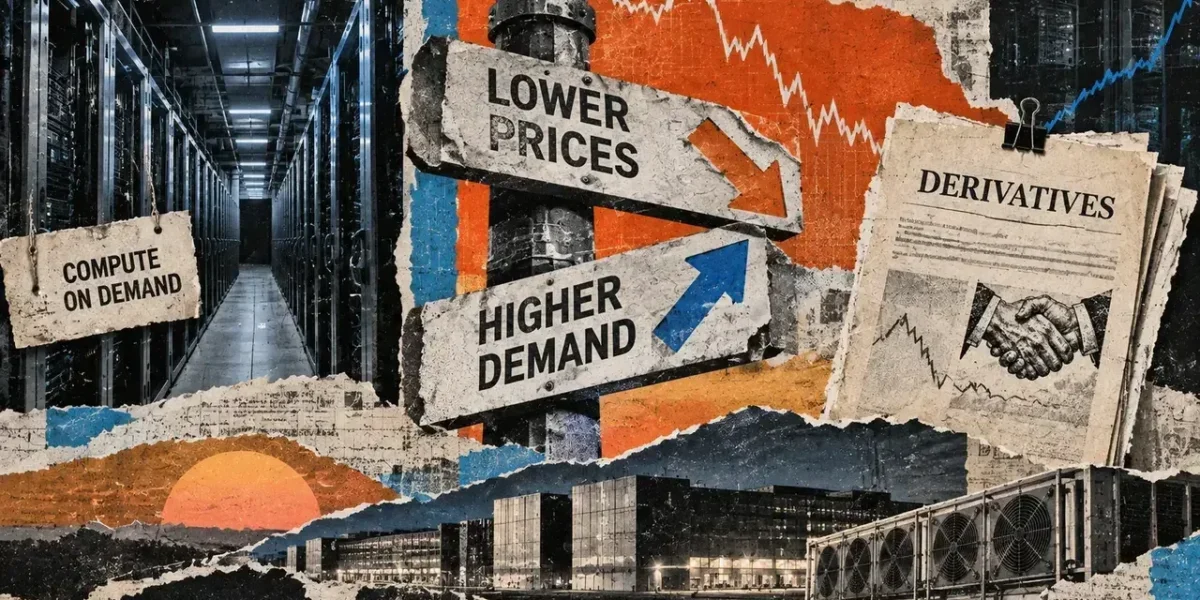
Organizations creating artificial intelligence applications can lease high-performance computers instead of purchasing the hardware themselves, paying for access to the graphics processing units (GPUs) that power their software.
While reduced rental costs make these applications more affordable to run, they simultaneously create challenges for the company that purchased the hardware and relies on that rental income to service its debts.
Financing a room full of GPUs under the assumption that clients will pay a specific hourly rate leaves operations vulnerable when a lower-cost competitor disrupts the financial model before the hardware is paid off. Although the machines may function perfectly and AI demand may remain robust, hourly earnings can drop below the revenue threshold required by the business.
Financial agreements can safeguard a portion of that revenue by triggering a payout when rental rates decline, in exchange for assuming matching obligations. This concept underpins AI compute derivatives, which allow companies to trade their exposure to computing costs independently from the physical lease of the computers.
Luxor, a firm offering services and financial products to Bitcoin miners, integrated these agreements into its recent expansion into the AI sector. The company aims to apply its background in hedging mining revenue to another industry that invests heavily in hardware before knowing its exact returns.
Representatives told CryptoSlate that the firm is actively brokering deals between compute capacity providers and end users.
Nonetheless, the cash-settled derivatives division remains in its early stages, and the firm noted it could not supply a customer hedge example or current trading volume figures because a liquid market has not yet developed.
Consequently, this promising concept faces the difficult commercial hurdle of convincing market participants to absorb losses that another enterprise wishes to avoid.
Successfully implementing this framework could assist operators in planning around steadier revenue streams, though the safeguard remains only as reliable as the pricing index used for calculations and the financial stability of the paying party.
Locking in the rent without locking in a customer
The conventional method for stabilizing rental income involves signing a client to an extended agreement at a fixed rate. This grants the client system access while giving the operator a dependable commitment for business planning.
This model succeeds when both parties seek identical terms, but clients cannot always predict their long-term computing needs. Operators may also prefer retaining the flexibility to sell capacity to various users.
Cash-settled derivatives provide an alternative by distributing funds based on a formula without requiring the physical exchange of computing resources. Operators can continue leasing GPUs to clients while deploying a separate financial contract to offset shifts in market rental rates.
Consider an operator projecting the sale of 1 million GPU-hours in a month, where one GPU-hour represents access to a single processor for an hour. At a rate of $2 per hour, revenue reaches $2 million, prompting the operator to enter a theoretical agreement designed to secure that baseline.
If the established market benchmark drops to $1.50, the contract compensates the operator for the 50-cent difference across the million hours, totaling $500,000. Assuming actual rental revenue similarly falls to $1.5 million, this payout restores the total to $2 million prior to fees and additional expenses.
Because the obligation operates bidirectionally, an increase in the benchmark to $2.50 requires the operator to pay out $500,000 despite collecting higher customer earnings. The operator sacrifices upside potential at higher rates to secure protection against downward fluctuations, simplifying revenue forecasting.
This simplified math illustrates the mechanism, though actual outcomes depend on the operator successfully selling the anticipated hours at rates that track the benchmark. Unused machines yield no rental income, meaning fixed hourly pricing does not guarantee customer acquisition.
Counterparties require an incentive to take on the opposing side of these payments, a motivation that AI enterprises facing rising computing expenses might possess. Their financial contract would pay out when the benchmark rises to offset larger rental bills, while price drops would generate payment obligations alongside cheaper computing rates.
Dealers can bridge these interests or absorb portions of the exposure directly, charging fees for the risks involved. However, clients require pricing tailored to their desired protection level and operational timeframe.
CME Group is pursuing an exchange-traded model via its announced H100 and B200 rental-index futures. Its August 11 announcement targeted an October 5 launch, pending regulatory review, for contracts tied to Silicon Data GPU rental benchmarks, though product listings alone cannot guarantee sufficient trading liquidity.
Your GPU hour might be different from mine
Even with willing counterparties, payment formulas require reference pricing that both sides accept as relevant to their operations.
In the previous scenario, the hedge functions ideally because the operator’s rental income fluctuates in tandem with the benchmark. Real-world conditions, however, rarely achieve such perfect correlation once actual clients are introduced.
Suppose clients negotiate rates down to $1.25 while the benchmark only declines to $1.50, potentially because the index evaluates an alternative service tier or hardware variety. The identical $500,000 hedge payout would lift $1.25 million in rental revenue to $1.75 million, creating a financial deficit despite the contract executing correctly.
This discrepancy is known as basis risk, occurring when a protected price fails to track the actual realized price precisely. Because compute hedges can expose Bitcoin miners to similar variances, every hedging strategy must be evaluated against the specific operational context of the user.
Luxor drew parallels between its AI strategy and its work in Bitcoin mining, where establishing a public reference price built a foundation for financial instruments. Its hashprice metric estimates earnings per unit of computing power in Bitcoin mining, offering operators a unified revenue standard even when individual operating costs vary.
While Bitcoin miners execute identical network operations, AI workloads attribute differing values to resource access that appears uniform on a specification sheet. Purchasing uninterrupted access for months constitutes a fundamentally different service than utilizing short-term computing jobs that can be interrupted whenever providers need hardware reclaimed.
Existing price providers account for such variables, with CCIR’s rental-data methodology treating interruptibility and commitment duration as distinct parameters. Utilizing publicly advertised rates means these metrics may overlook privately negotiated discounts.
The index provided by Luxor in its response was the AI Hardware Price Index, which tracks advertised rates for selected GPU systems. Although useful for evaluating equipment investments, acquisition costs and rental revenues involve separate pricing mechanisms, leaving the exact settlement mechanics for an AI rental hedge unestablished.
Luxor’s August data disclosures indicated that expanded compute spot pricing data is forthcoming. Operators seeking revenue protection must still utilize contracts tied to rental benchmarks that reliably mirror customer pricing.
Narrower benchmarks may offer tighter alignment, but additional contracts fracture trading liquidity among smaller subsets of participants. Establishing this market requires balancing individualized contract customization with pooling sufficient volume to keep trading accessible and affordable.
The protection has to survive the bad month
Even a tightly calibrated contract leaves operators dependent on counterparty solvency when rental income drops.
If the counterparty derives substantial revenue from AI infrastructure as well, falling computing costs could impair both enterprises simultaneously, precisely when financial support is required.
Collateral requirements can mitigate this risk by mandating cash or eligible assets to cover potential liabilities, providing a reserve if a counterparty defaults. This simultaneously creates financing demands, as funds locked in hedges cannot service other operational expenses.
In scenarios where rental prices rise, operators might need to settle hedge obligations before clients fulfill their elevated invoices.
The overarching financial model can remain viable despite cash flow crunches, making the timing of liquidity a critical factor in the affordability of risk protection.
Luxor did not disclose requested AI collateral terms or outline procedures for handling counterparty defaults. Its statement also omitted details on how it separates proprietary trading activities from brokerage services arranged for clients, a notable consideration given that its launch announcement featured an internal compute trading fund.
Enhanced revenue predictability can improve an operator’s confidence in meeting debt obligations, even when clients resist historical pricing models.
Realizing these benefits demands contracts that track earnings accurately, supported by payment liabilities the operator can sustain across the targeted protection window.
While cheaper computing expenses enable broader AI development and adoption, they may yield disappointing returns for hardware owners.
Financial derivatives cannot eliminate these losses, but they can transfer a portion of the risk to entities equipped to bear it, granting operators greater operational flexibility when rental revenues contract.
अक्सर पूछे जाने वाले प्रश्न
01What are AI compute derivatives?
AI compute derivatives are financial contracts that let businesses trade their exposure to computing and GPU rental prices separately from the physical leasing of the hardware.
### What is basis risk in GPU hedging?
Basis risk occurs when the financial benchmark used for a hedge does not move in exact sync with the actual rental prices or revenue a business receives from its customers.
### Who is offering AI compute derivatives?
Companies like Luxor, which expanded its Bitcoin mining financial services into the AI sector, and exchanges like CME Group are working on or offering compute-related derivatives and futures.