
द ब्लू इकोनॉमी: द वर्ड्स क्वाइटेस्ट इकोनॉमिक इंजन एंड इट्स स्मार्टेस्ट सिटीज़
$2.6 ट्रिलियन के मूल्य वाली, नीली अर्थव्यवस्था (ब्लू इकॉनमी) में तट और महासागर-आधारित उद्योग शामिल हैं जो स्टार्टअप्स और बंदरगाहों के नेतृत्व में डिजिटलीकरण, स्वचालन और टिकाऊ समुद्री नवाचार द्वारा संचालित भारी वृद्धि का अनुभव कर रहे हैं।


By Alberto Onetti
The “blue economy”—which spans ocean- and coast-based industries ranging from fisheries and shipping to marine biotechnology and offshore energy—stands as one of the world’s most massive yet overlooked economic powerhouses.
For startups, this sector presents distinct avenues to revolutionize resource management, energy production, and goods transportation.
Expanding twofold over a mere 25-year span, the blue economy now commands a $2.6 trillion valuation. To put this scale into perspective, if it were an independent nation, it would rank as the fifth-largest economy globally. As society pivots back to maritime solutions to confront pressing modern challenges—ranging from climate resilience and shifting energy costs to geopolitical friction—the blue economy is poised to take an even more central role.
Significant “blue technology” disruption is actively reshaping how marine value is generated, driven by automation and digitalization, the clean energy transition, environmental imperatives, and breakthroughs in marine biotechnology.
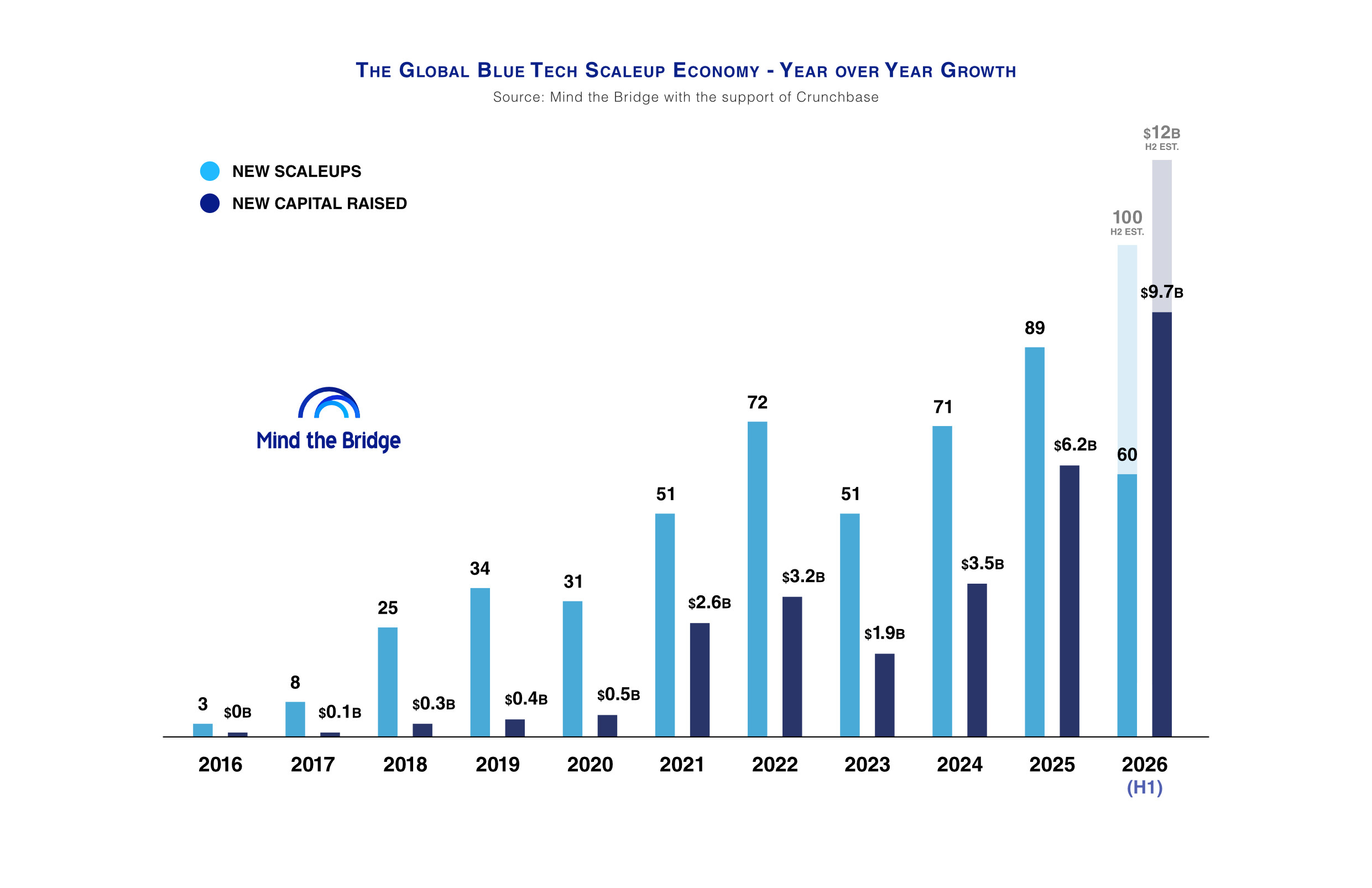
Capital deployment into these innovations is likewise surging, with a strong focus on sustainable growth. According to data tracked in the “Rethinking the Blue Economy” report by Mind the Bridge, developed with Crunchbase’s support, blue tech companies secured nearly $10 billion through the third quarter of 2026. This figure already surpasses the $6.2 billion raised during the entirety of 2025, propelled largely by substantial funding rounds for maritime-focused defense companies.
Blue tech: A sector defying global slowdown
Defying broader contractions across the global innovation sector, blue tech has maintained a steady upward climb since 2021. The industry has consistently generated roughly 70 new scaleups annually, with acceleration picking up pace over the past two years. Early projections for 2026 indicate that approximately 100 new blue tech scaleups could emerge before the year closes.
This momentum is equally visible in financial metrics. Blue tech funding reached $6.2 billion in 2025, marking a 100% increase over the previous year. By Q3 2026, global blue tech scaleups had already pulled in nearly $10 billion in fresh capital, putting the sector on track to exceed $12 billion by year’s end.
This growth is largely fueled by major maritime resilience transactions involving infrastructure and defense firms, such as Helsing (which raised $1.8 billion in 2026) and Anduril Industries (which secured $5 billion in 2026).
Not all blue tech is the same
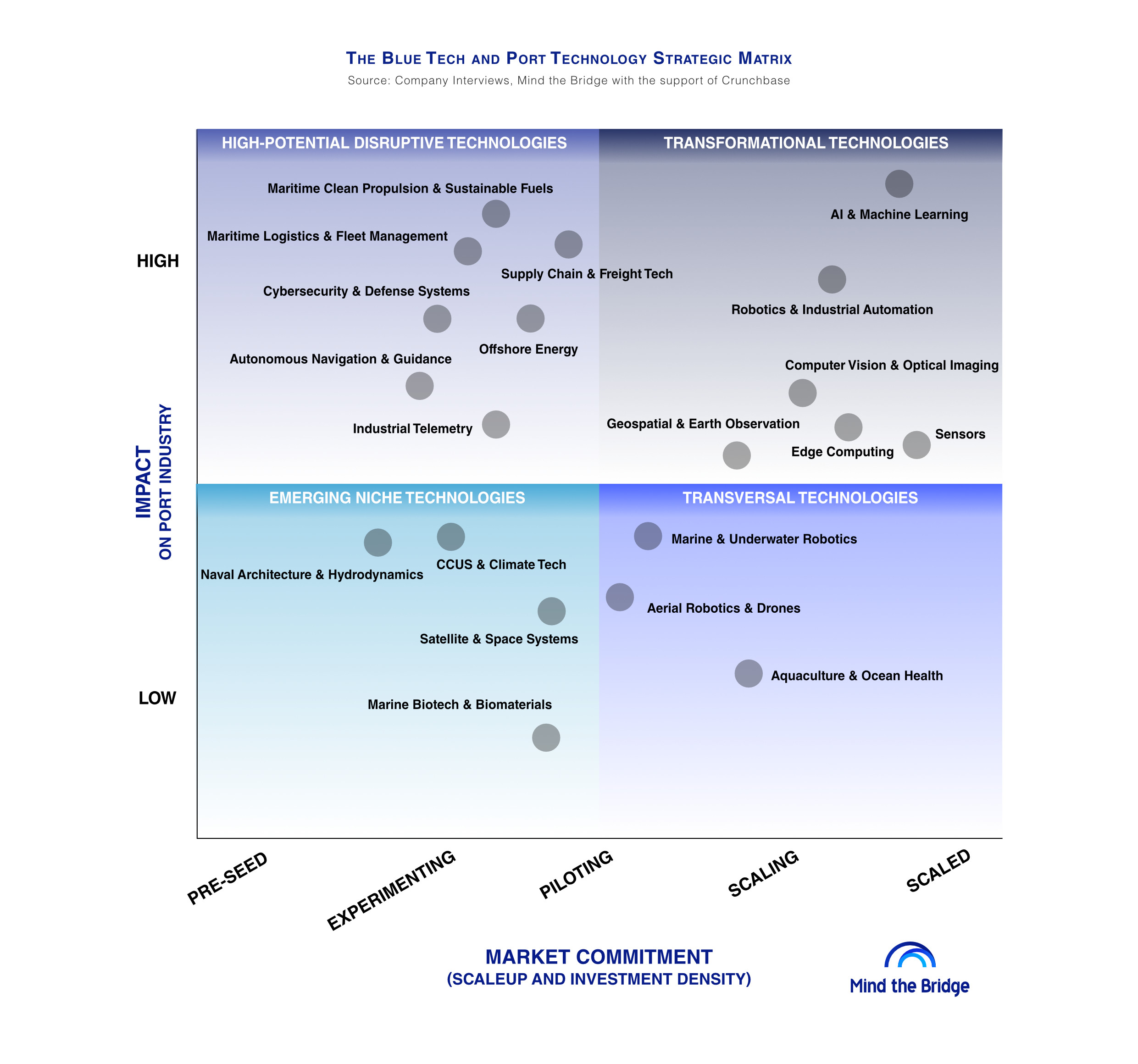
Because blue tech represents a broad umbrella covering diverse maturity levels, every unique technology created by these scaleups was categorized into 20 distinct groups for evaluation.
Each group was subsequently analyzed across two metrics: market commitment (measured by scaleup density and total invested capital) and overall industry impact.
The resulting matrix highlights:
- Transformational technologies: Highly impactful and relatively mature solutions. Artificial intelligence, machine learning, robotics, and industrial automation occupy a prime position here, boasting high impact, robust capital investment, and a density of over 200 scaleups backed by $20 billion in cumulative funding.
- High-potential disruptive technologies: Emerging categories with lower current scaleup density and moderate investment levels, typically ranging from $3 billion to $5 billion across roughly 50 scaleups per cluster. Standouts in this tier include freight tech, supply chain solutions, sustainable fuels, and maritime clean propulsion.
Remaining quadrants comprise emerging niche segments and transversal technologies that exert a more indirect industry influence.
Ports: the ‘smartest smart cities’
The ultimate question remains: Who will successfully navigate this blue economic shift?
The short answer is ports.
Acting as localized “blue economies,” ports represent the exact convergence point for forces transforming maritime activity. In many respects, they function as the ultimate “smart smart cities”—dense, intricate ecosystems where data, energy, logistics, people, and mobility intersect. They serve as ideal testing grounds where innovations can be validated at scale before expanding into the broader economy.
Much like smart cities a decade ago, these hubs now require a standardized playbook.
To capture the perspective of port authorities, the report’s authors interviewed 10 leading global port authorities to pinpoint their primary innovation barriers, priorities, and operational hurdles.
This research gathered practical case studies from authorities including the ports of Los Angeles, Seattle, Bergen, Rotterdam, and Barcelona, establishing blueprints of best practices for navigating blue economy innovations.
These findings illustrate blue tech’s capacity to act as a catalyst for the profound evolution of one of the world’s most expansive economic sectors.
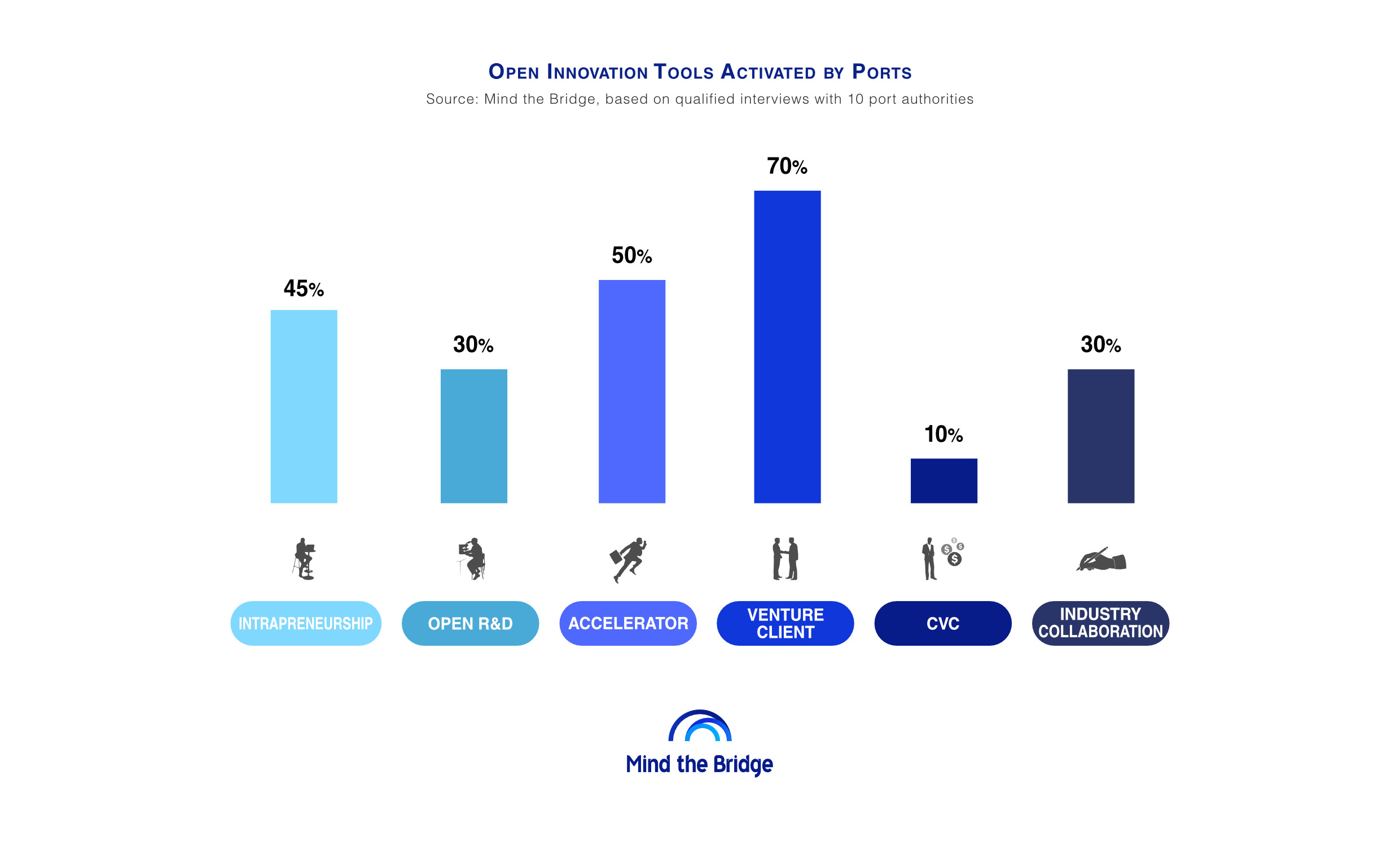
To capitalize on this momentum, the majority of ports are actively deploying various open innovation instruments, often utilizing structured frameworks and dedicated internal teams.
Nevertheless, achieving this vision requires policymakers, investors, startups, operators, and port authorities to align under a shared strategic agenda and tackle common challenges collectively.
Substantial foundational initiatives are already underway. A prominent illustration is the Port of Barcelona’s BlueTechPort, a collaborative innovation ecosystem that unites technology providers, researchers, entrepreneurs, and maritime enterprises. Outlined thoroughly within the report, this initiative is scaling globally via the Lighthouse International Acceleration Program, managed by Mind the Bridge.
For innovators charting these waters, the direction is clear: the task ahead is to catch favorable industry trends and ride them forward.
Get the full story in Mind The Bridge’s report, available for free download here.
अक्सर पूछे जाने वाले प्रश्न
01What is the blue economy?
The blue economy encompasses industries built around oceans and coasts, including shipping, fisheries, offshore energy, and marine biotechnology.
02How large is the global blue economy?
The blue economy has doubled in value over 25 years to reach $2.6 trillion, making it the equivalent of the world’s fifth-largest economy.
03What are the primary drivers of blue tech investment?
Growth is largely driven by digitalization, automation, environmental and climate pressures, the clean energy transition, and major maritime resilience deals involving defense and infrastructure.
04Why are ports considered “smart cities”?
Ports act as dense, complex systems where energy, logistics, data, mobility, and people meet, serving as ideal testing grounds for large-scale innovation.
Alberto Onetti is chairman of Mind the Bridge and a professor at University of Insubria. He is a serial entrepreneur who has started three startups in his career, the last of which is Funambol, among the five Italian scaleups that have raised the largest amount of capital. He is recognized among the leading international experts in open innovation and has wide experience in setting up and managing open innovation projects — venture clients, venture builders, intrapreneurship, CVCs — with large multinational companies, as well as advising and training on this subject. Onetti has a column on Sifted (Financial Times) and several other tech blogs.