India’s local crypto exchanges get just 0.7% of inflows, Chainalysis reports
A recent Chainalysis report reveals that Indian crypto users direct significant value to centralized platforms, yet local exchanges capture only 0.7% of total inflows, trailing far behind Brazil's domestic market share.

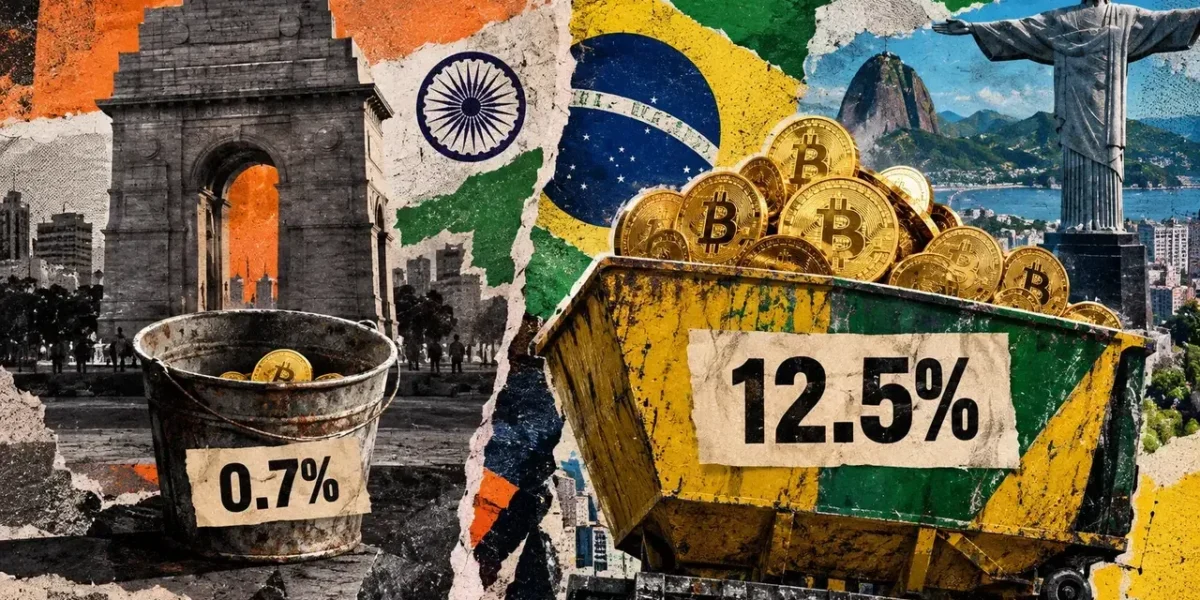
India’s digital asset users direct significant value toward centralized trading platforms, yet homegrown exchanges capture merely 0.7% of total exchange inflows, according to recent regional findings from Chainalysis. In contrast, the report’s chapter on Brazil indicates that Brazil-headquartered exchanges attract 12.5% of inbound funds.
This stark difference highlights two distinct business inquiries often conflated in adoption statistics: the overall level of activity originating from a specific nation versus the percentage captured by its domestic infrastructure. Although India’s transaction tax withholding diminishes the liquid capital accessible for subsequent trades, the exact role that venue selection plays remains an industry explanation rather than a quantified catalyst for the market split.
These insights were published in Chainalysis’s Central and Southern Asia and Oceania (CSAO) chapter on September 30 and its Latin America chapter on September 23. Their primary annual tracking window spans from July 2025 through June 2026, though the exact calendar dates for the market share observations are not detailed within the text. The updated publications cover prior activity concluded prior to October.
Chainalysis attributes $88.4 billion in centralized-exchange deposits to users residing in India throughout that yearly timeframe, establishing India as the largest market of its kind across Central and Southeast Asia and Oceania. This transaction volume frequently flows into international platforms.
The Indian market overview notes that the market share captured by domestic platforms dropped sharply from roughly 7% down to 0.7% following a steep decline in mid-2022. Conversely, the Brazil report outlines an alternative trajectory: platforms based in Brazil previously accounted for 1.5% of inbound volume and have since climbed to 12.5%.
These figures represent received value within the scope of Chainalysis’s exchange evaluations. Executed trade counts, business revenue, and active customer totals reflect separate dimensions of a platform’s operations. Because a single deposit can fuel multiple subsequent trades, the capital entering an exchange and the internal trading volume address fundamentally different questions.
The reports also leave unstated whether the sample of analyzed platforms remained consistent over time. While the highlighted divergence permits a descriptive evaluation, performing a directly synchronized annual market share analysis would demand perfectly aligned timeframes and sample sets.
Brazil’s broader cryptocurrency ecosystem registered $252.5 billion in total activity during the 12-month period ending June 30, despite experiencing a 1.6% contraction. That aggregate aggregates multiple transaction types and carries a broader scope than centralized exchange inflows alone. Generating an absolute annual dollar estimate for domestic exchanges in either country would necessitate share metrics and inflow volumes utilizing matching temporal windows, samples, and denominators.
Under its general 2026 methodology, Chainalysis allocates pooled service activity to specific user nations by analyzing web traffic patterns. For this distribution, traffic shares are adjusted to account for income disparities using the square root of GDP per capita. The exact mathematical formulas used to compute the domestic exchange market shares are not specified within the regional chapters.
Geographic assignment is determined by estimated user locations. This mechanism allows activity executed on overseas exchanges to factor into India’s recorded market size, while local platforms retain only a minor reported fraction.
Chainalysis concedes that filtering out virtual private network (VPN) usage and automated bot traffic remains an imperfect science. Consequently, the data represents geographically estimated activity with an inherent margin of uncertainty.
Withholding changes the cash available for another trade
India’s existing section 393 imposes a 1% tax deduction at source (TDS) on the transfer consideration of virtual digital assets paid to a resident, subject to standard exemptions. The designated payer must execute this deduction at the time of credit or payment, whichever occurs first.
The underlying calculation depends strictly on the consideration—the total amount paid for the asset transfer. Because the levy is assessed directly against that gross figure, the statutory deduction reduces immediate liquid proceeds even if a specific transaction yields minimal profit.
Consider a cash sale valued at ₹100,000 where the consideration is disbursed to a resident seller subject to the standard 1% deduction. Prior to transaction fees or other adjustments, the seller receives ₹99,000, with ₹1,000 retained for tax purposes. That withheld ₹1,000 cannot immediately be redeployed into a new purchase.
Subsequent taxable sales trigger additional deductions, compounding the total sum withheld. While the final tax filing dictates how these collected sums are credited, every applicable deduction immediately contracts available liquidity.
Exemptions under the current Act hinge on the identity of the payer and the aggregate consideration recorded across the financial year. The threshold is set at ₹50,000 for qualifying individuals or Hindu undivided families (HUFs), encompassing those lacking business or professional revenues. Eligibility also extends to individuals meeting the established prior-year business turnover limit of ₹1 crore or a professional receipts limit of ₹50 lakh. For all other categories of payers, the limit rests at ₹10,000.
These caps apply to cumulative financial-year transactions. Their applicability depends entirely on the specific financial standing of the payer, meaning eligibility verification must precede the application of standard rates.
The entity responsible for executing the deduction is also strictly defined. Statutory accountability falls squarely on the designated payer. Historical guidance issued by the tax department under section 194S outlines distinct responsibilities for buyers in direct peer-to-peer transactions versus centralized exchanges managing relevant settlement processes.
The tax department’s virtual digital asset (VDA) tax-certificate FAQ clarifies that deductees can claim credit for the deducted tax when submitting their annual returns. The legislation permits a financial refund whenever the total tax paid exceeds the actual tax liability, provided a formal return claim is filed.
Consequently, trading capital and tax credits operate on diverging timelines for market participants and trading platforms. While a deduction ultimately offsets tax obligations, it simultaneously curtails immediate trading liquidity. Transition guidelines establish how tax credits align with designated tax periods but guarantee no fixed processing timeline for refunds.
CoinSwitch co-founder Ashish Singhal informed Chainalysis that regulatory friction helps clarify why users turn to offshore platforms, noting that foreign venues may bypass domestic withholding requirements. This viewpoint reflects an operator’s perspective on the competitive pressures experienced by fully compliant domestic exchanges.
The exact degree to which tax withholding drove the reported market share decline remains unquantified. International platforms may still adhere to Indian statutory directives, and the physical location of a platform does not automatically confer a blanket exemption. Singhal’s rationale highlights a plausible competitive headwind without measuring its exact impact on the final statistical outcome.
Payment access extends across local and international venues
Fiat currency integration represents another potential factor influencing user behavior. Mercado Bitcoin, for example, integrates a Pix payment pathway enabling customers to buy digital assets directly via their banking applications, uniting a familiar financial service with cryptocurrency acquisition.
An Indian rupee (INR) purchasing guide published by CoinSwitch outlines deposit processes utilizing Unified Payments Interface (UPI) and net banking across platforms operating within India. This demonstrates how local fiat rails function domestically, though real-world availability fluctuates based on the specific platform and supported payment mechanisms.
Global competitors likewise leverage local financial channels. Binance’s Brazilian real (BRL) deposit documentation details support for Pix and TED bank transfers. Such examples prove that domestic payment gateways are utilized by both local and international service providers.
Chainalysis points to regulatory clarity, institutional investment, and enhanced localized product suites as potential catalysts for Brazil’s expanding domestic market share. Industry figures interviewed by the firm also reference corporate stablecoin adoption aimed at streamlining liquidity management and cross-border settlements. Such commercial demands could unlock business opportunities for platforms far beyond speculative retail trading. Nonetheless, the direct influence these factors exert on domestic venue selection remains a hypothesis, as product documentation merely illustrates available features while executive interviews capture subjective industry experiences.
India’s substantial volume of attributed exchange activity can easily coexist with a minimal market footprint for domestic platforms. Conversely, Brazil’s reported domestic gains illustrate an alternative pattern. For industry operators, identifying where exchange inflows ultimately land remains entirely distinct from measuring the sheer magnitude of national participation.
Frequently Asked Questions
- Why do Indian crypto exchanges capture such a small percentage of inflows? According to industry commentary and reports, regulatory friction like India’s 1% tax deduction at source (TDS) creates competitive pressures that push users toward offshore platforms.
- What is the difference between overall crypto activity and domestic exchange capture? Overall crypto activity measures how much digital asset volume originates from users in a country, while domestic exchange capture measures the share of that volume handled specifically by platforms headquartered within that same nation.
- How does tax withholding affect crypto traders in India? A 1% TDS is deducted from the gross consideration of a virtual digital asset transfer, which reduces the immediate cash proceeds available to the seller for subsequent trading activities.