
Kalshi’s $40 billion growth story hits tough questions about its trading volume
Kalshi is ending its Volume Incentive Program early amid regulatory scrutiny over its trading patterns, while simultaneously pursuing a massive new funding round that values the prediction-market platform near $40 billion.

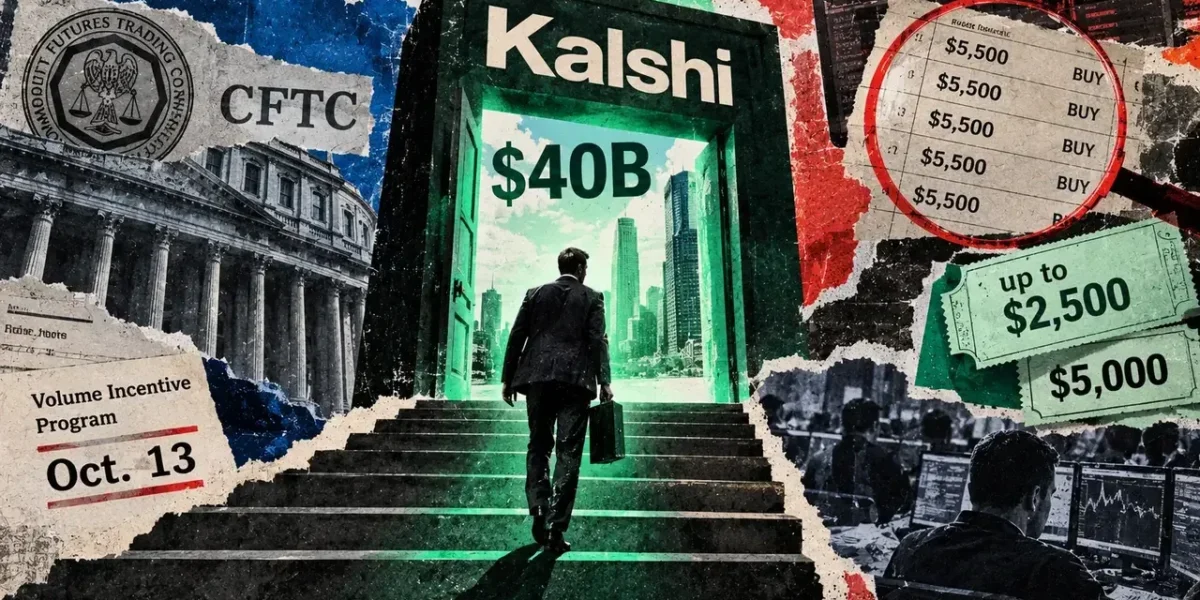
Kalshi is winding down a trader-volume incentive initiative nearly a year ahead of schedule amid heightened scrutiny regarding activity within its cryptocurrency markets.
As indicated in a September 28 filing with the Commodity Futures Trading Commission (CFTC), the prediction-market platform stated that its Volume Incentive Program will conclude no sooner than October 13. Originally set to run through October 1, 2027, this adjustment significantly shortens the program’s intended timeline.
This move transpires as Kalshi confronts inquiries concerning trading patterns observed within its perpetual futures markets. According to reports, the CFTC reviewed transaction activity after researchers flagged repetitive trades clustered around specific dollar increments, such as approximately $5,500 executed in Ethereum perpetuals.
Maintaining that it is not undergoing an official investigation, Kalshi has dismissed allegations of wash trading. The platform attributes these frequent transactions to market makers placing fixed-size quotes that are repeatedly triggered by other participants.
The regulatory submission does not explicitly connect the early termination of the program to these inquiries, nor does it provide a specific rationale for halting it prematurely. Under the established terms, the exchange maintains the discretion to end the program at will.
Initially introduced to bolster liquidity on Kalshi’s central limit order book, the initiative allowed the exchange to designate specific markets and allocate fixed reward pools. Participants earned a share relative to their portion of qualifying volume, with event-contract rewards capped at half a cent per contract for each individual. Furthermore, perpetual futures were included and exempted from the standard qualifying price parameters of 3 cents to 97 cents.
This incentive framework is now being replaced by a more versatile structure, granting Kalshi greater flexibility in deploying capital to attract and retain users.
Kalshi shifts toward targeted trader rewards
Days prior to filing for the termination of the volume-based program, Kalshi submitted a new Deposit and Trading Reward Incentive Program to the CFTC. Agency docket records note a modified version was received on September 25, with the filing establishing September 28 as the earliest possible effective date.
Although the two systems are not formally classified as direct replacements and may temporarily overlap prior to the expiration of the older framework, the new arrangement alters how Kalshi can distribute perks.
Instead of dividing a fixed pool based on each user’s share of overall market volume, Kalshi can now implement time-sensitive promotions tied directly to deposits, trading activity, or both. These campaigns can span from three to 90 days, targeting specific demographics defined by account age, funding status, historical trading frequency, inactivity, geographic location, and prior engagement with particular contract types.
Individual promotions can grant up to $2,500 per user, with total cumulative rewards capped at $5,000 per person throughout the program’s intended two-year lifespan. Kalshi is permitted to utilize percentage matches or fixed-value bonuses across diverse verticals, including crypto, sports, economics, financials, politics, weather, and entertainment.
Additionally, the filing outlines stricter guidelines regarding abusive trading. Transactions currently under review for potential self-matching, wash trading, prearranged trades, or alternative restricted practices will be disqualified from earning promotional bonuses.
Kalshi noted that its compliance and surveillance teams will apply intensified oversight to participants receiving rewards, with the authority to revoke eligibility or initiate disciplinary measures.
Consequently, Kalshi secures a more focused customer-acquisition mechanism during a period when the underlying economics and sustainability of trading volumes across prediction platforms face rigorous examination.
Record trading supports a $40 billion pitch
This overhaul of incentives arrives despite little indication that Kalshi is experiencing difficulty generating high headline volumes.
Throughout September, the platform repeatedly shattered previous trading milestones. Figures compiled by DeFiRate reveal that Kalshi processed a record $3.24 billion on September 27 alone, while weekly volume reached $15.66 billion for the seven-day period ending on that date. Its market share of tracked prediction-market activity hovered near 80%, marking a substantial surge compared to the previous year.
This rapid expansion is increasingly reflected in the valuation prospective investors place on the firm.
As reported by Reuters, citing sources close to the negotiations, Kalshi is engaged in advanced discussions to secure roughly $1 billion in funding at a valuation near $40 billion. Sequoia Capital and Wellington Management are reportedly in talks to lead the financing round, alongside potential investments from Tiger Global and Dragoneer Investment Group.
Closing a transaction at this magnitude would nearly double the $22 billion valuation Kalshi achieved during a $1 billion fundraising effort in May. Reuters additionally noted that the company is investigating expansion opportunities beyond prediction markets into alternative asset classes, alongside preliminary considerations regarding an initial public offering.
These developments render the transition in incentive structures significant beyond the scope of mere promotional payouts. As Kalshi targets a valuation comparable to established financial exchange operators, investors will increasingly need to evaluate how much of its escalating volume stems from genuine customer demand versus the financial stimuli engineered by the platform.
Frequently Asked Questions
01Why is Kalshi ending its Volume Incentive Program early?
Kalshi filed to terminate the program nearly a year ahead of its original 2027 end date. While the filing did not directly link the decision to recent scrutiny over repetitive trading patterns and perpetual futures markets, the platform retains the discretion to end the program at any time.
02What is Kalshi replacing the old program with?
Kalshi introduced a new Deposit and Trading Reward Incentive Program that allows the exchange to run time-limited promotions tied to deposits and trading activity, offering targeted rewards rather than distributing a fixed pool based strictly on market volume share.
03Is Kalshi facing an official investigation?
Kalshi has stated that it is not under investigation and has rejected allegations of wash trading, explaining that repeated transactions are the result of market makers placing fixed-size quotes.
04What is Kalshi’s current company valuation?
Reports indicate that Kalshi is in advanced discussions to raise about $1 billion at a valuation of approximately $40 billion, nearly doubling the $22 billion valuation it achieved in May.