
Robinhood Chain’s $1.5 billion boom is attracting memecoin rug factories
Robinhood Chain attracts organized memecoin rug factories as its total value locked surpasses $1.5 billion. Blockchain security firm GoPlus reports malicious operations funneling millions through wallet consolidation schemes.

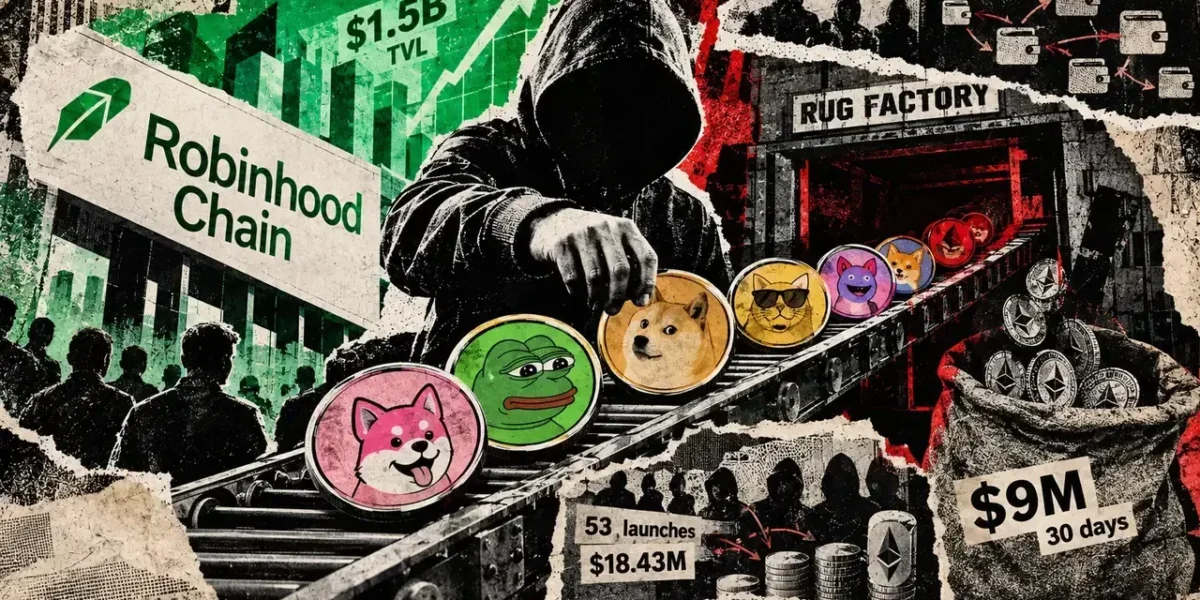
A second suspected memecoin rug factory has emerged on Robinhood Chain, as the rapidly growing network continues to draw increasingly organized scam operations.
Blockchain security firm GoPlus reported on Sept. 28 that it uncovered a high-risk operation responsible for hundreds of memecoins. Over the preceding 30 days, this network funneled more than $9 million through a shared fund-consolidation system.
According to GoPlus, the scheme relied on batches of newly generated wallets to gather and sell tokens, subsequently sweeping the earnings into connected addresses. As of Sept. 28, the primary consolidation wallet logged roughly 3,589 ETH—equaling about $9.49 million—in bidirectional flows across its most recent 400 transactions.
GoPlus clarified that this figure reflects gross movement rather than net gains or actual investor losses. Nevertheless, the security team explained that the wallet activity demonstrated a consistent pattern where profits from one wave of token releases appeared to fund the next.
In practice, operators would generate a token centered on a trending topic, scatter the token supply among freshly made wallets possessing minimal transaction history, and execute sales using contracts like PonsV2Helper and UniversalRouter. The ETH obtained from those sales was then funneled via local sweep wallets before landing in the broader consolidation pool.
This structural approach can obscure the true volume of a token controlled by a single entity. Instead of one wallet dumping a massive holding, dozens of seemingly unconnected addresses sell off tokens incrementally, mimicking organic market activity before the funds eventually pool together elsewhere.
GoPlus pointed out that this setup differs from a standard rug pull, where liquidity vanishes abruptly or traders are blocked from selling. Instead, the firm’s primary concern centers on the coordinated ownership and exit strategies executed across outwardly distinct wallets, followed by the reinvestment of capital into upcoming token releases.
Earlier operation extracted $18.4 million from 53 launches
These findings follow an earlier discovery by on-chain analyst Wazz, who flagged another suspected serial-rug operation on Robinhood Chain. That group allegedly drained roughly $18.43 million across at least 53 memecoin debuts over a span of about two months.
That particular scheme utilized a different variation of the same core strategy. Networks ranging from 70 to 200 wallets accumulated heavy portions of a token’s supply right after launch, frequently leaving the cluster in control of over 70% of the asset.
Wazz also uncovered ties between consecutive launches, such as capital from one project transferring directly into wallets used to fund another. This indicated that earnings were being recycled instead of cashed out following each individual trade.
GoPlus noted that both operations share striking similarities, such as heavy reliance on Pons V2 infrastructure, large batches of wallets designed to mask supply centralization, and the movement of funds from one project into the next.
However, the security firm cautioned that there is no proof linking both clusters to the same individuals. The newer scheme depends more heavily on fresh wallets followed by consolidation, whereas the group identified by Wazz utilized larger clusters positioned to secure supply dominance early in the token lifecycle.
This distinction indicates that the activity extends beyond a single crew. Identical economic models can be replicated using varied wallet architectures, providing scammers with multiple methods to make coordinated token dumps look like standard trading behavior.
Consequently, wallets, launchpads, and trading interfaces face a much harder detection challenge. Spotting malicious code alone will not necessarily flag a token whose smart contracts operate normally while its supply remains quietly hoarded across dozens of associated addresses.
Robinhood Chain’s rapid growth raises the stakes
These suspected scam factories are appearing as Robinhood Chain expands at a rate rarely seen among new blockchain networks.
Operating as an Ethereum layer-2 network since its July 1 launch, the chain has surpassed $1.5 billion in total value locked according to DeFiLlama figures, hitting that milestone in under 90 days and highlighting its rapid adoption.
Token Terminal estimates place Robinhood Chain’s revenue at roughly $50 million over this three-month window, pointing to substantial trading volume already coursing through the ecosystem.
Robinhood’s wider potential reaches far beyond fees generated by crypto-native participants. With 28.6 million funded brokerage clients and roughly $384 billion in assets, the platform offers developers the opportunity to build on-chain applications capable of ultimately tapping into a massive, established financial user base.
That distribution advantage also increases the dangers of failing to catch abusive token deployments early.
While a permissionless network allows external developers to roll out products without requiring Robinhood to clear every individual contract, the applications and interfaces through which users discover those assets can still incorporate filtering tools, wallet alerts, and concentration analysis.
The arrival of a second suspected rug factory makes implementing these protective measures critical before Robinhood exposes a broader segment of its brokerage audience to on-chain ecosystems.
For Robinhood, the core business dilemma is whether it can maintain the open environment fueling its network’s expansion while keeping organized token manipulators from exploiting that exact distribution channel to target a much larger pool of retail capital.
Frequently Asked Questions
01What is a memecoin rug factory?
A memecoin rug factory refers to a coordinated operation that repeatedly launches multiple memecoins—often using fresh wallets and shared consolidation networks—to distribute token supplies, execute coordinated sell-offs, and recycle profits into subsequent token launches.
02How much total value locked does Robinhood Chain have?
As of press time, DeFiLlama data indicates that Robinhood Chain has crossed $1.5 billion in total value locked.
03Does GoPlus consider this activity a traditional rug pull?
No, GoPlus noted that the setup does not resemble a traditional rug pull where liquidity suddenly disappears or buyers cannot sell. Instead, the concern is the coordinated ownership and exit process across apparently separate wallets followed by the recycling of proceeds into future launches.
04Are the two suspected operations linked?
Security firm GoPlus stated there is no evidence that the two clusters belong to the same operators, though they share several operational characteristics.