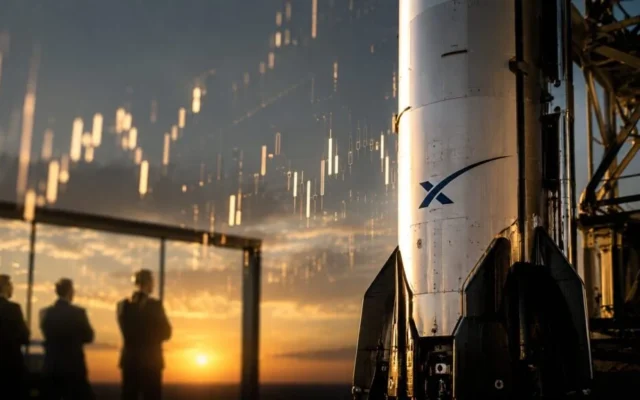
SpaceX Stock Forecast: Needham Sees $250, Bernstein $248, BofA $235
Wall Street maintains an optimistic SpaceX stock forecast, with analysts from Needham, Bernstein, and BofA issuing targets above the current trading price as Starlink revenue and subscriber growth fuel long-term optimism.


Achieving millionaire status through SpaceX shares is within the realm of possibility, but current valuations suggest it is a decades-long endeavor rather than an immediate Tesla-style windfall. Trading at $148.07 following a 1.85% decline on October 1, the share price remains close to its debut level, resulting in modest early gains. Nonetheless, Wall Street maintains an optimistic SpaceX stock forecast, with 37 analysts projecting an average 12-month price target of $226, supported by robust growth that included a 92% surge in second-quarter revenue to $7.8 billion.
Also Read: Nvidia vs. SpaceX: BofA Sees SPCX Up 61%, Nvidia Joins $668M AI Deal
SpaceX Stock Returns: Can Its Growth Make Investors Millionaires?
Why Tesla’s Run Sparked The Question
Since its 2010 public debut, Tesla has delivered average annual returns of 40.11%, turning a $5,000 investment back then into more than $1 million today. Following Elon Musk’s decision to take SpaceX public on the Nasdaq on June 12, 2026, under the ticker SPCX, investors immediately began wondering whether SpaceX stock could replicate that trajectory.
That milestone has already materialized for over 4,000 current and former employees who attained millionaire status via the IPO, according to estimates. Conversely, retail investors who bought in at the debut have experienced a different reality, as the share price has hovered near its starting point, keeping early returns for the public relatively small.
Consequently, fulfilling the ambition of accumulating wealth through the stock relies heavily on the company’s performance over the coming decades.
SpaceX Stock Forecast: Needham Sees $250, Bernstein $248, BofA $235
Overall, Wall Street leans toward further share appreciation. Out of 37 ratings issued over the past three months, 30 analysts recommend a Buy, five advise a Hold, and two suggest a Sell. Their consensus 12-month SpaceX price target is $226—roughly 52.63% above the current valuation—with individual projections ranging from a high of $450 to a low of $140.
Recent updates from prominent financial institutions reflect this sentiment. Needham leads the group with a target of $250, followed by Bernstein SocGen Group at $248, BofA Securities at $235, UBS at $210, and Mizuho at $200. Each of these five firms maintained their Buy ratings during updates on September 29 and 30.
Driving this anticipated growth are lower launch expenses. While reusable Falcon 9 boosters have already significantly reduced costs, the fully reusable Starship is expected to drive expenses down further while expanding profit margins.
Starlink Fuels Hopes
Starlink serves as the primary catalyst for long-term investment optimism. The division closed the second quarter with 12 million subscribers—double the figure from the prior year—while quarterly connectivity revenue climbed 66% to $4.29 billion.
During the earnings call, Elon Musk remarked:
“I think people are really underestimating Starlink here”
Mizuho, carrying an Outperform rating and a $200 price target, noted:
“SpaceX is not a rocket company. It is the infrastructure layer of the orbital economy.”
Furthermore, the corporation narrowed its net loss to $541 million from $1 billion a year prior. Musk has also highlighted internal projections targeting $1 trillion in annual revenue by 2030. Should SpaceX approach that benchmark, current price forecasts may prove overly conservative, underpinning the thesis for long-term investors aiming for substantial gains.
Why The Valuation Carries Real Risk
At the same time, the steep valuation introduces notable risks. Sporting a market capitalization near $2 trillion, SpaceX trades at roughly 200 times forward earnings, meaning a substantial portion of future expectations is already priced in. Over the past 52 weeks, the share price has fluctuated between $104.83 and $225.64.
Additional insider share lockups expiring on October 9 and October 24 could create near-term pressure on the stock. Moreover, the planned launch of Starship Flight 14 on September 28—aiming to reach orbit for the first time—presents operational risk, as an unsuccessful mission could swiftly impact shares.
Replicating Tesla’s performance presents mathematical hurdles as well. Matching those gains over the next 16 years would elevate the enterprise value to approximately $441 trillion, or about 14 times the annual U.S. GDP, a scenario described by the Motley Fool as extremely unlikely.
Ultimately, realizing significant wealth from the asset will likely require acquiring shares during steep corrections and maintaining a holding period spanning roughly 30 years. While long-term expansion could yield substantial rewards—and 30 of the 37 covering analysts currently issue Buy ratings—the dissenting lowest target of $140 highlights divergent views on Wall Street. Investors should anticipate a volatile path ahead if they intend to build major capital from today’s levels.
Frequently Asked Questions
01What is the ticker symbol for SpaceX?
SpaceX trades on the Nasdaq under the ticker symbol SPCX following its public debut on June 12, 2026.
02What is the average Wall Street price target for SpaceX?
Based on ratings from 37 analysts over a three-month period, the average 12-month price target sits at $226.
03How is Starlink performing financially?
Starlink finished its second quarter with 12 million subscribers and generated $4.29 billion in quarterly connectivity revenue, marking a 66% year-over-year increase.