
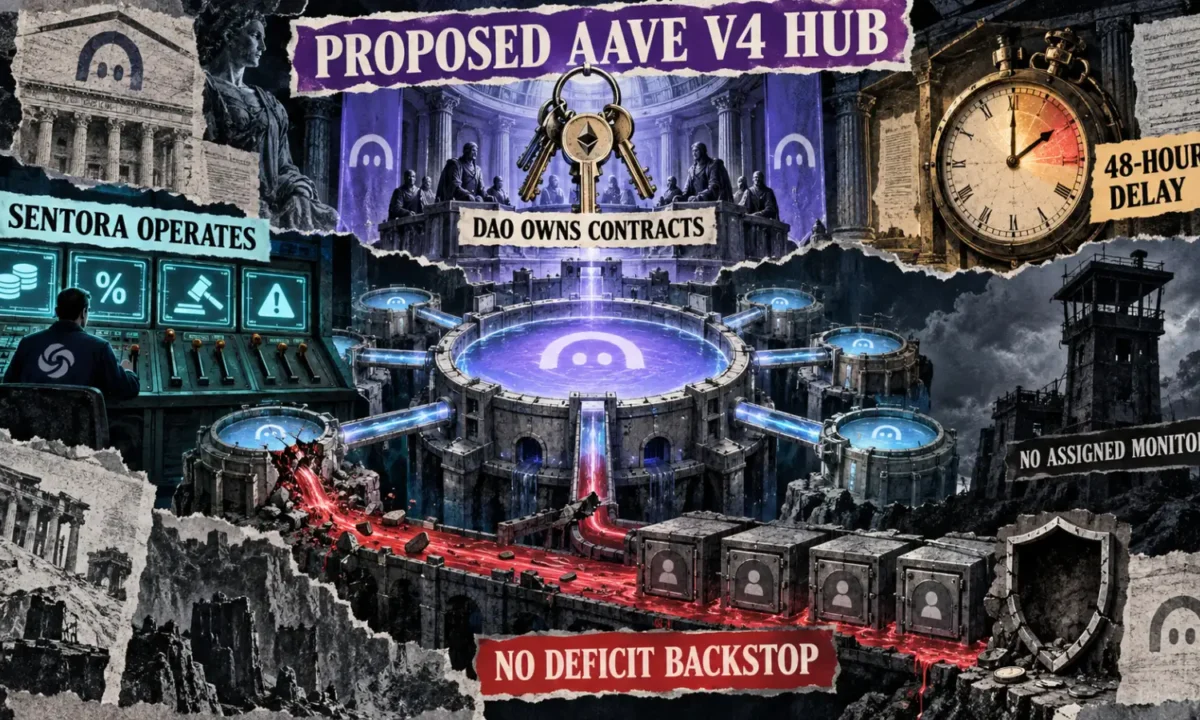










Under a governance proposal posted Sept. 28, the Aave DAO would hold the contracts for a proposed Ethereum lending market, but DeFi risk manager Sentora would control the day-to-day decisions governing its credit risk.
The plan asks to run an isolated Aave V4 Hub and its lending Spokes via revocable roles. This arrangement places immediate risk management squarely in Sentora’s hands, whereas the DAO retains ownership, a review mechanism for new markets, and the authority to strip Sentora of those operational roles.
Sentora would retain the power to select collateral, interest-rate curves, liquidation settings, and oracles. Meanwhile, Aave’s existing risk service providers are not assigned to monitor this specific instance, offer recommendations, or respond to emergencies.
Because the submission remains an ARFC for community input, moving forward requires a Snapshot vote followed by an on-chain Aave Improvement Proposal before final approval.
Who can act, and when
Aave V4 divides liquidity into a central Hub while loans are issued against collateral in separate Spokes. Sentora’s plan features a single Ethereum Hub for its Spokes, completely isolated from credit lines to or from other Aave DAO Hubs, while its Spokes continue to draw liquidity from suppliers within Sentora’s own Hub.
The text restricts borrowable assets strictly to RLUSD, PYUSD, and OUSD, leaving out USDC and USDT.
The DAO’s Governance Short Executor maintains admin privileges over the Hub, Spokes, and AccessManager. While the DAO keeps control over contract upgrades and role assignments, Sentora will not own any of the underlying contracts.
Instead, Sentora receives operational roles to administer the markets, and the DAO holds the power to revoke these permissions via an on-chain governance vote.
Those roles dictate varying response speeds:
| Proposed action | Who acts | When | DAO recourse |
|---|---|---|---|
| Pause or freeze a reserve, halt an asset or Spoke | Sentora operational address | Immediately through a restrictive role | Revoke Sentora’s roles through governance |
| Reduce a collateral factor or tighten a cap | Sentora through a one-way Risk Steward | Immediately | Revoke Sentora’s roles through governance |
| Increase risk, or change a rate model or liquidation configuration | Sentora operational address | After a 48-hour on-chain delay | Observe the scheduled change and pursue role revocation; no individual cancellation power is specified |
| Add collateral or deploy another Hub | Sentora proposes; an appointed DAO service provider may object | Two-week forum review before scheduling or deployment | An objection pauses the action for a binding Snapshot vote |
The 48-hour delay affects risk increases as well as ambiguous adjustments such as rate models and liquidation configurations. The draft imposes no cap on the scale of an increase and no mandatory cooldown period between updates.
While the delay makes a scheduled modification transparent, the DAO lacks a direct tool to cancel that particular action during the active window. Revoking Sentora’s permissions demands an independent on-chain governance proposal to strip its authority moving forward.
When introducing a new Hub or collateral asset, Sentora must publish an analysis and wait two weeks. If any designated Aave DAO service provider objects, the rollout halts and triggers a binding Snapshot vote.
At the same time, the proposal clarifies that no service provider is formally scoped or compensated to evaluate these submissions. It also exempts this deployment from providers’ standard monitoring, parameter-recommendation, and incident-response duties.
While providers retain the freedom to voice concerns voluntarily, a quiet review window does not guarantee that anyone actually analyzed the modification. The proposed veto relies entirely on someone spotting an issue and deciding to speak up.
In a November 2025 essay, Sentora CEO Anthony DeMartino emphasized that risk oversight requires measurable controls and continuous observation. This new framework transfers that operational responsibility directly to Sentora, allowing the DAO’s existing providers to speak up without imposing a formal obligation to watch the market.
Who absorbs a shortfall?
If a liquidation wipes out a borrower’s collateral while debt remains outstanding, the Spoke logs the deficit with the Hub that provided the underlying debt asset. The Hub tracks this shortfall against that specific asset, and according to TokenLogic’s V4 Umbrella proposal, suppliers of that Hub asset take the loss.
A secondary ledger tracks the originating Spoke, and the lack of cross-Hub credit lines prevents direct draws on other DAO Hubs for these particular loans. However, this structure does not shield suppliers inside Sentora’s Hub from the risk generated by its own Spokes.
The financial arrangement splits protocol revenue evenly, giving 50% to Sentora and 50% to the DAO, which encompasses reserve-factor earnings and protocol liquidation fees.
A separate Aave V4 Umbrella ARFC outlines deficit offsets and staked coverage for Core WETH, Core USDC, and Core USDT. Because that coverage excludes Sentora’s proposed Hub—and Sentora’s ARFC outlines no Umbrella market, deficit offset, or dedicated first-loss layer—a distinct protection gap remains.
While a later proposal could bridge this divide, lenders cannot assume safety solely based on the DAO holding contract keys or taking a share of fees.
Sentora’s narrative states that USDe and PST will anchor the initial RLUSD yield loans, with PRIME and mWIN incorporated later, though its technical specifications list all four simultaneously. Similarly, its Bluechip description highlights RLUSD borrowing against kBTC, whereas the accompanying table features RLUSD, PYUSD, and OUSD.
Furthermore, the OUSD oracle selection remains unconfirmed prior to launch. The final decisions regarding assets and price feeds will ultimately dictate the level of risk carried by suppliers.
Before any Snapshot or AIP vote, the DAO must weigh whether to delegate these operational powers without assigning an independent watchdog or establishing first-loss protection for the isolated Hub.
For potential suppliers, the final asset roster, chosen oracles, and any explicit deficit protection will dictate how much underlying risk accompanies those DAO-controlled contract keys.
Frequently Asked Questions
01What is the proposed split between Sentora and the Aave DAO?
Sentora and the Aave DAO would split protocol revenue 50/50, which includes reserve-factor earnings and protocol liquidation fees.
02Who bears the financial losses if a borrower defaults?
Suppliers of the specific Hub asset absorb any losses if a liquidation completely exhausts a borrower’s collateral and leaves an unpaid deficit.
03Does the Aave DAO retain any control over Sentora’s market?
Yes, the DAO retains contract ownership, admin roles via the Governance Short Executor, and the power to revoke Sentora’s operational authority through an on-chain governance proposal.
04Are Aave’s existing risk providers responsible for monitoring this new Hub?
No, Aave’s current risk service providers have no assignment to monitor the instance, offer parameter recommendations, or handle incident responses for this specific Hub.