The same Fed rate hike can help stablecoins and hurt Bitcoin borrowers
A Federal Reserve interest rate hike can increase reserve income for dollar stablecoin issuers like Circle while simultaneously raising interest expenses for firms taking on debt to purchase Bitcoin.

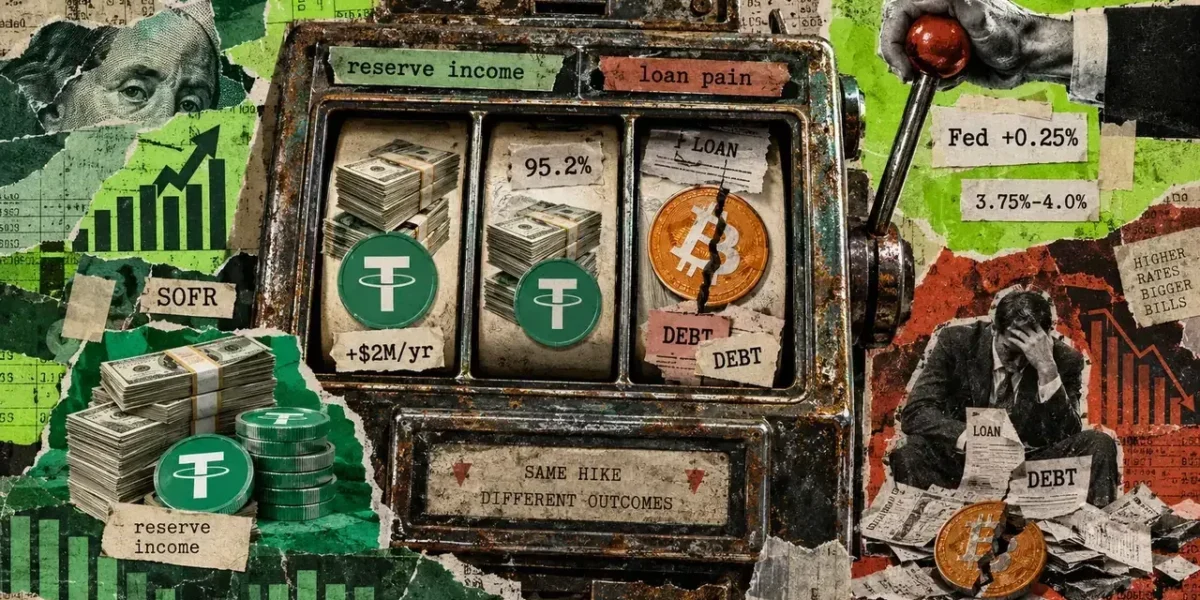
When you hold a dollar stablecoin, another party may be collecting interest on the assets backing your balance. Meanwhile, a firm taking on debt to purchase Bitcoin must secure funds to service its lenders.
Although both operations are native to the crypto sector, an elevated interest rate can benefit the former while straining the financial mechanics of the latter.
That important distinction often gets overlooked whenever every shift in Treasury yields is treated as a blanket indicator of whether capital is becoming more accessible or restrictive for the entire ecosystem.
Because different rates impact individual enterprises through their specific agreements, a bond-market fluctuation that discourages investors from purchasing speculative assets can simultaneously enhance the income generated by certain cryptocurrency reserves.
This dynamic is evident in Circle’s second-quarter financial filing, which revealed that reserve income accounted for 95.2% of its revenue during the three-month period ending June 30, 2026. The returns on its reserves closely track the secured overnight financing rate (SOFR), meaning its revenue relies heavily on the volume of outstanding stablecoins and the yield generated by their backing.
The rate applied in these calculations matters significantly because overnight returns and the yield on 10-year Treasuries can move in opposite directions. Viewing both as representing the identical cost of money can lead to false assumptions of a financial windfall for a stablecoin issuer whose reserve earnings are actually moving downward.
Money has more than one price
The Federal Reserve’s Sept. 16 action to increase its target range by a quarter of a percentage point to 3.75%-4% directly influenced this dynamic. Higher overnight rates can enhance returns on short-term stablecoin reserves as those assets mature or reset, whereas borrowers with debt tied to those same rates may encounter heavier interest expenses.
While short-term rates shape the returns on instruments that experience quick maturity or resetting cycles, the 10-year Treasury yield factors in future short-rate projections along with a premium for holding longer-duration debt.
Research from the New York Fed regarding term premiums employs specialized models to isolate these underlying variables since the extra compensation itself cannot be observed directly.
Market participants might demand higher compensation to hold long-term government bonds while simultaneously anticipating future cuts to overnight rates, keeping long-term financing costs elevated even if short-term reserve returns decline.
Under such circumstances, a firm financing a protracted construction initiative and an issuer reinvesting maturing Treasury bills could both face negative outcomes, albeit for distinct reasons.
Bitcoin investors must perform a different evaluation because direct ownership of the asset generates no contractual interest payments. They can achieve gains if the asset’s price increases, but higher available yields on bonds provide them with a guaranteed stream of income to evaluate against a return that relies solely on what a subsequent buyer is willing to pay.
That comparative assessment depends heavily on an investor’s personal circumstances, including considerations of inflation, tax obligations, and the timeframe they can commit their capital.
As the SEC outlines in its guide to interest-rate risk, long-term Treasury bonds can experience market value declines when yields climb. Consequently, an investor needing to liquidate holdings next month faces an entirely different financial scenario than someone holding those instruments until maturity.
The correlation between real yields and Bitcoin valuations reflects only one dimension of crypto’s overall market exposure. Firms generating interest on reserves can accumulate additional cash flow when speculative assets lose appeal among investors, and neither of these outcomes contradicts the other.
Your dollars can pay somebody else’s interest rate income
Consider a hypothetical issuer managing $10 billion in reserves that generate a 4% annual return, yielding $400 million prior to operational expenses and partner payouts.
If that return drops to 3%, total income falls to $300 million. Restoring the original revenue figure would necessitate approximately $13.33 billion in reserves, representing roughly a one-third increase.
These illustrative figures demonstrate why a stablecoin issuer can expand its customer base yet still generate less revenue per dollar managed. While a larger token supply helps, those additional balances must compensate for the reduced yield, and gross reserve income must still cover operating overhead and distribution fees.
Token holders frequently receive none of this income unless the product’s explicit terms grant them entitlement to it, given that what they are actually purchasing is typically the utility of holding and transferring a dollar-denominated balance.
That service offers clear value, particularly in regions where traditional dollar-denominated banking access is restricted. However, a higher reserve return can boost an issuer’s profitability while simultaneously raising the interest costs its users forfeit elsewhere.
Borrowers encounter the reverse side of this mathematical equation. For instance, a hypothetical enterprise securing $100 million in new interest-bearing debt would incur an extra $2 million annually if its borrowing rate climbed by two percentage points.
The underlying business must then generate that capital through operations, supplemental financing, or asset liquidations, regardless of whether the assets it originally purchased have become any more productive.
The impact on an enterprise borrowing to accumulate Bitcoin depends heavily on the structure of its debt, seeing as existing fixed-rate liabilities do not automatically become costlier simply because Treasury yields shift.
Floating-rate loans can reset on accelerated timelines, whereas refinancing brings the corporate borrower back to the open market once older obligations mature, giving lenders a fresh opportunity to adjust terms.
Convertible debt introduces additional complexity because lenders may accept a reduced coupon rate in exchange for the prospect of securing equity participation.
Focusing exclusively on interest obligations overlooks that embedded equity value alongside the potential dilution borne by existing shareholders, meaning two companies with identical coupons can maintain entirely different financial structures.
Cryptocurrency miners evaluating data center developments face a parallel challenge in aligning their capital financing with prospective future income, given that construction expenditures commence well before the finished facility generates intended revenues.
Within a project boasting a narrow anticipated surplus, an expanded interest burden can absorb that margin prior to the arrival of the first paying customer, though the final outcome ultimately hinges on construction expenses, client contracts, and the specific composition of debt and equity.
Consequently, a company with fixed financing terms and dependable customer commitments may find itself in a stronger position than a competitor utilizing cheaper-appearing debt that requires near-term refinancing.
Comprehending this distinction requires careful review of the underlying agreements, as aggregate Treasury yields alone cannot reveal which enterprise possesses the financial staying power to complete its project.
DeFi has to explain the extra return
Decentralized finance (DeFi) lending creates alternative mechanisms for establishing interest rates. Documentation from protocols like Aave regarding token supply notes that supplier yields are dictated by borrowing utilization metrics and specific protocol parameters.
While prevailing Treasury yields shape the alternative options available to users, actual demand within a given lending pool plays a vital role in determining its payouts.
When borrowers seek out a substantial portion of accessible stablecoins, rates tend to climb. Conversely, weaker demand or increased token supplies push rates downward. Governance configurations and incentive programs can likewise influence advertised returns, meaning any percentage displayed on a user dashboard requires a clear accounting of the actual source of those funds.
Imagine a short-term government debt instrument paying a 4% return alongside an onchain position advertising 7%.
That three-percentage-point difference must be weighed against additional contractual, liquidity, technical, and counterparty risks. A higher promoted yield does not inherently signify that an investor is receiving adequate compensation for absorbing those hazards.
Market participants also operate with diverse alternatives; certain individuals lack access to conventional government debt products, while others must keep their tokens liquid for use as collateral or transactional payments.
An investor may rationally accept a reduced return in exchange for utility they require, which clarifies why yields do not instantly converge across traditional and decentralized financial markets.
Consequently, the exposure of cryptocurrencies to interest rates operates across multiple simultaneous channels, involving stablecoin issuers pursuing reserve income, borrowers attempting to outearn their financing costs, and Bitcoin holders balancing potential price appreciation against alternative income streams.
Tracing who collects payments, who owes interest obligations, and the schedules upon which those terms reset helps explain how a single bond market can simultaneously support one segment of the digital asset industry while complicating the financial viability of another.
Frequently Asked Questions
01How does a Federal Reserve rate hike impact stablecoin issuers?
A higher Fed rate can increase the returns on the short-term reserves backing stablecoins as assets mature or reset, boosting the issuer’s reserve income.
02Why does a rate hike hurt Bitcoin borrowers?
Borrowers who take on debt to buy Bitcoin must find extra funds to service their lenders when interest rates rise, eating into their financial economics, especially if their debt tracks floating rates.
03Do token holders automatically receive the interest earned on stablecoin reserves?
Not necessarily. Token holders typically receive no share of that reserve income unless the specific product’s terms explicitly grant them the right to it.
04Why do decentralized finance (DeFi) yields differ from traditional Treasury yields?
DeFi yields are driven by onchain lending demand, protocol parameters, governance settings, and incentives, alongside additional liquidity, technical, and counterparty risks.