Cardano’s DeFi has shrunk by more than half and RealFi is betting credit can revive it
Cardano launches RealFi to introduce real-world credit backing and revive its shrinking DeFi ecosystem through new dollar-tokens, USDrf and sUSDrf, connecting blockchain finance with emerging-market lending.

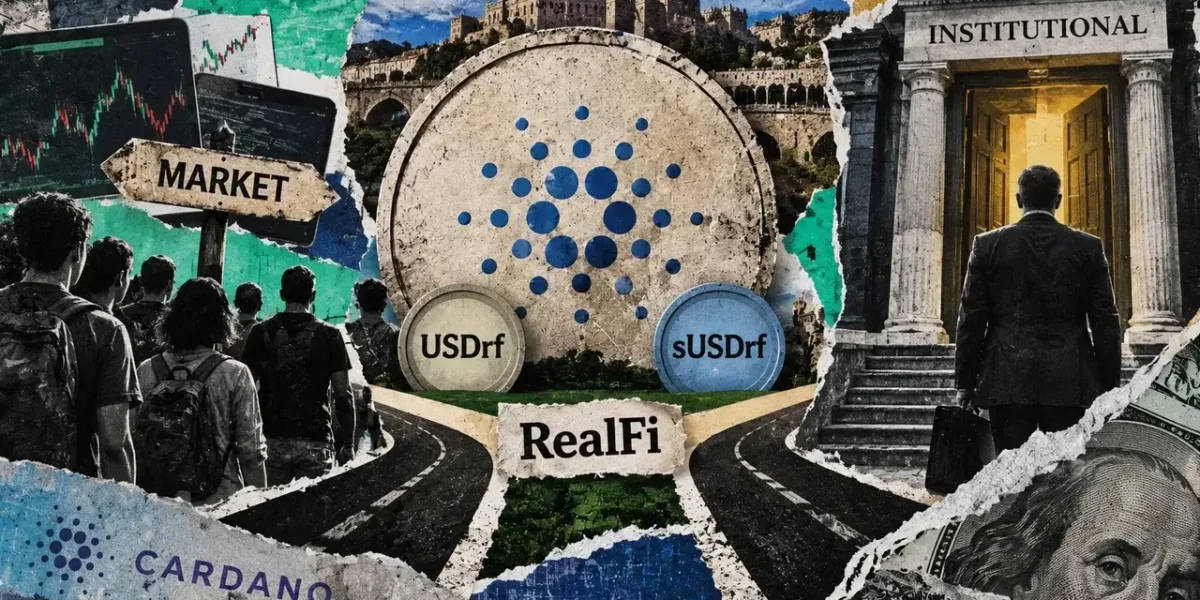
Cardano’s “bank the unbanked” initiative has officially gone live through the launch of RealFi, introducing real-world credit backing to a newly introduced dollar-token system.
On Oct. 1, RealFi rolled out USDrf alongside its yield-bearing counterpart, sUSDrf, on the Cardano network. This milestone brings a project into production that Cardano founder Charles Hoskinson has spent years framing as a crucial link between blockchain finance and emerging-market lending.
Eligible retail participants can acquire USDrf and stake it to receive sUSDrf, which provides variable returns produced by the underlying asset portfolio. Meanwhile, direct minting and redemption privileges with the issuer are limited to verified institutional partners, establishing distinct exit mechanisms depending on the holder’s status.
Back in July, Hoskinson stated that he personally invested several million dollars into RealFi. He noted that the team had previously serviced loans in Uganda and Kenya while quietly building out the platform largely behind the scenes. He characterized this rollout as the initial phase of Cardano’s mission to “bank the unbanked,” with yields generated via lending activities outside of traditional crypto markets rather than relying primarily on token incentives.
This debut occurs at a pivotal juncture for Cardano. While the network’s stablecoin reserves are climbing toward record levels, the total capital locked within decentralized finance (DeFi) applications has experienced a sharp decline.
Cardano needs somewhere for its dollars to go
Over the past year, Cardano has shifted its strategy away from developing isolated, native solutions for individual financial tasks, moving instead toward direct competition for advanced DeFi liquidity concentrated on Ethereum, its Layer-2 networks, and Solana.
This pivot has gained urgency as Cardano’s own DeFi presence contracts.
Metrics from DeFiLlama indicate that the network holds approximately $67 million in total value locked, representing a drop of over 50% from roughly $150 million in May. By comparison, ecosystems like Ethereum and Solana continue to maintain DeFi markets valued in the billions.
Conversely, stablecoins paint a different picture. Dollar-pegged tokens on Cardano are nearing an all-time high of about $70 million, granting the blockchain nearly as much stablecoin liquidity as the total capital secured within its DeFi protocols.
RealFi provides this expanding pool of dollar-denominated assets with an alternative destination.
USDrf channels stablecoin capital into a diversified portfolio that RealFi notes may encompass private-credit funds, direct loans, public credit, investment-grade collateralized loan obligation ETFs, money-market instruments, and Treasuries. Participants willing to assume heightened risk can stake the token into sUSDrf to capture a portion of the income produced by these holdings.
This mechanism aligns with Cardano’s broader objective to draw in financial activity that does not rely exclusively on native token trading. Should RealFi succeed in transforming stablecoin balances into active lending and yield generation, it would introduce a vital source of demand to an ecosystem where DeFi liquidity has recently trended downward.
However, product accessibility and direct access to the issuer’s balance sheet remain distinct.
Retail gets liquidity while institutions get redemption
While eligible retail participants can purchase USDrf, they generally lack the ability to redeem it directly with RealFi Reserve for cash dollars.
Instead, RealFi directs retail holders toward supported decentralized exchanges (DEXs), leaving their exit reliant on prevailing market prices and available liquidity on those platforms at any given time.
Verified institutional participants utilize a different pathway. Following compliance checks, account approval, and wallet whitelisting, these entities can mint USDrf directly and request redemptions at a nominal value of $1 per token—or the equivalent in eligible assets—minus applicable fees.
Nevertheless, these institutional redemptions remain governed by strict controls.
RealFi states that institutional requests may enter a first-in-first-out queue and are subject to daily or monthly caps. The issuer retains the authority to halt minting or redemptions under circumstances involving liquidity stress, reserve pressures, security incidents, regulatory or sanctions concerns, and broader market disruptions.
Stakers must navigate an additional layer of friction. Exiting sUSDrf necessitates a seven-day cooldown period prior to claiming USDrf, and the conversion rate is not guaranteed to remain pegged at a one-to-one ratio.
This consideration is critical because sUSDrf ranks below the base token within RealFi’s loss-allocation hierarchy.
Protocol first-loss reserves absorb initial credit impairments. If those financial buffers are depleted, sUSDrf holders absorb losses ahead of senior USDrf participants. Consequently, the total number of sUSDrf tokens in a user’s wallet may stay identical even as each individual token becomes redeemable for a smaller amount of USDrf.
RealFi explicitly defines sUSDrf as a junior loss-absorbing instrument, noting that its yield can plummet to zero and its principal value is susceptible to impairment.
Although USDrf enjoys a higher degree of protection, it functions neither as an insured bank deposit nor as a guaranteed dollar exit avenue for retail participants.
The banking pitch now faces a balance-sheet test
The exact magnitude of these protective measures remains difficult to evaluate based on the public details disclosed at launch.
RealFi highlights liquid reserves, strict underwriting controls, a stability fund, and additional safeguards intended to facilitate redemptions and absorb portfolio losses. Its public reserve-attestation page references HT Digital, though as of Oct. 1, it did not feature a dated reserve quantity.
Furthermore, public disclosures did not supply current figures regarding first-loss capital and settled staking balances, making it impossible to calculate the exact volume of credit deterioration sUSDrf can withstand before USDrf experiences downward pressure.
At present, RealFi restricts users residing in the United States, the United Kingdom, the European Union, the European Economic Area, Hong Kong, and other restricted jurisdictions. In regions where local laws govern retail offerings of capital-markets products, sUSDrf availability is restricted strictly to institutional, accredited, or otherwise qualified investors.
Consequently, the success of RealFi’s upcoming phase relies on much more than simply securing deposits.
Hoskinson has already outlined an expansive roadmap that connects the platform with Bitcoin DeFi and the privacy-focused network Midnight.
Under this long-term vision, users could borrow against Bitcoin-pegged assets, channel the proceeds into RealFi, and leverage privacy-preserving credentials to satisfy identity verification standards without depending on conventional banking relationships.
These integrations are still under development.
The immediate commercial viability test will unfold as RealFi’s credit portfolio matures and participants begin routing meaningful capital through the ecosystem. Loan repayments, default rates, DEX liquidity levels, and institutional redemption queues will ultimately determine whether Cardano’s expanding stablecoin reserves can evolve into sustainable credit activity or merely remain another pool of idle digital dollars.
Frequently Asked Questions
- What is RealFi on Cardano? RealFi is a platform launched on Cardano that bridges blockchain finance with real-world credit and lending markets in emerging regions, issuing dollar-backed tokens like USDrf.
- Can retail users redeem USDrf directly for dollars? No. Direct minting and redemption with the issuer are reserved for verified institutional partners. Retail users must exit via supported decentralized exchanges.
- What is the difference between USDrf and sUSDrf? USDrf is the base dollar-token, while sUSDrf is the yield-bearing staked version that functions as a junior loss-absorbing instrument, meaning stakers take on higher risk for variable returns.