California signs into law restrictions banning public officers from issuing crypto meme coins
California Governor Gavin Newsom has signed AB 2409 into law, banning public officers and select government employees from issuing political meme coins while imposing listing restrictions on digital asset service providers.

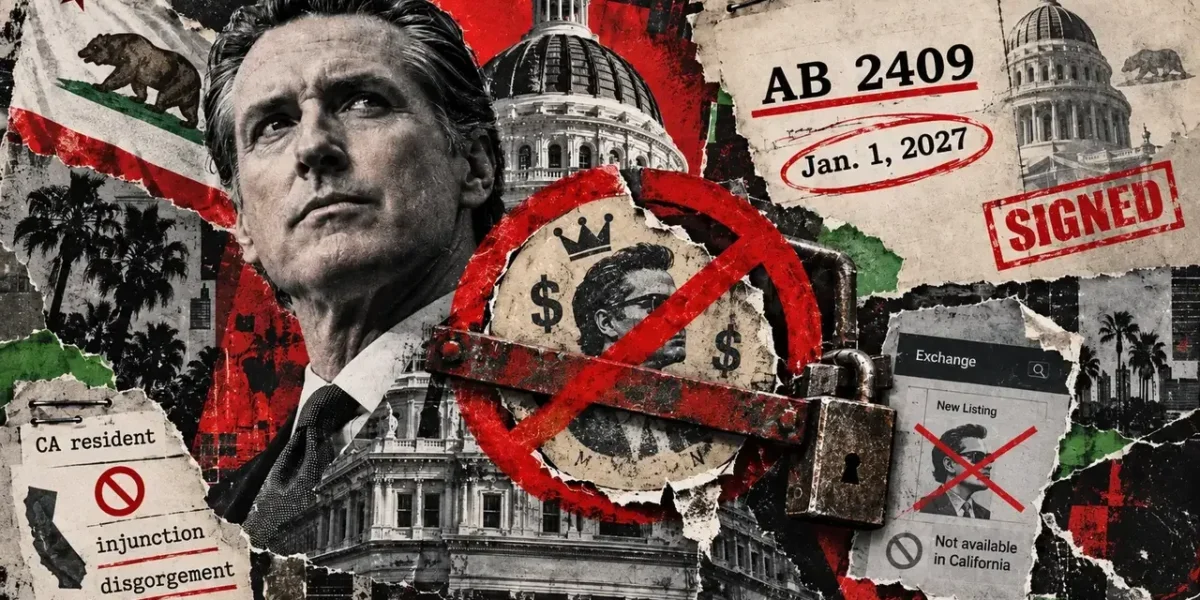
On Sept. 27, California Gov. Gavin Newsom enacted AB 2409, establishing a pair of restrictions regarding political meme coins. Under the legislation, specified California public officers and select government employees are prohibited from issuing them, while digital asset service providers face separate limits regarding the listing of new official-linked coins for residents of California.
The legislation makes an official’s participation central to both provisions. Its listing rule applies to coins offered by or in partnership with a federal public official or a state or local public officer, provided the digital asset was issued on or after Jan. 1, 2027. This Jan. 1 date serves as the threshold determining which newly issued tokens fall under the provider listing requirement.
For the direct issuance ban, the definition of a California public officer encompasses elected and appointed state or local officers, legislators, and members of government boards or commissions. Serving on a body with solely advisory powers still meets this definition. Meanwhile, the employee category targets state and local government workers who hold decision-making authority over procurement offers and contracts for their employer. Consequently, an advisory-board appointee falls under the officer classification, whereas an employee’s coverage relies on the contracting authority linked to their position.
The statute defines “issue” as making a meme coin available for public purchase, donation, or exchange of any value, regardless of whether it receives promotion. A meme coin is defined as a digital asset primarily tied to themes like internet memes, public figures, fictional characters, current events, or social trends, with its value derived principally from public interest, speculation, or community engagement.
Federal officials are incorporated into the provider listing clause, which defines them to include elected and appointed officers and members of federal government bodies, including advisory ones. Conversely, the direct issuance provision targets California state and local officers alongside the specified employee group, representing distinct categories of individuals under the signed text.
The provider rule bans digital asset service providers from listing for sale on behalf of, or for purchase by, a California resident any qualifying meme coin issued on or after Jan. 1, 2027. Furthermore, the coin must be offered by or in partnership with one of the public officials designated in that clause. Thus, the statute treats the token’s issuance date, the resident-facing listing, and the official’s involvement as separate elements of the test.
Coins issued prior to that threshold remain exempt from this specific listing requirement. The provision also zeroes in on an official’s offer or partnership. Governor Newsom’s announcement described the measure generally as a restriction on coins utilizing an official’s likeness or image, whereas the enrolled text relies on the offer-or-partnership test. Any platform evaluating a new coin for California residents must establish the connection outlined in the statute.
The governor’s release points to the meme coin launched by Trump in 2025. Because that existing coin was issued prior to Jan. 1, 2027, it falls outside the listing rule’s criteria. This reference illustrates the political contrast highlighted in Newsom’s announcement, while the statutory threshold strictly governs the new listing restrictions.
AB 2409 provides mechanisms for civil enforcement. The California Attorney General is authorized to seek an injunction against any violation of either rule and may also request disgorgement. Additionally, a district attorney, city attorney, or county counsel may pursue these same remedies specifically for breaches of the direct issuance ban. The statute assigns the enforcement responsibility for the separate provider listing clause exclusively to the Attorney General.
The bill’s legislative findings highlight concerns regarding conflicts of interest, public trust, and potential pay-to-play arrangements when public officials issue or promote financial instruments. Newsom framed the bill signing as a contrast to President Donald Trump’s meme coin. His office rolled out AB 2409 alongside other consumer protection and fraud measures, which include separate bills addressing fraud restitution and cryptocurrency seizures. AB 2409 itself establishes the meme-coin issuance and listing restrictions alongside their corresponding civil enforcement remedies.
Frequently Asked Questions
- When did California sign AB 2409 into law? California Gov. Gavin Newsom signed AB 2409 on Sept. 27.
- Who is barred from directly issuing political meme coins under the law? Covered California public officers (including elected and appointed state or local officers, legislators, and board or commission members) and government employees with decision-making authority over procurement offers and contracts are barred.
- What is the date threshold for the provider listing rule? The provider listing rule applies to qualifying meme coins issued on or after Jan. 1, 2027.
- Who is responsible for enforcing the new rules? The California Attorney General may seek injunctions and disgorgement for violations of either rule, while a district attorney, city attorney, or county counsel may pursue these remedies for direct issuance ban violations.