
Stablecoins may not drain banks of dollars but they can still make lending more expensive
Stablecoins may not completely drain bank dollars, but they transform reliable retail deposits into volatile corporate holdings. This shift can raise regulatory funding costs for banks and ultimately make lending more expensive for everyday borrowers.

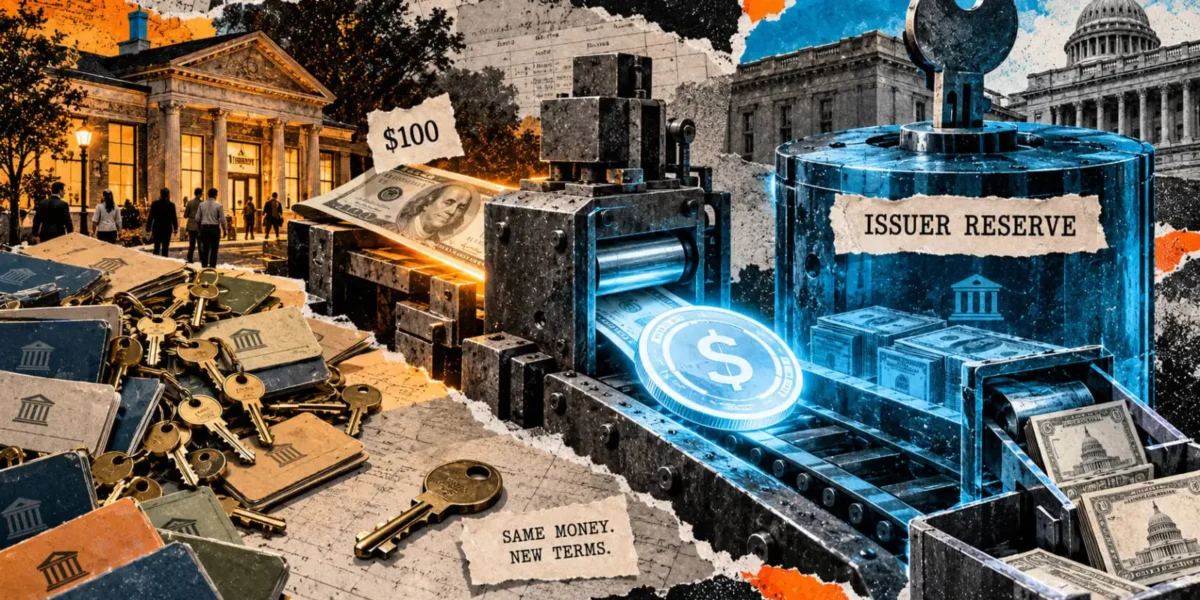
Consider a simple hypothetical scenario: you take $100 from your bank account to purchase newly issued stablecoins. The stablecoin issuer accepts your dollars, deposits them into its own bank account, and provides you with a blockchain-based balance you can transfer freely.
You have successfully obtained your desired product, and somewhere within the intricate and complex banking system, that $100 remains present.
From afar, this might seem like a non-issue for traditional banks. While they lose a deposit, they also regain a deposit, which prompts the question of why bankers frequently warn that stablecoins could drain the financial system.
The core issue is that your bank genuinely valued you as a retail customer. By removing your funds, the bank now owes that exact amount to a corporate entity managing withdrawals for thousands of individuals, complete with designated personnel deciding where those reserves should be allocated.
Although the dollars returned, they arrived under new ownership—and that new owner can act as a much more demanding creditor.
This nuanced aspect of the stablecoin debate often gets lost when analysts estimate the trillions of dollars that might exit traditional banks. The total aggregate amount in the banking system may remain unchanged, yet individual banks receive a significantly worse deal because a deposit’s underlying value depends heavily on how long a customer leaves it parked there and the associated maintenance costs.
A 2026 analysis from the Bank for International Settlements utilized a $100 purchase model to illustrate how everyday household deposits can transform into corporate issuer deposits, thereby rendering bank funding less reliable according to regulatory standards.
Should banks be forced to incur higher expenses to sustain those funds, a portion of those costs will inevitably trickle down to everyday borrowers—including individuals who may not even know what a stablecoin is.
Your bank likes you a little boring
The active balance displayed in your banking application represents money the bank officially owes you. While you maintain the legal right to spend those funds, the bank does not isolate every single customer’s balance in a separate vault awaiting collection. Its asset portfolio often includes long-term loans repaid over several years, whereas customers retain the ability to withdraw their deposits much sooner.
While banks can generate new deposits when issuing loans, they still require adequate liquidity to cover the outgoing payments initiated by customers. Maintaining a dependable core base of deposits is vital to supporting this activity.
This system functions smoothly largely because people rarely demand all of their money at the exact same moment.
As your paycheck arrives while someone else’s rent payment is dispatched, and scaled across a vast customer network, the bank can forecast and plan around a reasonably stable deposit baseline. Although it still requires immediate cash on hand for day-to-day transactions, it does not anticipate every account emptying out simultaneously on the first of the month.
Naturally, that comfort has distinct limits, as demonstrated by any historical bank run. Nevertheless, numerous individual balances utilized for everyday living expenses remain far simpler to manage than a single, massive institutional account whose owner can shift the entire balance with a single click. Bankers classify the former as retail funding and the latter as wholesale funding.
Stablecoin issuers likewise face critical obligations to maintain. If token holders decide to redeem their assets, the issuer requires immediate cash liquidity, meaning the withdrawal of reserves from a banking partner may be necessary to fulfill those redemption requests.
Consequently, a bank can lose a deposit balance even if its financial health is pristine, simply because the issuer’s end-users require their money elsewhere.
Research from the Federal Reserve regarding stablecoins and bank deposits outlines this specific conversion process from fragmented household balances into large institutional holdings. While this does not imply that every single household is strictly loyal or every issuer inherently flighty, it explains why simply tallying total deposit figures overlooks the complex daily calculations managed by a bank’s funding division.
Under the Basel banking framework, the Liquidity Coverage Ratio (LCR) compares assets that a bank can quickly liquidate into cash against potential net cash outflows projected over a 30-day period of financial stress. Different classifications of deposits carry varying assumptions regarding the speed at which they might exit.
For instance, a bank holding $120 million in qualifying liquid assets alongside $100 million in estimated net outflows yields a ratio of 120%. However, a shifting composition of customers could elevate estimated outflows to $110 million while those liquid assets remain completely unchanged.
As a result, the ratio drops to approximately 109%, despite the fact that no actual customer withdrawals have taken place.
While this serves as a back-of-the-napkin calculation, it clearly demonstrates why banks cannot simply dismiss the stability of their books by pointing to flat aggregate deposit levels. Their projected cash obligations have effectively expanded, leaving a narrower cushion above the required regulatory buffers.
Depending on the applicable regulations, the bank may find it necessary to acquire additional liquid assets or secure longer-term funding sources—both of which involve substantial costs.
The dollars don’t disappear when someone buys a Treasury bond
Crypto issuers do not always leave their funds sitting idle in a traditional bank account. They frequently purchase short-term U.S. Treasury bills to back their digital tokens, generating interest yields while holding assets they plan to liquidate when customers demand cash redemptions.
This brings another participant into our $100 example: the entity selling the Treasury bill. If the stablecoin issuer acquires an existing Treasury security from a nonbank investor, the issuer’s bank balance decreases by $100 while the seller’s bank balance increases by $100. While the capital has changed hands, the broader banking system retains the deposit.
This transaction alone does not reveal how stable the new owner’s balance will be, nor does it indicate where those funds will travel next. It simply proves that viewing an issuer’s Treasury purchase as a permanent $100 outflow from bank deposits ignores the individual or institution that received the payment for the security.
Conversely, acquiring a bill owned directly by a bank produces a different accounting outcome. The bank relinquishes an asset, and the incoming payment can extinguish a deposit liability, effectively shrinking both sides of the banking system’s balance sheet.
In doing so, the bank also parts with a security it might have otherwise reserved to manage its own internal cash requirements.
Purchasing newly issued government debt introduces an extra layer of complexity because the payment flows directly into the U.S. Treasury’s account, with subsequent government spending ultimately releasing money back into circulation. This differs fundamentally from paying a private investor, meaning that simply stating “the issuer bought Treasuries” fails to capture the entire picture.
In an August address, BIS General Manager Pablo Hernández de Cos emphasized that reserve composition lies at the heart of these banking impacts. The specific pathway taken by token backing dictates the ultimate effect on banks, meaning forecasts focused solely on token supply metrics cannot accurately predict potential losses in lending capacity.
Furthermore, our scenario assumes capital actively reaches the issuer to back newly minted tokens. If an investor purchases pre-existing stablecoins from another marketplace participant, the payment goes directly to that seller and does not automatically generate a brand-new reserve deposit.
Another crucial distinction exists between banks collectively and the specific bank utilized for your initial transaction. Your local community lender might lose your individual deposit while the stablecoin issuer’s primary corporate banking partner secures the replacement account.
While national totals appear unaffected, your former bank is still left scrambling to secure alternative funding or restructure its operations.
Furthermore, the receiving banking institution is under no obligation to issue the exact same loans to the same borrowers. It maintains its own internal client base and strict lending criteria, meaning that money reappearing somewhere within the broader banking network does not guarantee that a local business seeking a credit line will find an equally accommodating lender.
Banks now need to compete with stablecoins
None of these dynamics entitle a traditional bank to retain your capital cheaply for an indefinite period. If a stablecoin offers superior payment processing services that your bank lacks, switching providers is a completely rational choice, and protecting institutional profit margins is certainly not your responsibility.
Banks retain the ability to compete by increasing deposit interest rates or upgrading their proprietary payment infrastructure. They can also offset lost deposits through long-term borrowing instruments, though institutional lenders committing capital for extended periods will demand terms that reflect commensurate risk.
Consequently, the bank must evaluate how much additional overhead it can absorb and determine the resulting impact on the lending rates it can profitably offer borrowers.
A Federal Reserve study examining how banks adapted to earlier financial competitors analyzed market shifts toward money-market funds and emerging payment platforms. Stablecoins are far from the first product to provide consumers with alternative transaction vehicles, and banks possess strategic alternatives beyond passively watching capital walk out the door.
One potential strategy involves providing tokenization technology while maintaining the customer as an active depositor. CryptoSlate’s coverage of tokenized deposits and bank funding highlighted that recording a deposit on a distributed blockchain ledger can preserve a customer’s direct claim against the bank.
Nevertheless, the sales proposition must still appeal directly to the consumer—particularly regarding whether the product can seamlessly route funds to external destinations where they are actually needed.
Directly issuing stablecoins represents another operational avenue, though it comes with strict regulatory mandates. Proposed guidelines issued by the Fed on Sept. 24 outline comprehensive reserve and risk-management protocols for payment stablecoin issuers under its direct oversight, alongside formal application processes for supervised banking institutions seeking approval for subsidiary issuance.
Capital committed to honoring token redemptions cannot simply be treated as standard, interchangeable bank funding earmarked for long-term loan portfolios. Simply owning the issuing entity does not erase the fundamental promise made to token holders.
While BIS examples clearly illustrate how these accounts function, they do not conclusively prove that stablecoins have already forced commercial banks to curtail lending activity. Establishing such a causal link would require empirical data directly from the participating banks, detailing how they replaced lost deposits and tracked changes within their loan books.
It would also necessitate knowing the exact origin of the buyers’ funds, as fresh dollar demand originating from overseas markets does not necessarily mirror the economic effects of domestic customers relocating existing local deposits.
Ultimately, this operational trade-off is worth examining without automatically siding with traditional banking interests. Accelerated payment processing delivers genuine economic value, and forcing banks to compete more vigorously for consumer business can be a positive development—even if maintaining dependable funding becomes more costly along the way.
Your original $100 may successfully find its way back into a commercial bank, but the comfortable customer relationship originally tied to it is permanently gone. The bank now answers to a different institutional creditor under terms that may demand higher cash reserves or elevated interest rates, and those operational expenses directly shape what the bank can afford to offer the next person requesting a loan.
Frequently Asked Questions
01Do stablecoins completely remove money from the banking system?
Not necessarily. When a user buys newly issued stablecoins, the issuing company typically deposits those dollars into its own bank account or uses them to purchase short-term U.S. Treasury bills from a private investor, meaning the funds often remain within the broader financial and banking ecosystem.
02Why do banks worry about stablecoin adoption if the total money supply remains similar?
The core concern is funding stability and composition. Stablecoin issuers act as large, demanding institutional creditors (wholesale funding) rather than stable, fragmented retail depositors. This shift can negatively impact a bank’s regulatory liquidity metrics, forcing them to hold more cash buffers or secure costly long-term funding.
03How can traditional banks compete with stablecoins?
Banks can compete by raising interest rates on deposits, upgrading their own digital payment infrastructure, offering tokenized deposit products on blockchains, or launching compliant stablecoin issuance subsidiaries under regulatory supervision.